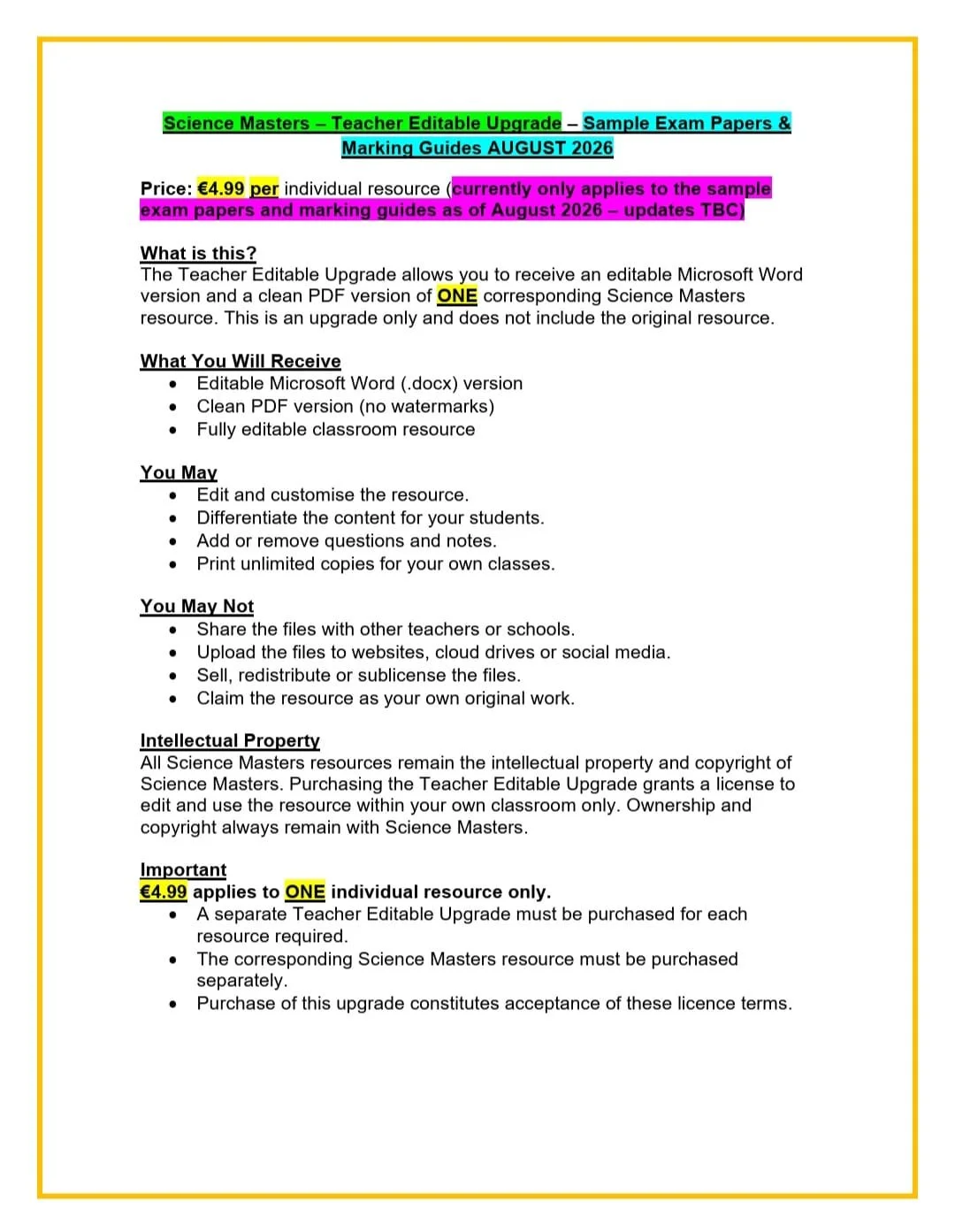
A comprehensive 94-page marking guide covering all six Science Masters Ordinary Level Biology sample examination papers.
Complete Ordinary Level Biology Marking Guide and Sample Answers
Transform six full sample examination papers into a complete teaching, assessment and revision programme with this comprehensive 94-page Senior Cycle Biology Ordinary Level marking guide.
This resource provides detailed marking guidance and sample answers for Science Masters Ordinary Level Biology Sample Papers 1–6. Every question and sub-question from the six papers is reproduced, followed immediately by the corresponding answer, acceptable alternatives and key biological points.
This is much more than a short answer key.
The guide helps students understand the depth, terminology and scientific reasoning required when answering different types of Ordinary Level Biology questions. It also provides teachers with a practical and consistent framework for correcting assessments, reviewing student work and discussing alternative scientifically accurate answers.
Across the six marking guides, students receive support with biological knowledge, calculations, diagrams, experimental design, graph interpretation, sequencing, evaluating conclusions, analysing claims and applying Biology to unfamiliar real-world contexts.
What is included?
One combined 94-page marking guide
Complete guidance for Sample Papers 1–6
Every question and sub-question reproduced
Detailed sample answers
Acceptable biological alternatives
Key scientific marking points
Guidance using / for alternative answers
Guidance using // for separate biological points
“Any one”, “Any two” and similar response requirements
Worked calculations and numerical answers
Graph, table and data-interpretation guidance
Scientific-method and investigation answers
Suggested responses to evaluation and application questions
Support for teachers correcting student work
Support for student self-assessment and independent revision
Designed for students
Students can use the marking guide to:
Correct completed examination papers
Compare their answers with strong sample responses
Identify missing biological terminology
Improve explanations and justifications
Understand how separate marking points may be developed
Recognise when more than one answer may be scientifically acceptable
Build confidence before classroom and mock examinations
Designed for teachers
Teachers can use the guide to:
Correct the six sample papers efficiently
Support classroom assessment and revision
Discuss acceptable alternative answers
Demonstrate appropriate Ordinary Level response depth
Review calculations, graphs and experimental questions
Guide students through unfamiliar biological stimuli
Provide consistent and constructive feedback
Six papers—six different areas of preparation
Sample Paper 1: Core Biology Confidence
Sample Paper 1 consolidates essential knowledge across cells, enzymes, digestion, ecology, genetics, circulation, respiration and microorganisms.
Sample Paper 2: Practical and Graphing Skills
Sample Paper 2 focuses particularly on investigations, variables, fair testing, osmosis, mitosis, graphing, photosynthesis, fermentation and ecological cycles.
Sample Paper 3: Applied Human Biology
Sample Paper 3 develops understanding of sleep, exercise, the nervous system, reaction time, plant transport, DNA profiling, inheritance and pond ecology.
Sample Paper 4: Modern Biology and Sustainability
Sample Paper 4 examines biotechnology, immobilised enzymes, the microbiome, genetic engineering, epigenetics, immunity, antibiotic resistance and climate change.
Sample Paper 5: Examination Skills and Scientific Reasoning
Sample Paper 5 provides extensive practice with food investigations, evaluating claims, sequencing, classification, natural selection, cancer, blood groups and circulation.
Sample Paper 6: Visual and Real-World Biology
Sample Paper 6 explores vaping, reproduction, contraception, diabetes, biodiversity, biological control, digestion, biotechnology, reflex actions and plant responses.
Important information
These marking guides provide indicative answers and suggested biological points. Equivalent scientifically accurate answers should be accepted where appropriate.
As the first cohort following the current Senior Cycle Biology specification has not yet completed the State examination, precise future SEC mark allocations have not been established. Individual marks have therefore not been assigned to every sub-question.
This resource has been developed independently by The Science Masters and is not affiliated with or endorsed by the State Examinations Commission, NCCA or Department of Education.
A comprehensive 94-page marking guide covering all six Science Masters Ordinary Level Biology sample examination papers.
Complete Ordinary Level Biology Marking Guide and Sample Answers
Transform six full sample examination papers into a complete teaching, assessment and revision programme with this comprehensive 94-page Senior Cycle Biology Ordinary Level marking guide.
This resource provides detailed marking guidance and sample answers for Science Masters Ordinary Level Biology Sample Papers 1–6. Every question and sub-question from the six papers is reproduced, followed immediately by the corresponding answer, acceptable alternatives and key biological points.
This is much more than a short answer key.
The guide helps students understand the depth, terminology and scientific reasoning required when answering different types of Ordinary Level Biology questions. It also provides teachers with a practical and consistent framework for correcting assessments, reviewing student work and discussing alternative scientifically accurate answers.
Across the six marking guides, students receive support with biological knowledge, calculations, diagrams, experimental design, graph interpretation, sequencing, evaluating conclusions, analysing claims and applying Biology to unfamiliar real-world contexts.
What is included?
One combined 94-page marking guide
Complete guidance for Sample Papers 1–6
Every question and sub-question reproduced
Detailed sample answers
Acceptable biological alternatives
Key scientific marking points
Guidance using / for alternative answers
Guidance using // for separate biological points
“Any one”, “Any two” and similar response requirements
Worked calculations and numerical answers
Graph, table and data-interpretation guidance
Scientific-method and investigation answers
Suggested responses to evaluation and application questions
Support for teachers correcting student work
Support for student self-assessment and independent revision
Designed for students
Students can use the marking guide to:
Correct completed examination papers
Compare their answers with strong sample responses
Identify missing biological terminology
Improve explanations and justifications
Understand how separate marking points may be developed
Recognise when more than one answer may be scientifically acceptable
Build confidence before classroom and mock examinations
Designed for teachers
Teachers can use the guide to:
Correct the six sample papers efficiently
Support classroom assessment and revision
Discuss acceptable alternative answers
Demonstrate appropriate Ordinary Level response depth
Review calculations, graphs and experimental questions
Guide students through unfamiliar biological stimuli
Provide consistent and constructive feedback
Six papers—six different areas of preparation
Sample Paper 1: Core Biology Confidence
Sample Paper 1 consolidates essential knowledge across cells, enzymes, digestion, ecology, genetics, circulation, respiration and microorganisms.
Sample Paper 2: Practical and Graphing Skills
Sample Paper 2 focuses particularly on investigations, variables, fair testing, osmosis, mitosis, graphing, photosynthesis, fermentation and ecological cycles.
Sample Paper 3: Applied Human Biology
Sample Paper 3 develops understanding of sleep, exercise, the nervous system, reaction time, plant transport, DNA profiling, inheritance and pond ecology.
Sample Paper 4: Modern Biology and Sustainability
Sample Paper 4 examines biotechnology, immobilised enzymes, the microbiome, genetic engineering, epigenetics, immunity, antibiotic resistance and climate change.
Sample Paper 5: Examination Skills and Scientific Reasoning
Sample Paper 5 provides extensive practice with food investigations, evaluating claims, sequencing, classification, natural selection, cancer, blood groups and circulation.
Sample Paper 6: Visual and Real-World Biology
Sample Paper 6 explores vaping, reproduction, contraception, diabetes, biodiversity, biological control, digestion, biotechnology, reflex actions and plant responses.
Important information
These marking guides provide indicative answers and suggested biological points. Equivalent scientifically accurate answers should be accepted where appropriate.
As the first cohort following the current Senior Cycle Biology specification has not yet completed the State examination, precise future SEC mark allocations have not been established. Individual marks have therefore not been assigned to every sub-question.
This resource has been developed independently by The Science Masters and is not affiliated with or endorsed by the State Examinations Commission, NCCA or Department of Education.

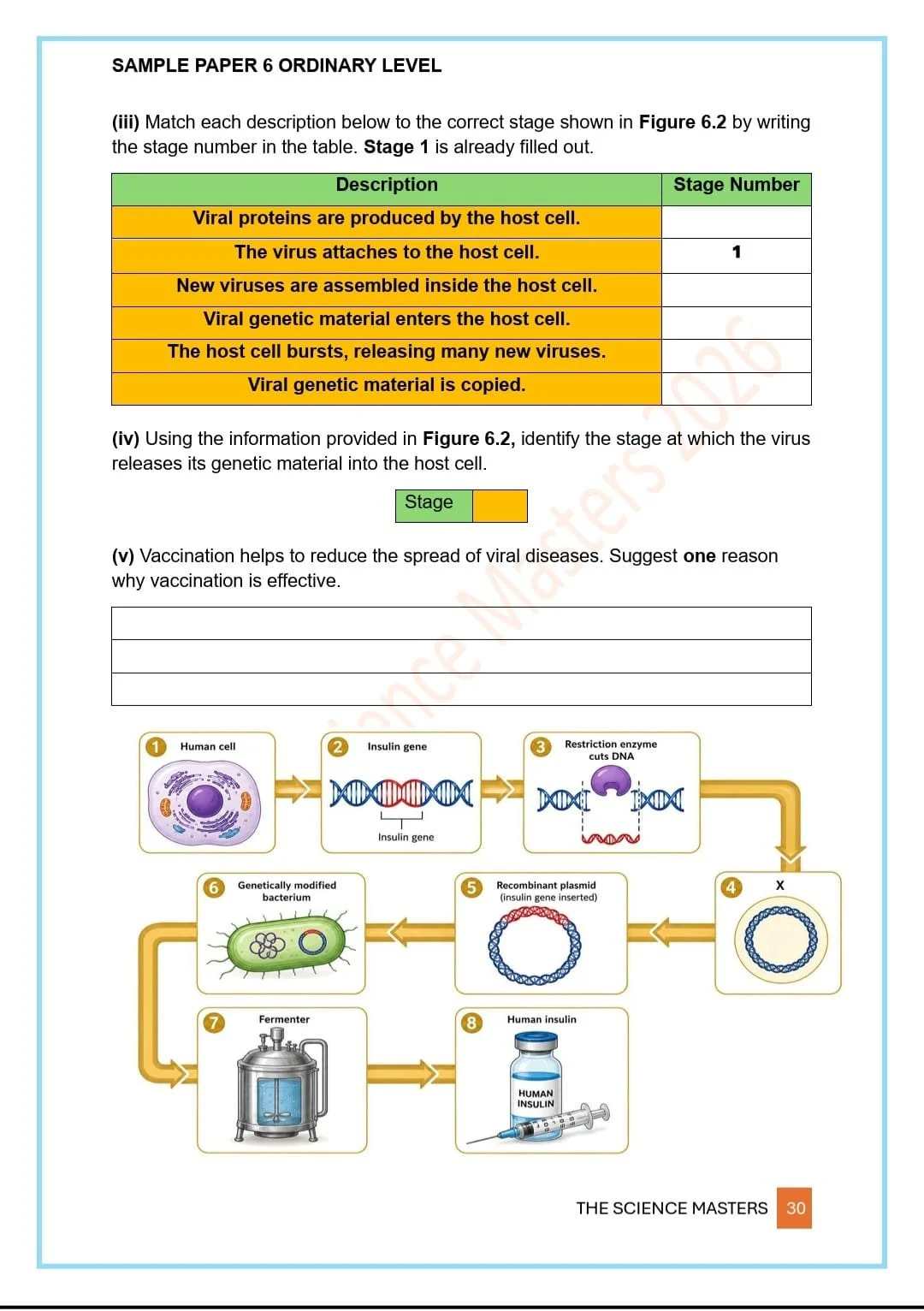 Image 1 of 3
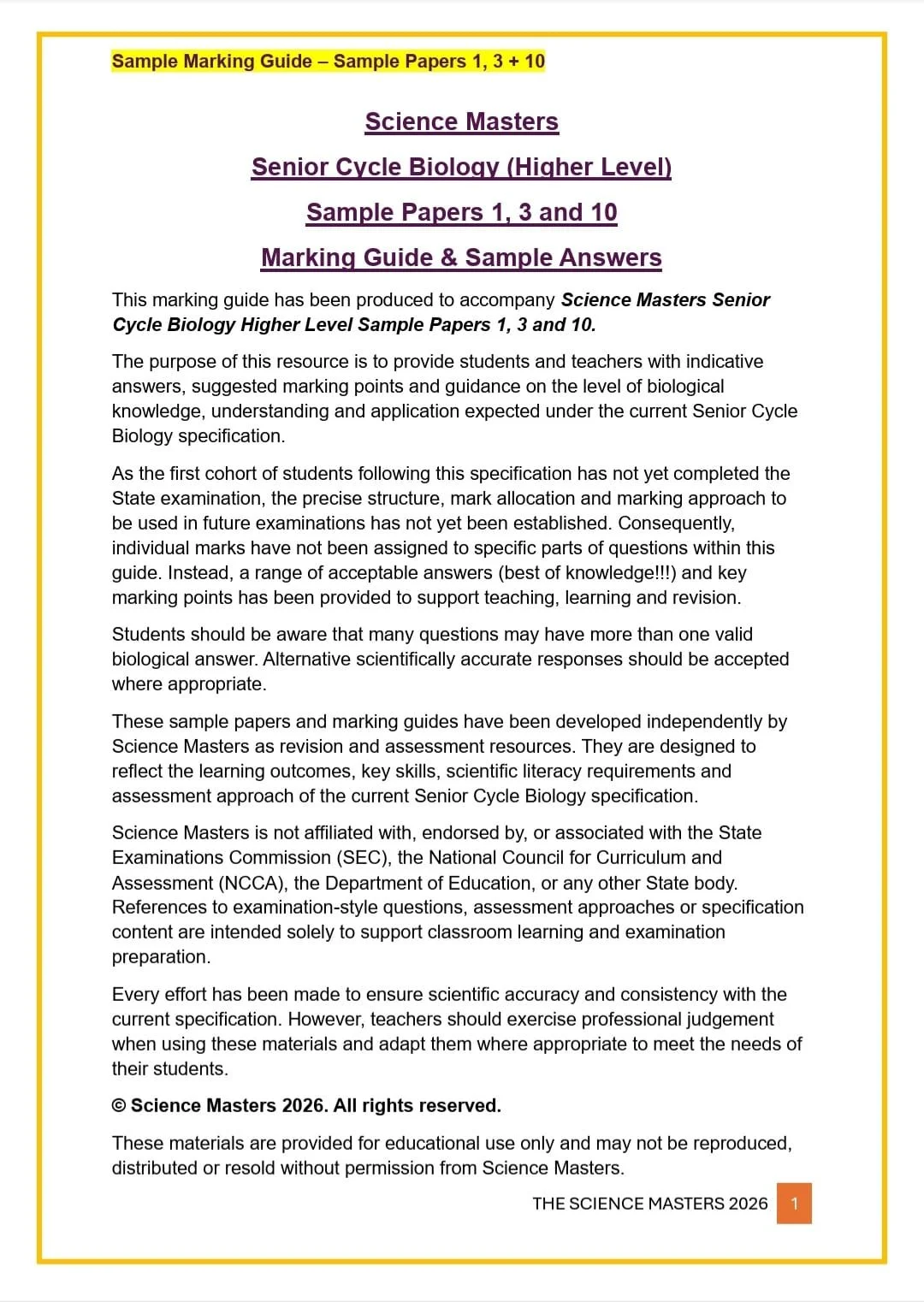 Image 2 of 3
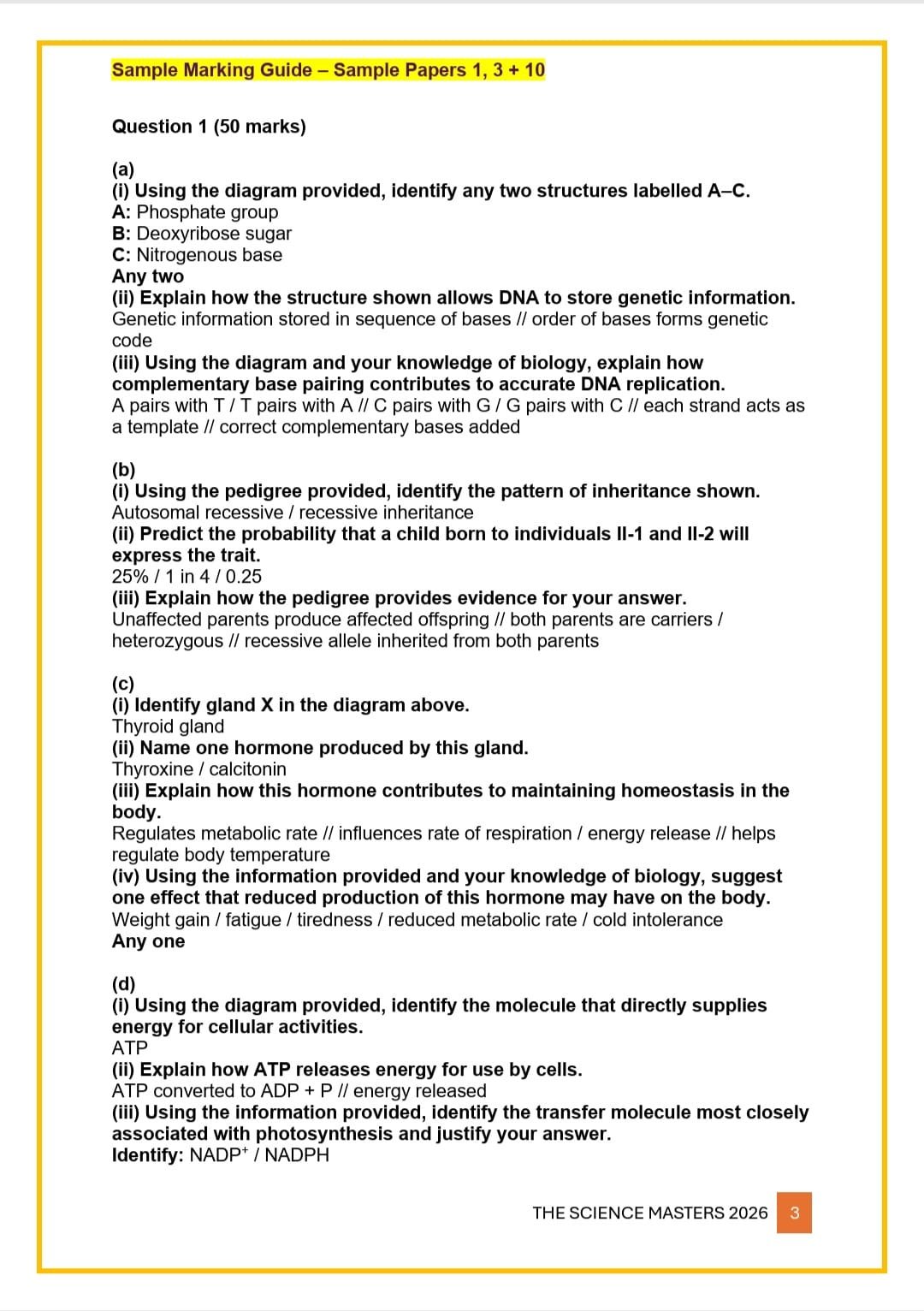 Image 3 of 3