
 Image 1 of 1
Fire Round Questions – Unifying Strand is a structured, exam-aligned question bank designed to strengthen the exact skills assessed in:
The Chemistry in Practice Investigation (40%)
Evaluation and data-based questions in the written examination
High-level scientific reasoning across all strands
This resource focuses on thinking like a chemist — not memorising definitions.
Students will develop the ability to:
Evaluate reliability and validity
Identify and explain experimental error
Justify conclusions using evidence
Construct and critique hypotheses
Analyse data and identify limitations
Evaluate scientific claims and bias
Understand and critique scientific models
Apply investigation skills in realistic chemistry contexts
The document is organised into five structured sections:
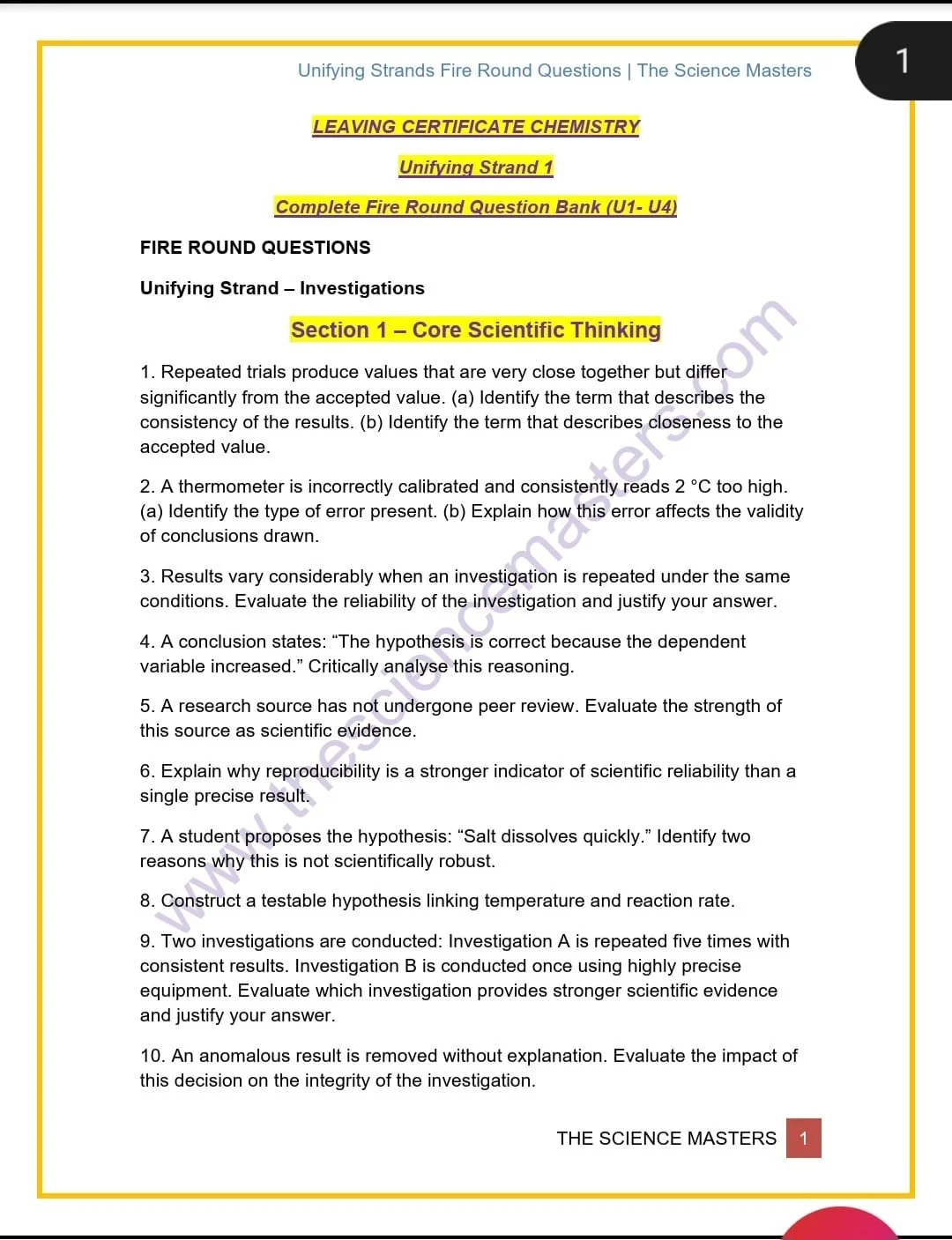
Core Scientific Thinking
Precision in terminology, error analysis, bias, reproducibility, and scientific reasoning.
Investigation Design & Evaluation
Scenario-based chemistry investigations (rates, titration, calorimetry, equilibrium, electrochemistry).
Data, Evidence & Conclusions
Analytical judgement, anomaly treatment, correlation vs causation, sample size evaluation.
Models & Abstraction
Evaluating assumptions, limitations, predictive power, and representation in chemistry.
Chemistry in Society
Ethical considerations, sustainability, scientific literacy, and evaluation of public claims.
Total: 58 high-quality, exam-style questions.
This resource is ideal for:
Senior Cycle Chemistry students targeting for a higher grade
Teachers preparing students for the Chemistry in Practice Investigation
Revision classes focused on strengthening evaluation and justification skills
Mock exam preparation
Structured homework or assessment practice
This is not a glossary worksheet.
It is a judgement-training document designed to:
Eliminate weak reasoning
Improve structured answers
Prevent loss of “easy but invisible” marks
Strengthen performance in both coursework and written examination
Fully student-facing
Clean, professional layout
Suitable for printing or digital use
Designed in Arial, size 12
5–6 pages of structured, progressive challenge
This resource supports:
The Unifying Strand (Nature of Science)
Investigation skills across all contextual strands
Preparation for the 40% Chemistry in Practice Investigation
Evaluation-style written examination questions
Fire Round Questions – Unifying Strand is a structured, exam-aligned question bank designed to strengthen the exact skills assessed in:
The Chemistry in Practice Investigation (40%)
Evaluation and data-based questions in the written examination
High-level scientific reasoning across all strands
This resource focuses on thinking like a chemist — not memorising definitions.
Students will develop the ability to:
Evaluate reliability and validity
Identify and explain experimental error
Justify conclusions using evidence
Construct and critique hypotheses
Analyse data and identify limitations
Evaluate scientific claims and bias
Understand and critique scientific models
Apply investigation skills in realistic chemistry contexts
The document is organised into five structured sections:
Core Scientific Thinking
Precision in terminology, error analysis, bias, reproducibility, and scientific reasoning.
Investigation Design & Evaluation
Scenario-based chemistry investigations (rates, titration, calorimetry, equilibrium, electrochemistry).
Data, Evidence & Conclusions
Analytical judgement, anomaly treatment, correlation vs causation, sample size evaluation.
Models & Abstraction
Evaluating assumptions, limitations, predictive power, and representation in chemistry.
Chemistry in Society
Ethical considerations, sustainability, scientific literacy, and evaluation of public claims.
Total: 58 high-quality, exam-style questions.
This resource is ideal for:
Senior Cycle Chemistry students targeting for a higher grade
Teachers preparing students for the Chemistry in Practice Investigation
Revision classes focused on strengthening evaluation and justification skills
Mock exam preparation
Structured homework or assessment practice
This is not a glossary worksheet.
It is a judgement-training document designed to:
Eliminate weak reasoning
Improve structured answers
Prevent loss of “easy but invisible” marks
Strengthen performance in both coursework and written examination
Fully student-facing
Clean, professional layout
Suitable for printing or digital use
Designed in Arial, size 12
5–6 pages of structured, progressive challenge
This resource supports:
The Unifying Strand (Nature of Science)
Investigation skills across all contextual strands
Preparation for the 40% Chemistry in Practice Investigation
Evaluation-style written examination questions