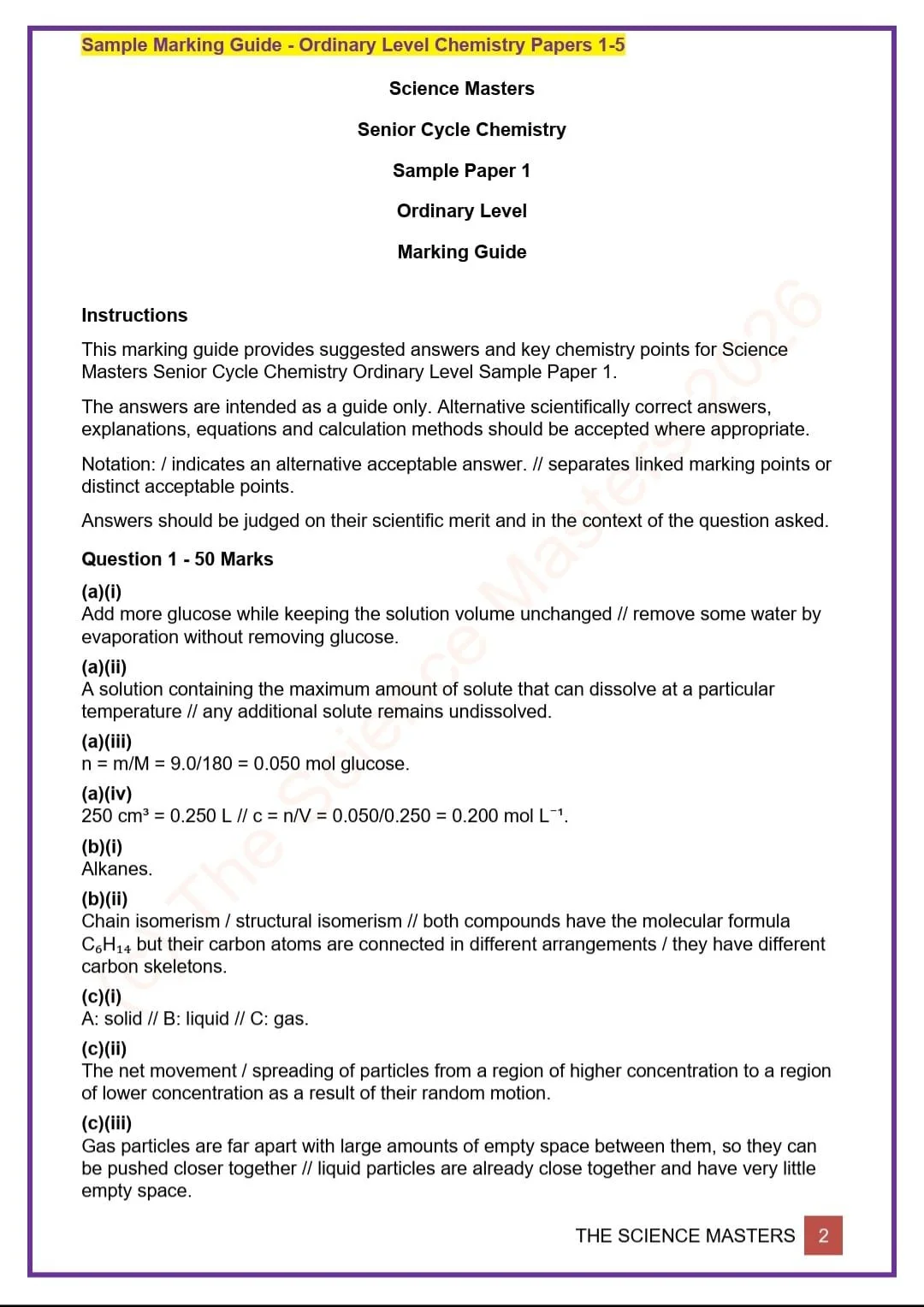
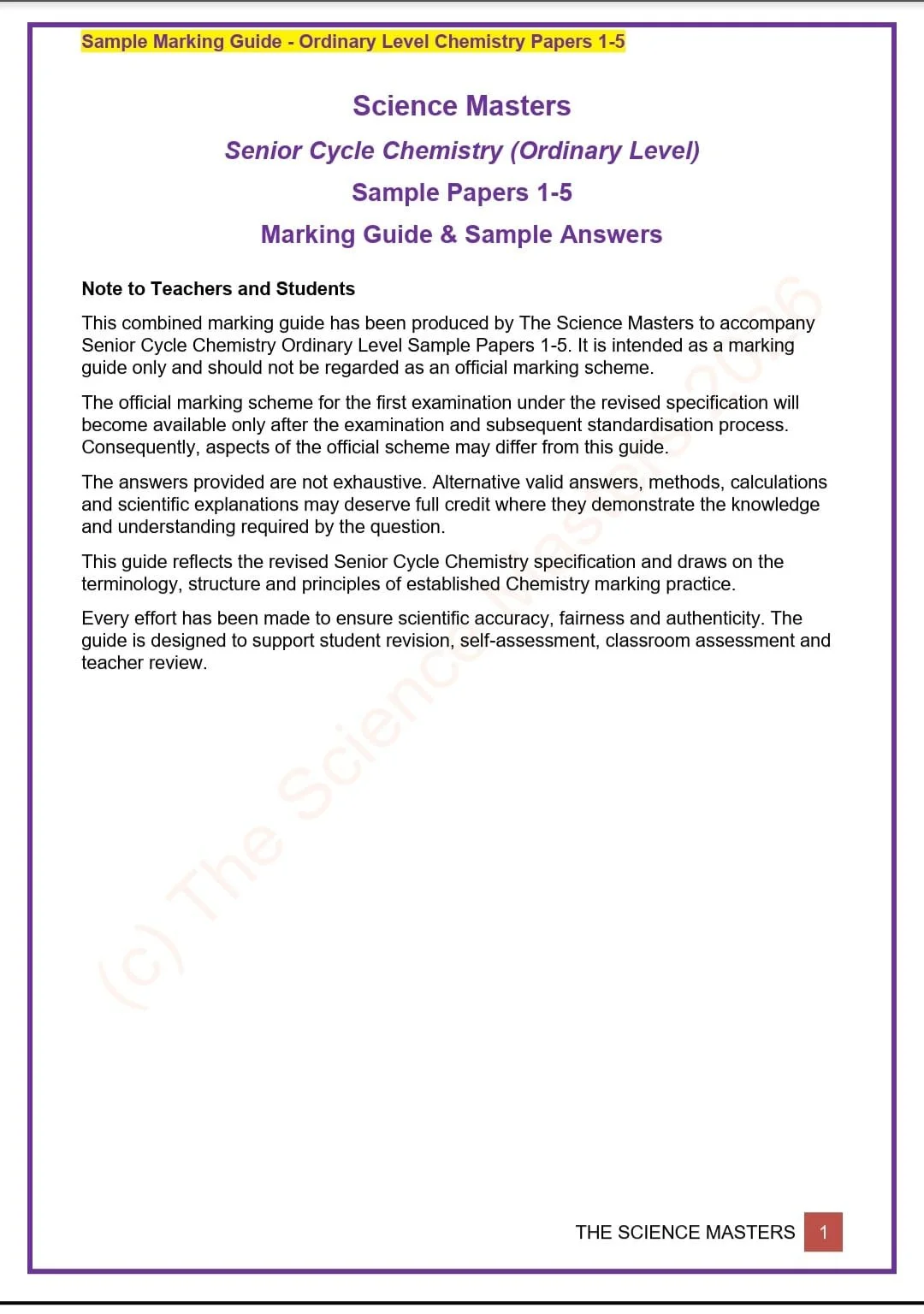
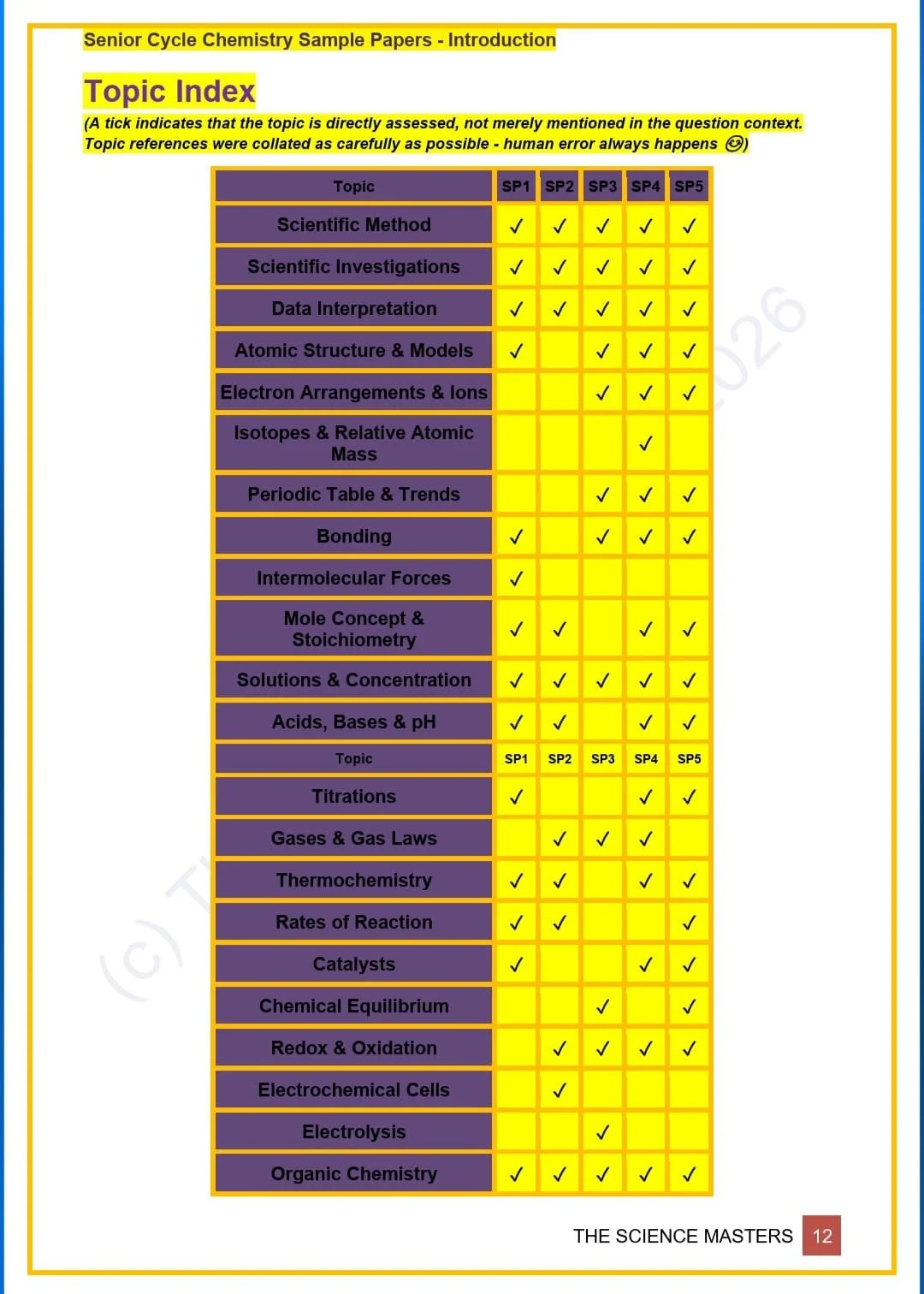
This comprehensive marking guide has been designed to accompany the Science Masters Ordinary Level Chemistry Sample Papers 1–5.
Every question has been carefully marked using clear, structured marking schemes to support accurate assessment and meaningful feedback.
Ideal for teachers, tutors, parents and students wishing to review answers in detail, this guide provides an efficient way to assess performance while reinforcing key Chemistry concepts.
✔ Complete marking schemes for all five sample examination papers
✔ Fully worked solutions and suggested answers
✔ Clear mark allocations throughout
✔ Examiner-style marking approach
✔ Introduction and guidance for using the papers
✔ Copyright and permitted-use information
✔ Professionally formatted PDF for easy printing and digital use
• Chemistry teachers
• Student teachers
• Tutors and grinds teachers
• Parents supporting revision at home
• Students self-correcting completed papers
• Schools using the Science Masters sample examinations
The marking guide has been written to complement the sample papers and provide clear, consistent marking throughout. It helps identify strengths, highlight areas for improvement and supports effective exam preparation under the new Senior Cycle Chemistry specification.
Whether you're teaching a class, providing one-to-one tuition or preparing independently, this marking guide is an invaluable companion to the Science Masters Chemistry Sample Papers.
Science Masters – Learn Smarter. Build Confidence. Achieve More.
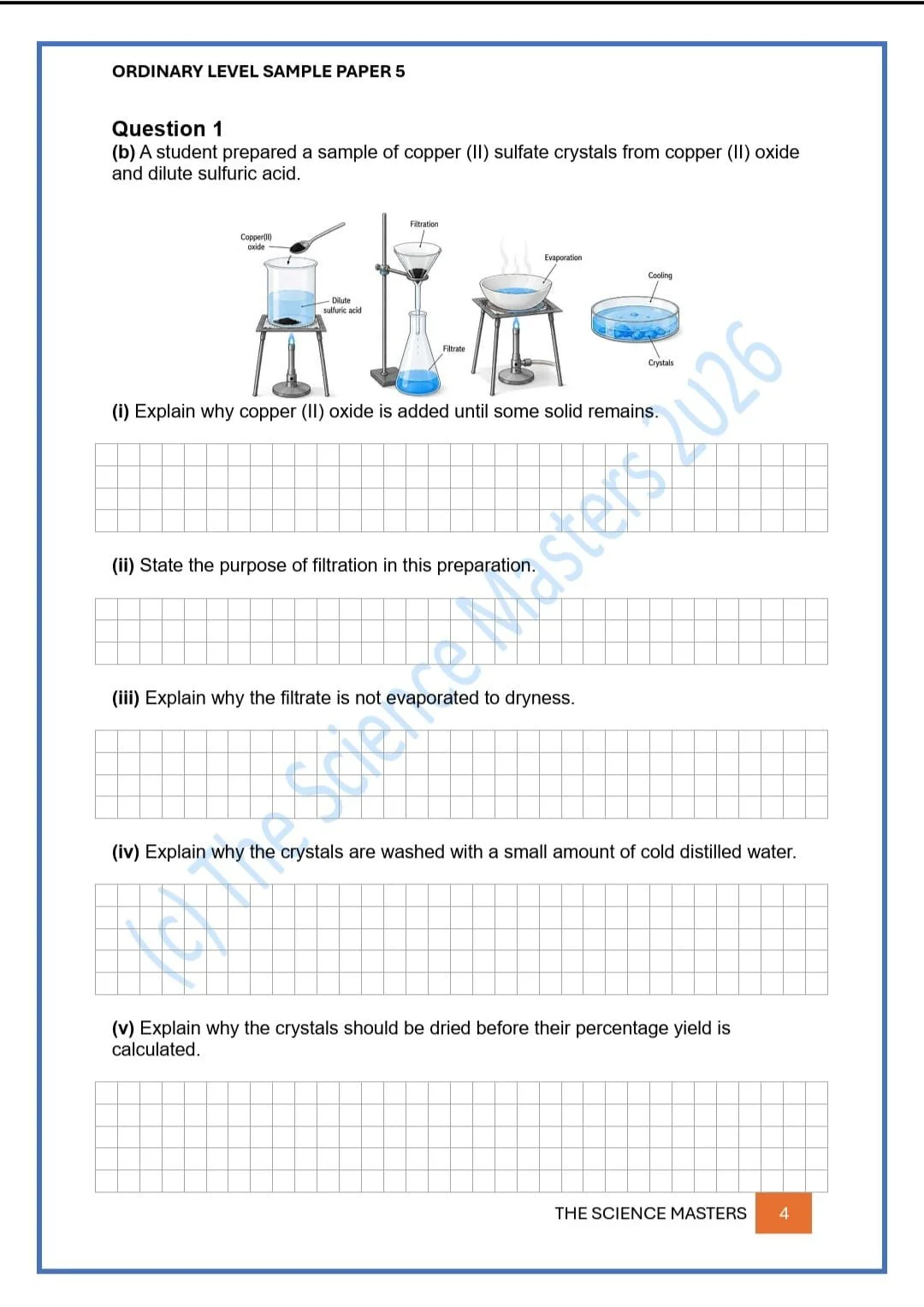
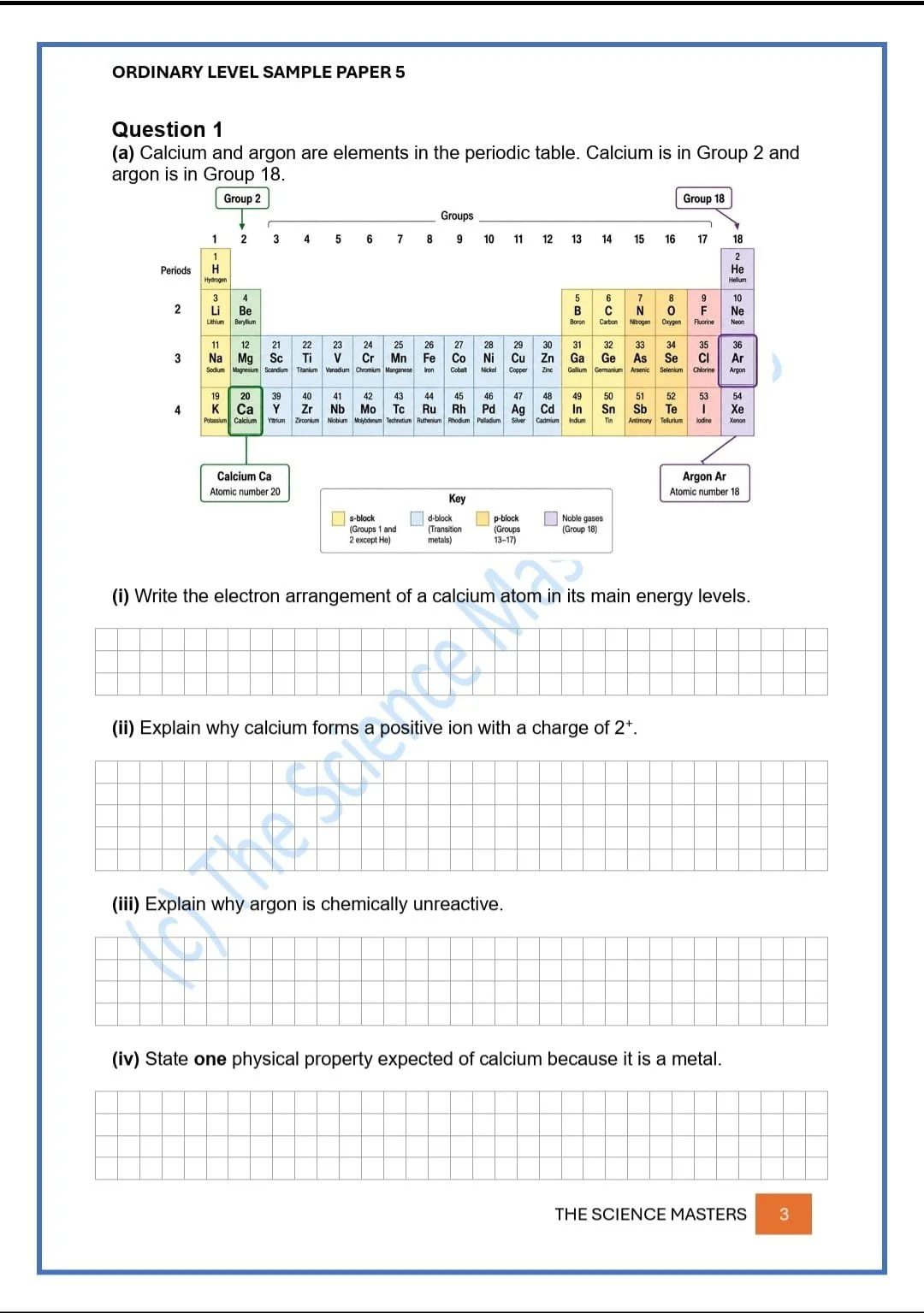
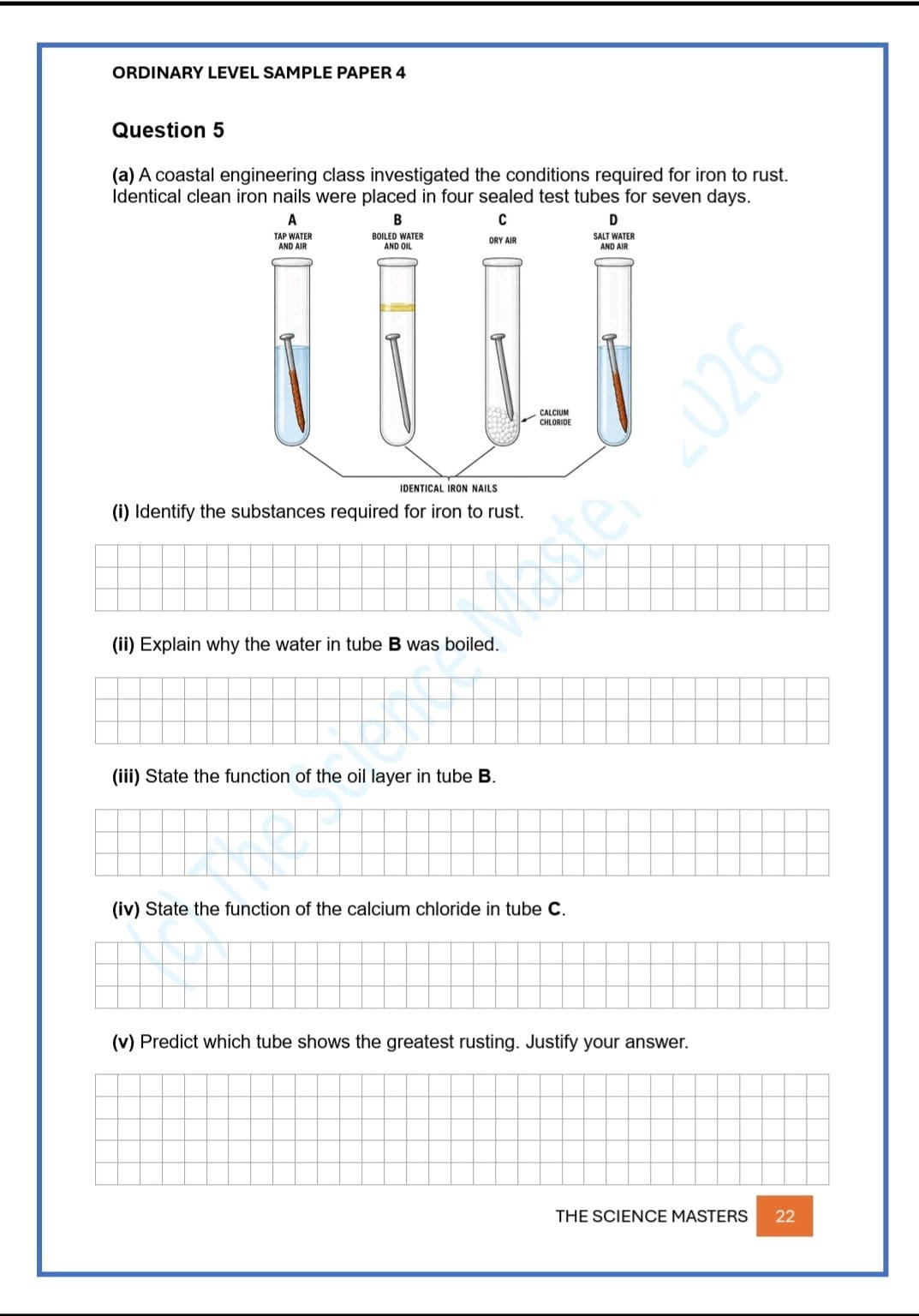
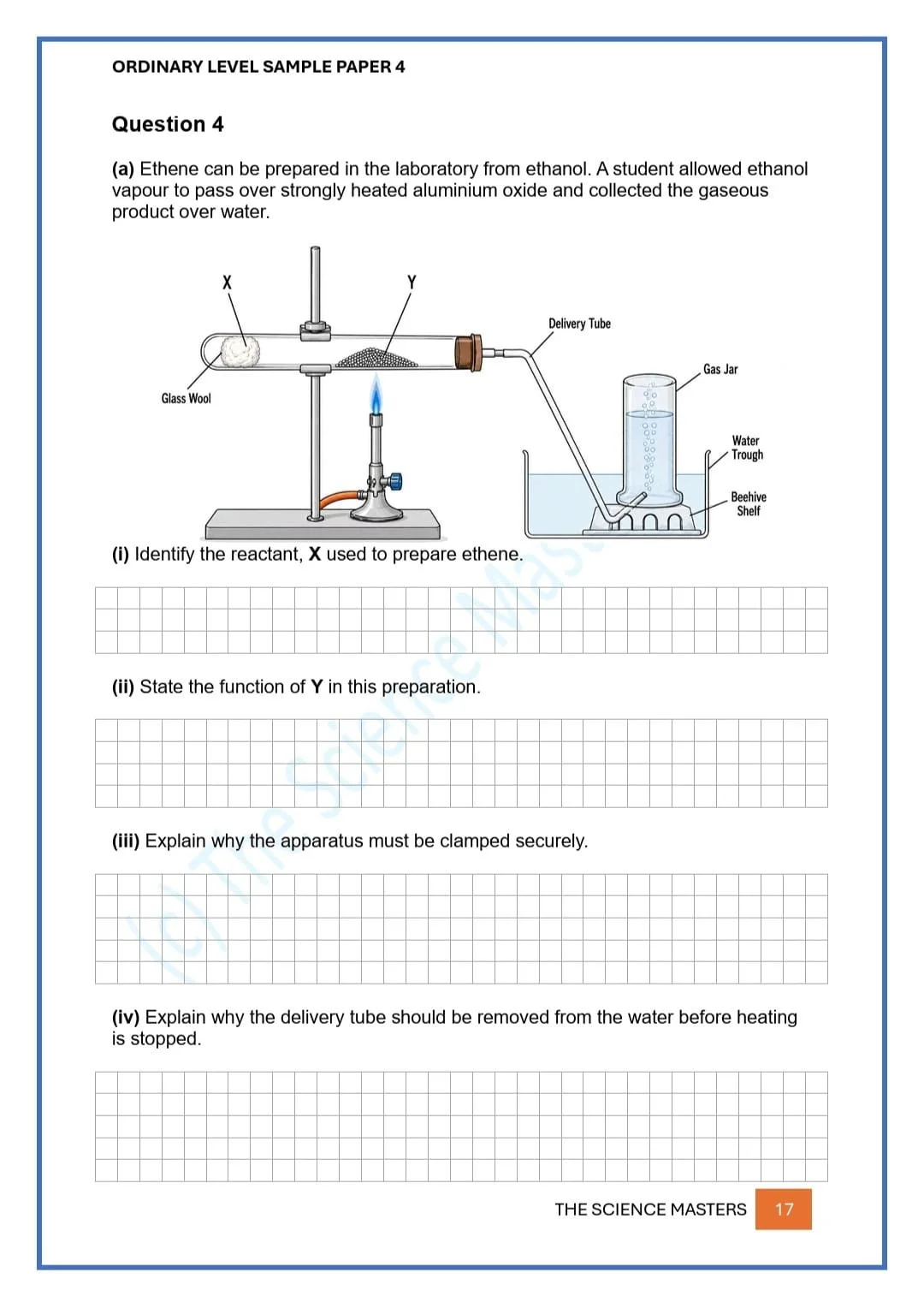
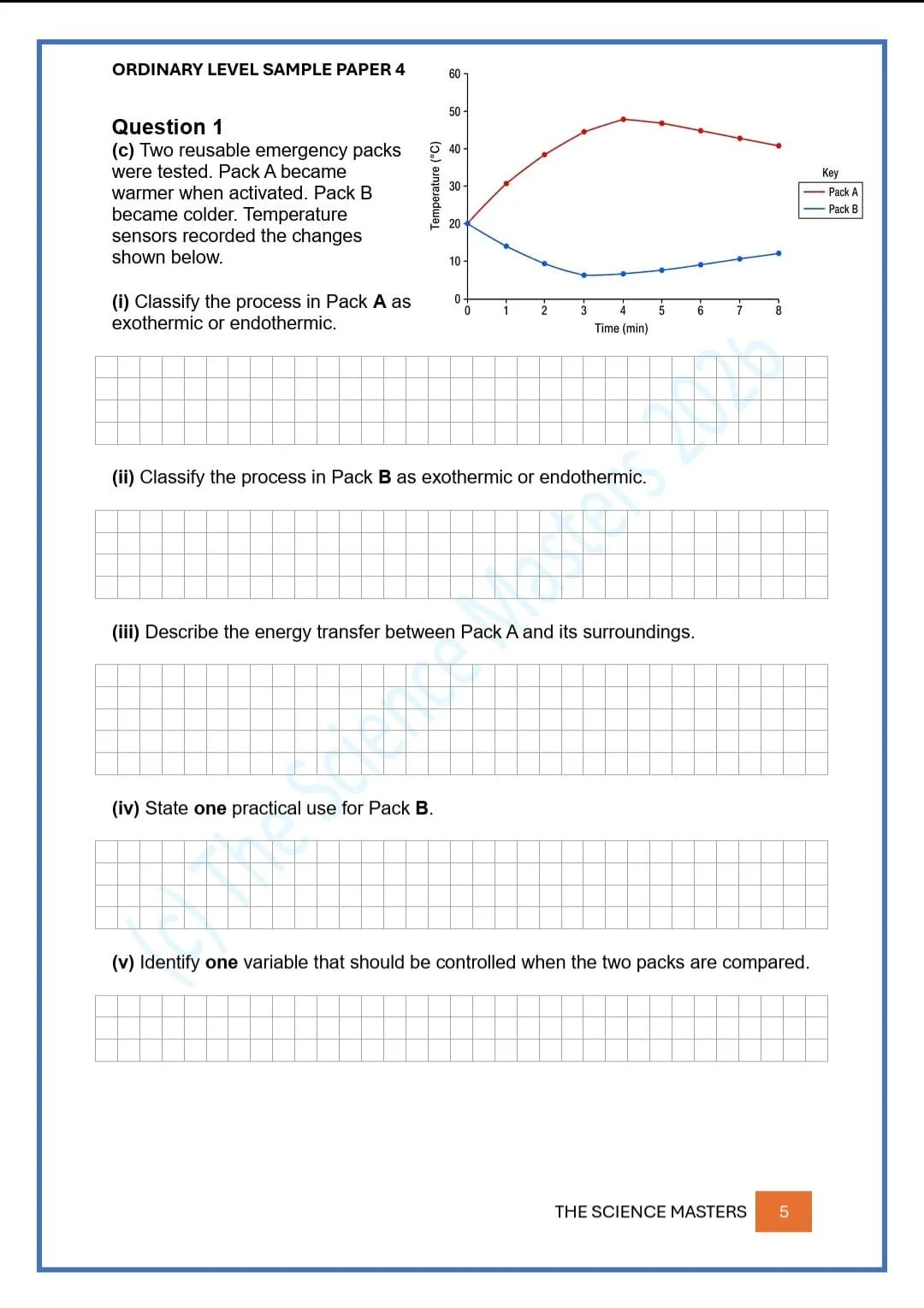
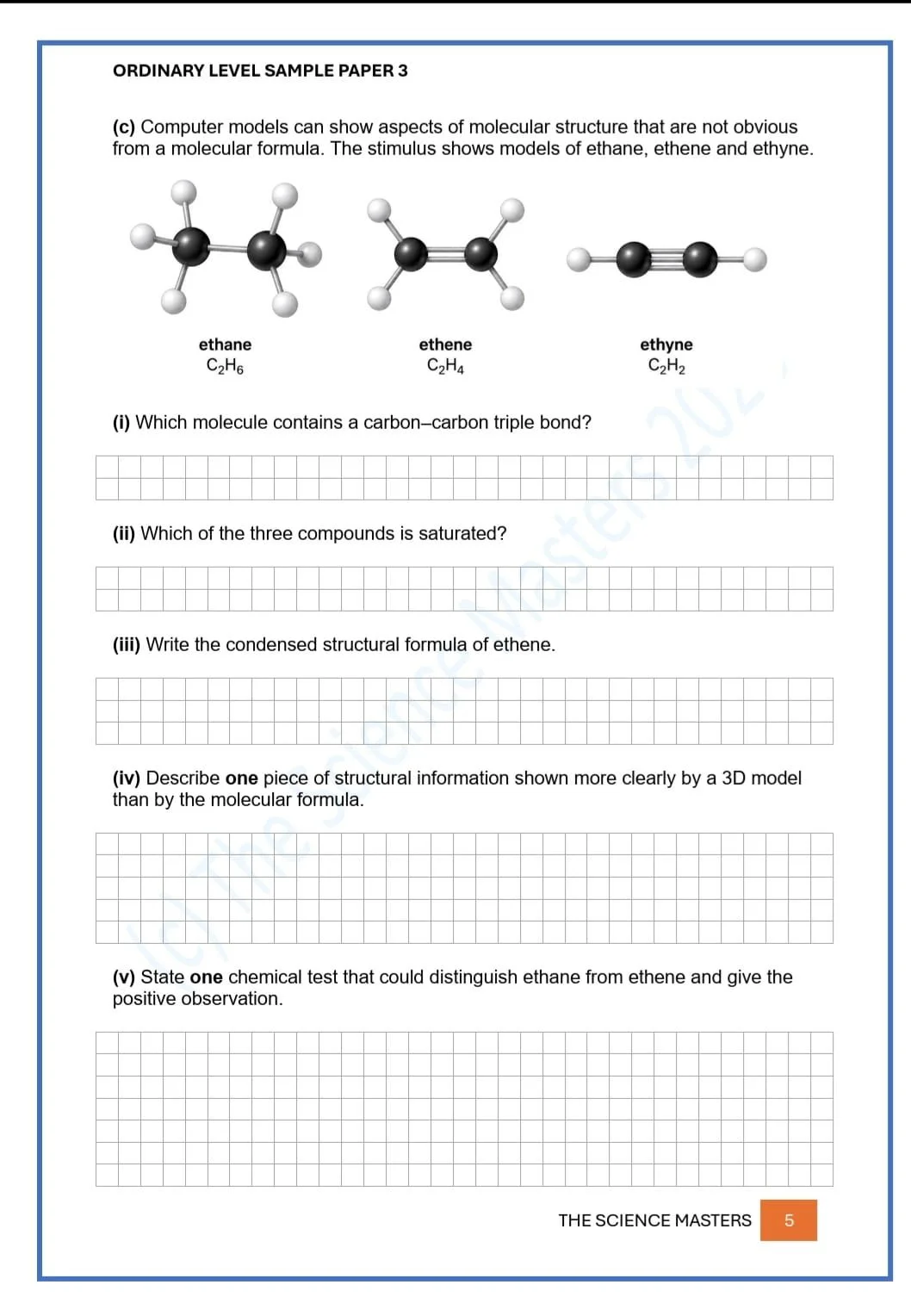
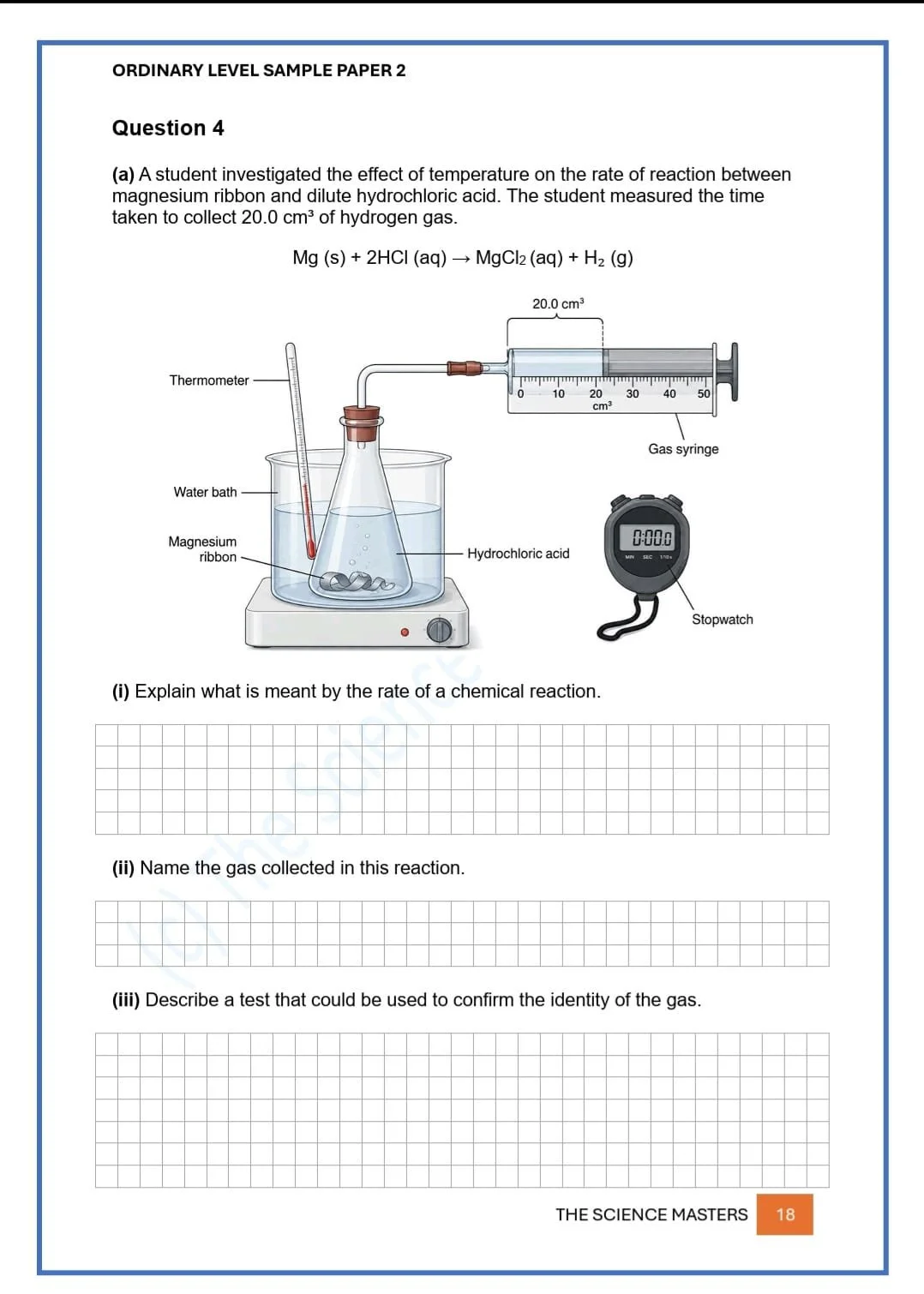
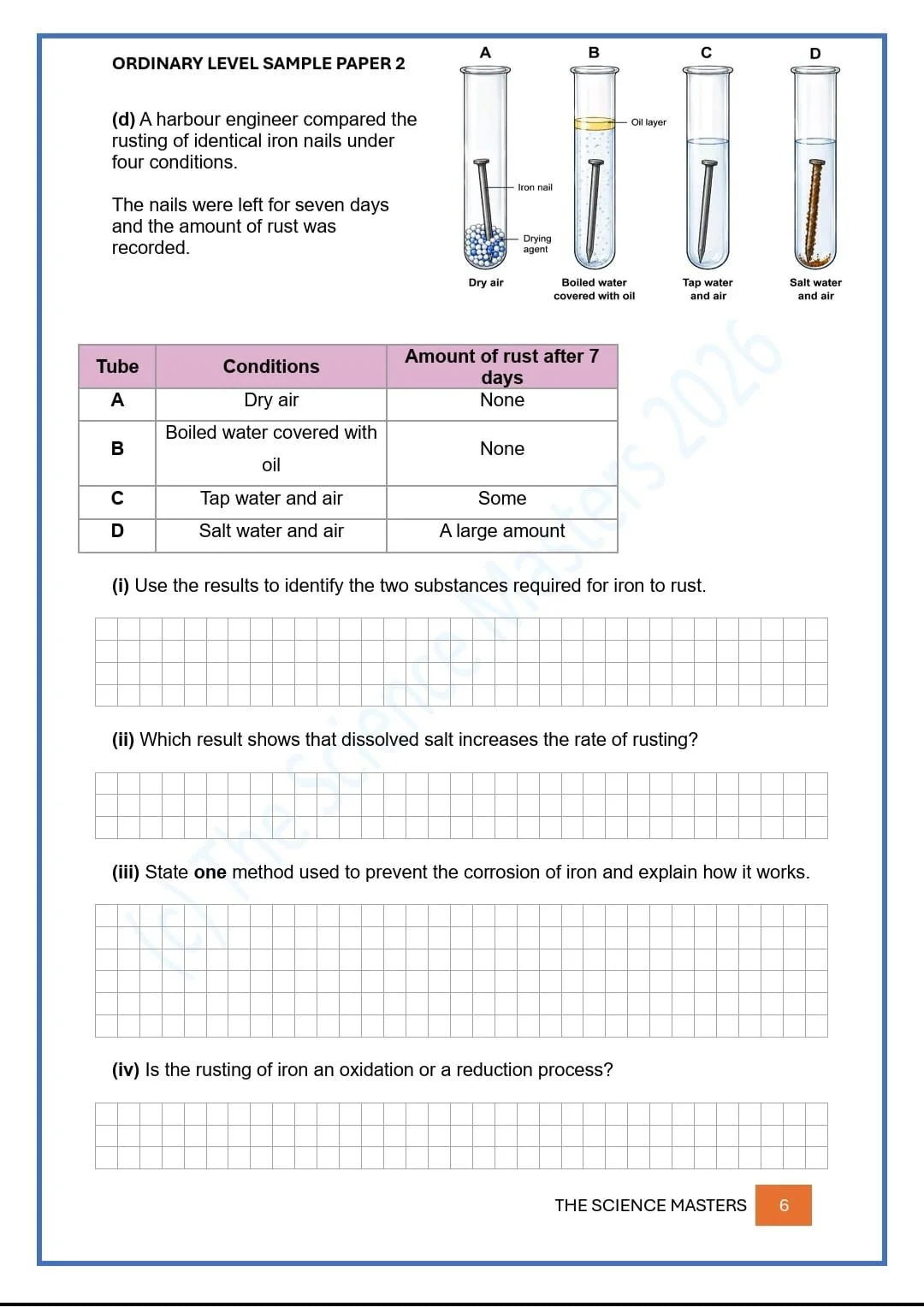
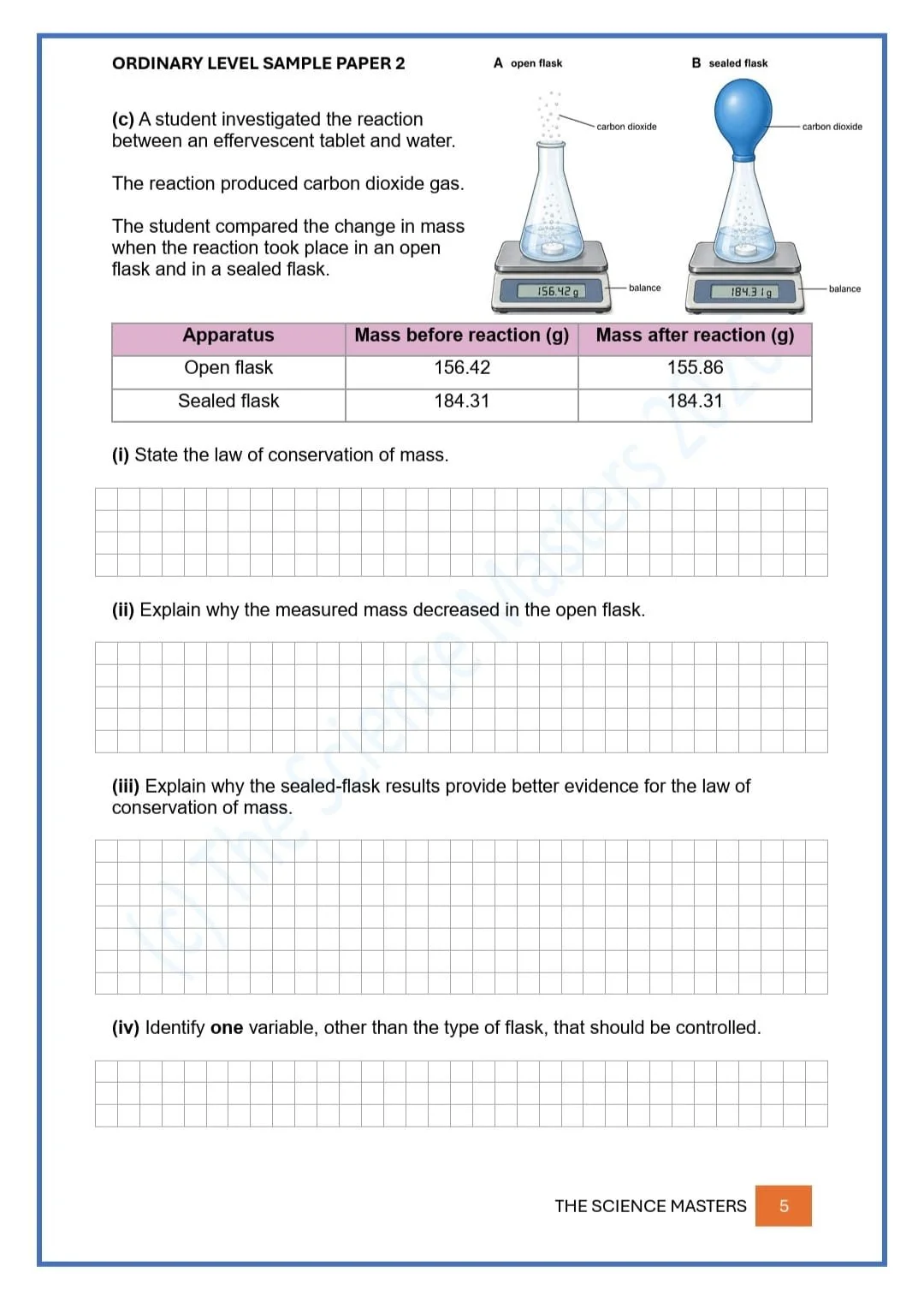
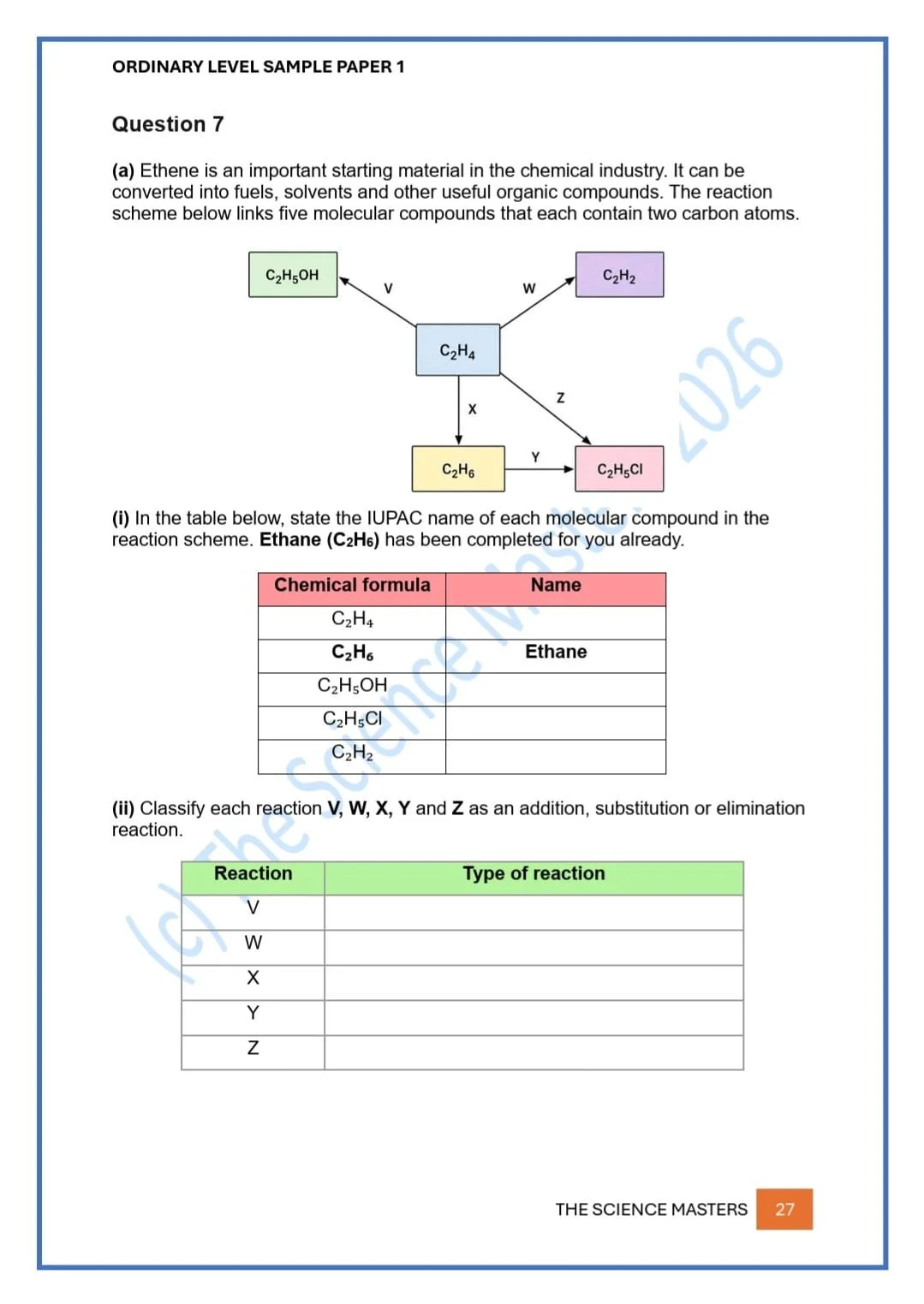
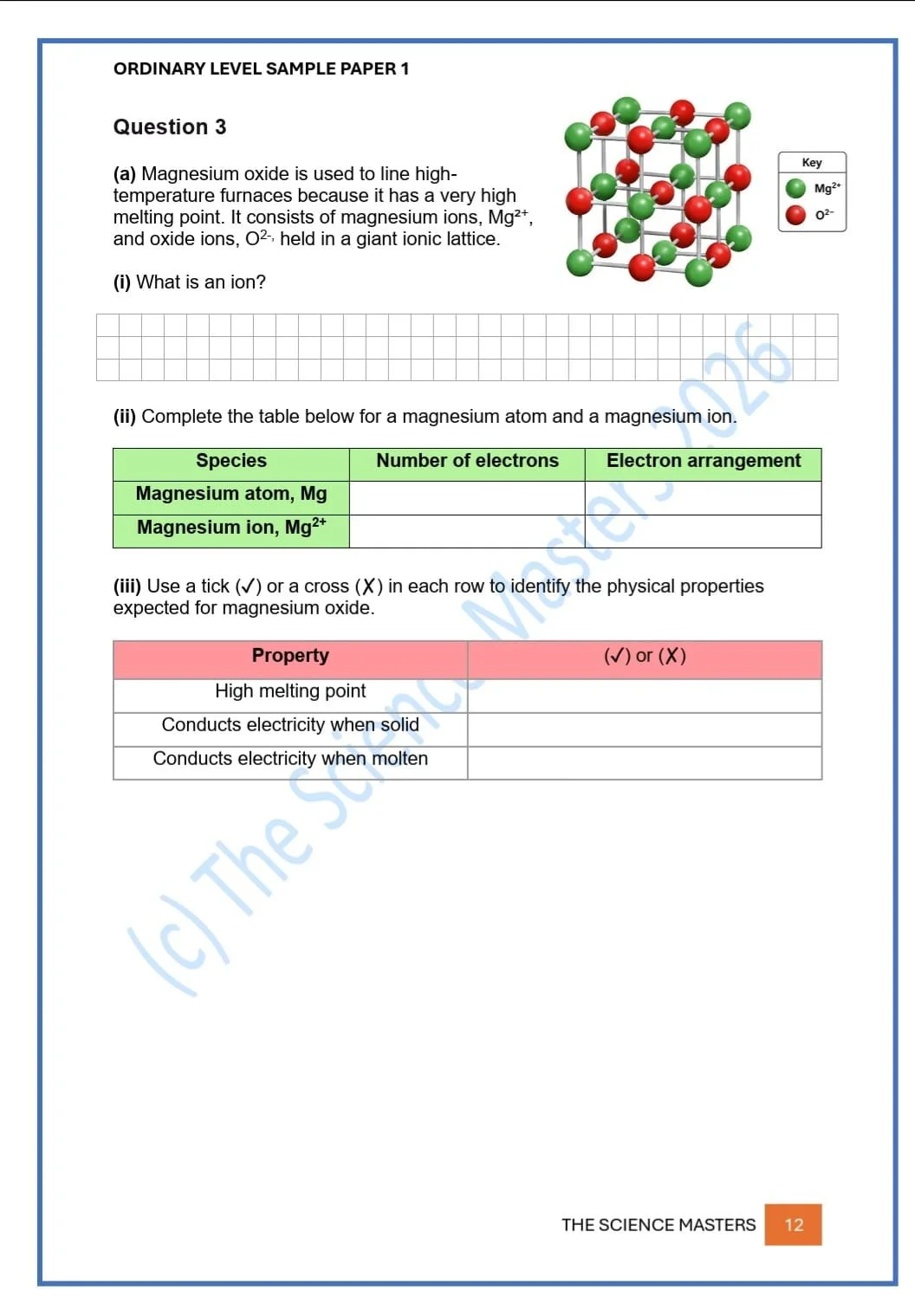
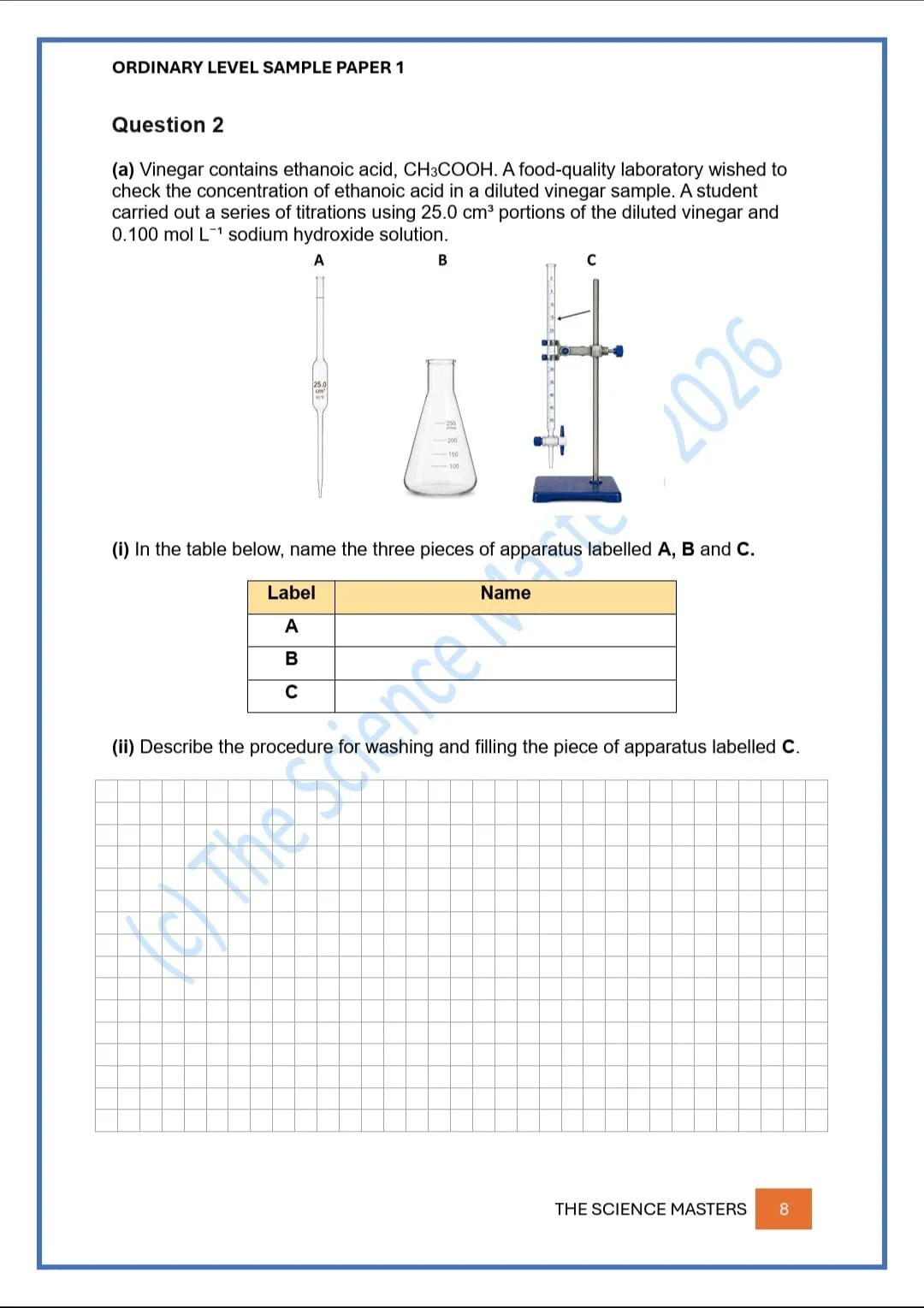
Prepare with confidence for the new Leaving Certificate Chemistry examination with this premium collection of five original Ordinary Level sample examination papers, written specifically for the 2025 Senior Cycle Chemistry specification.
Designed by an experienced Chemistry teacher, these papers closely reflect the style, structure and level of challenge expected in the new examination, helping students develop confidence, improve exam technique and identify areas for further revision.
Unlike simple question collections, these are complete examination papers that provide realistic practice throughout the course.
✔ Five complete Ordinary Level Chemistry sample examination papers
✔ Original examination-style questions
✔ Hundreds of marks of realistic exam practice
✔ SEC-style diagrams, graphs, tables and practical investigations
✔ Questions covering the full breadth of the 2025 Senior Cycle Chemistry specification
✔ Professionally formatted papers suitable for revision, homework, classroom assessment and mock examinations
• Leaving Certificate Chemistry students
• Students preparing for class tests and Christmas or summer examinations
• Mock examination preparation
• Independent study and revision
• Teachers looking for high-quality assessment resources
• Students who want additional exam practice beyond the official sample materials
Every paper has been carefully developed to challenge students while reinforcing key concepts from the new specification. The questions encourage scientific thinking, data analysis, practical application and problem-solving—the same skills required for success in the new Leaving Certificate Chemistry examination.
Whether you're aiming to build confidence, improve your exam technique or maximise your final grade, this bundle provides the realistic practice needed to succeed.
Science Masters – Learn Smarter. Build Confidence. Achieve More.
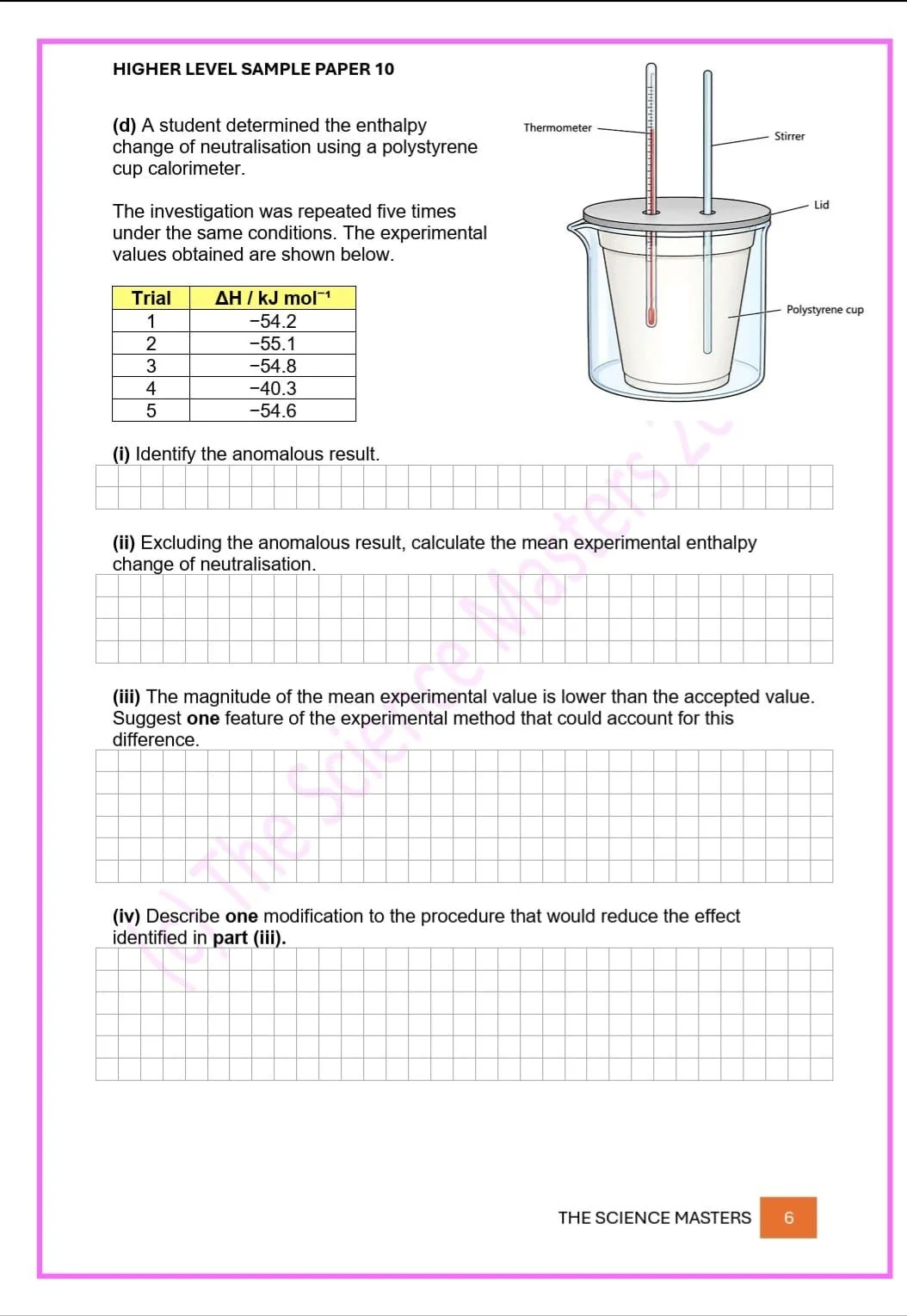
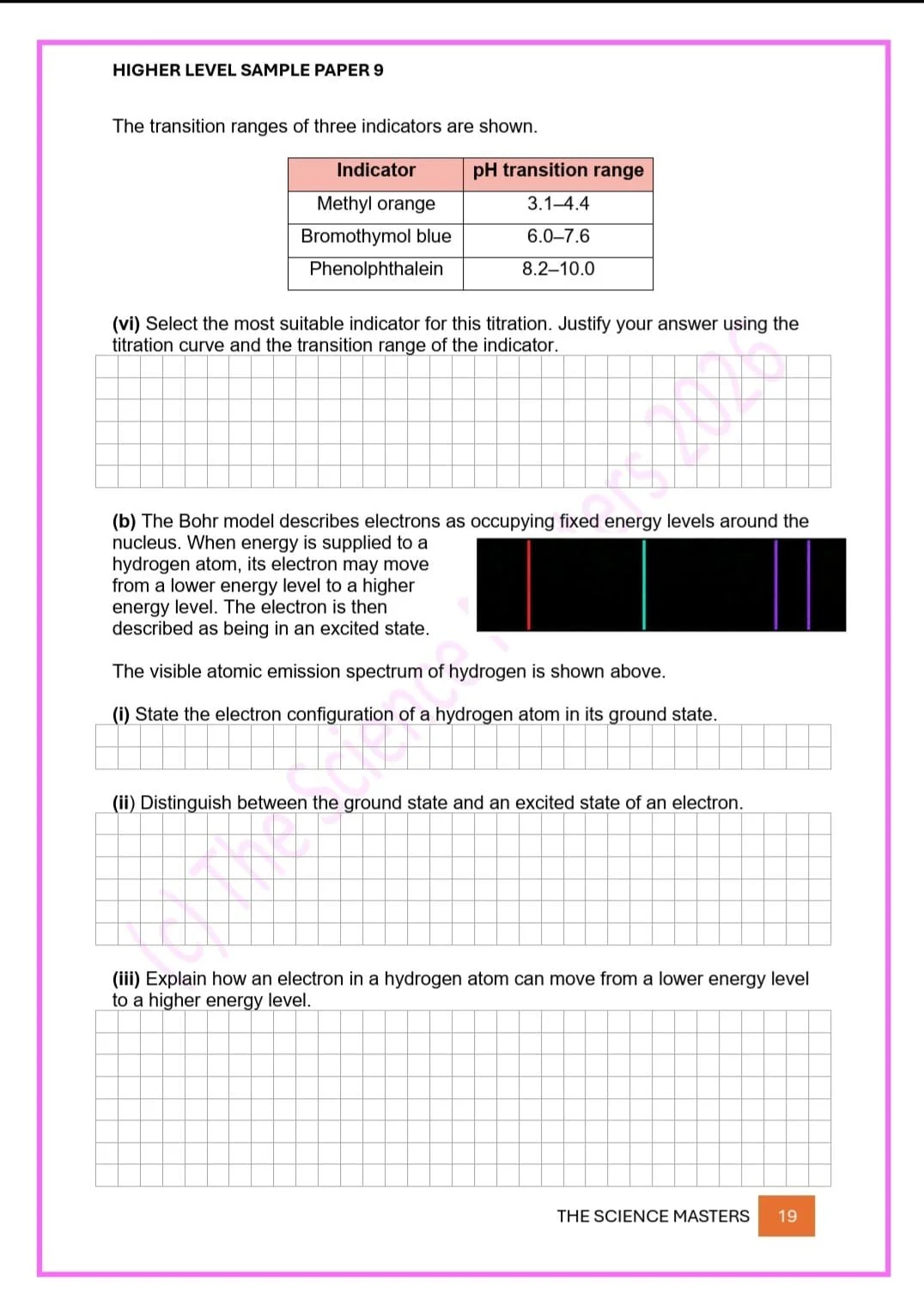
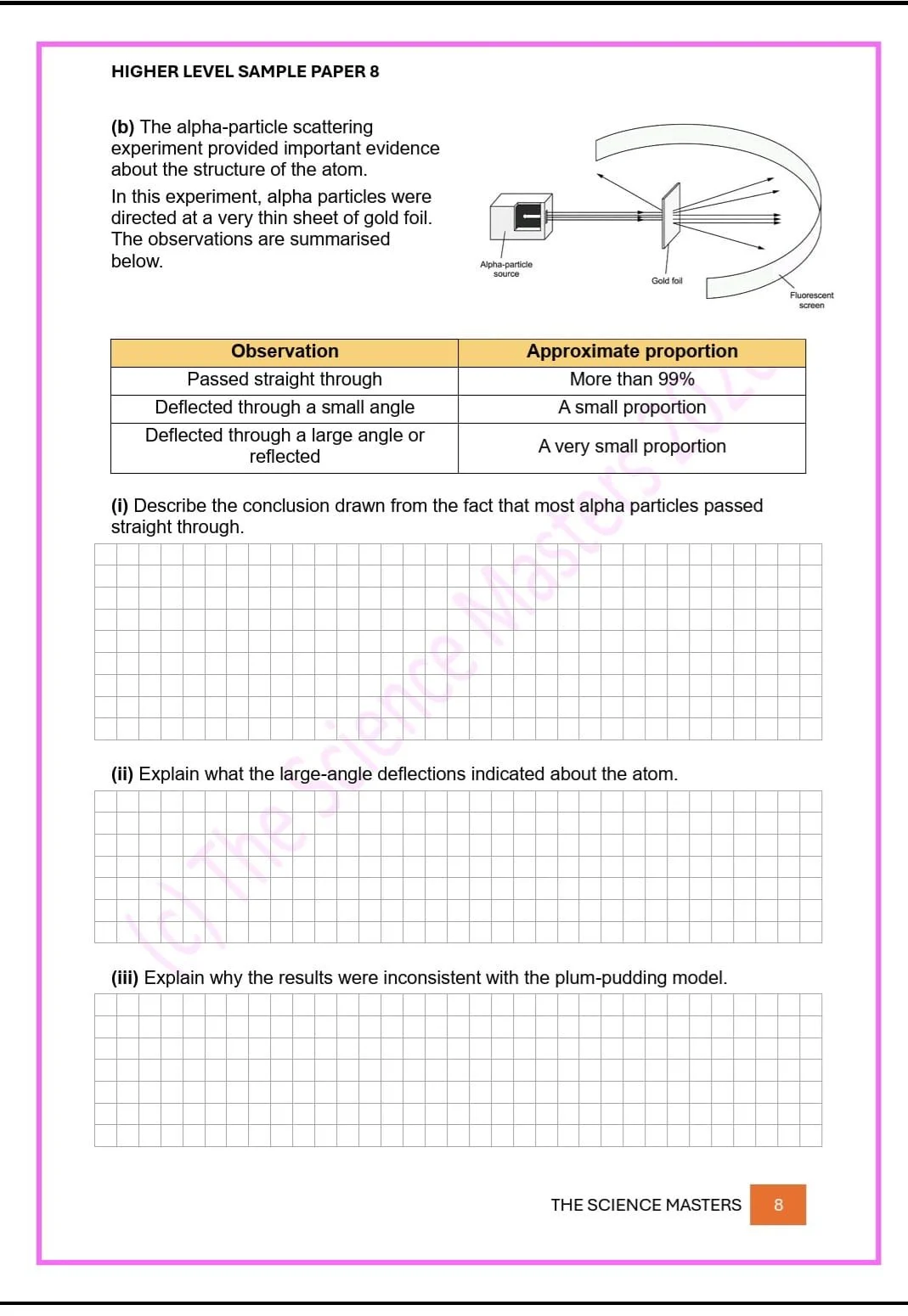
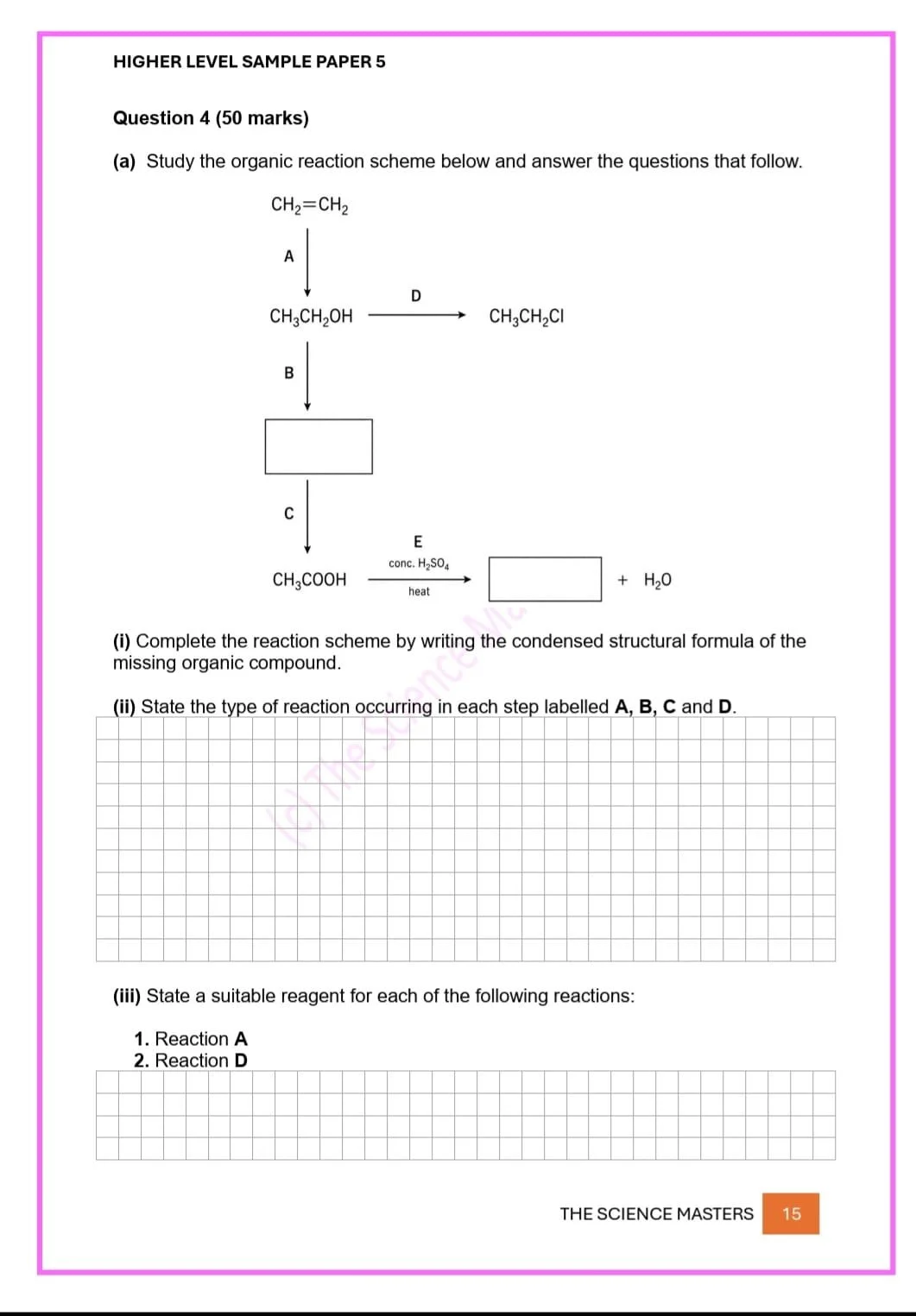
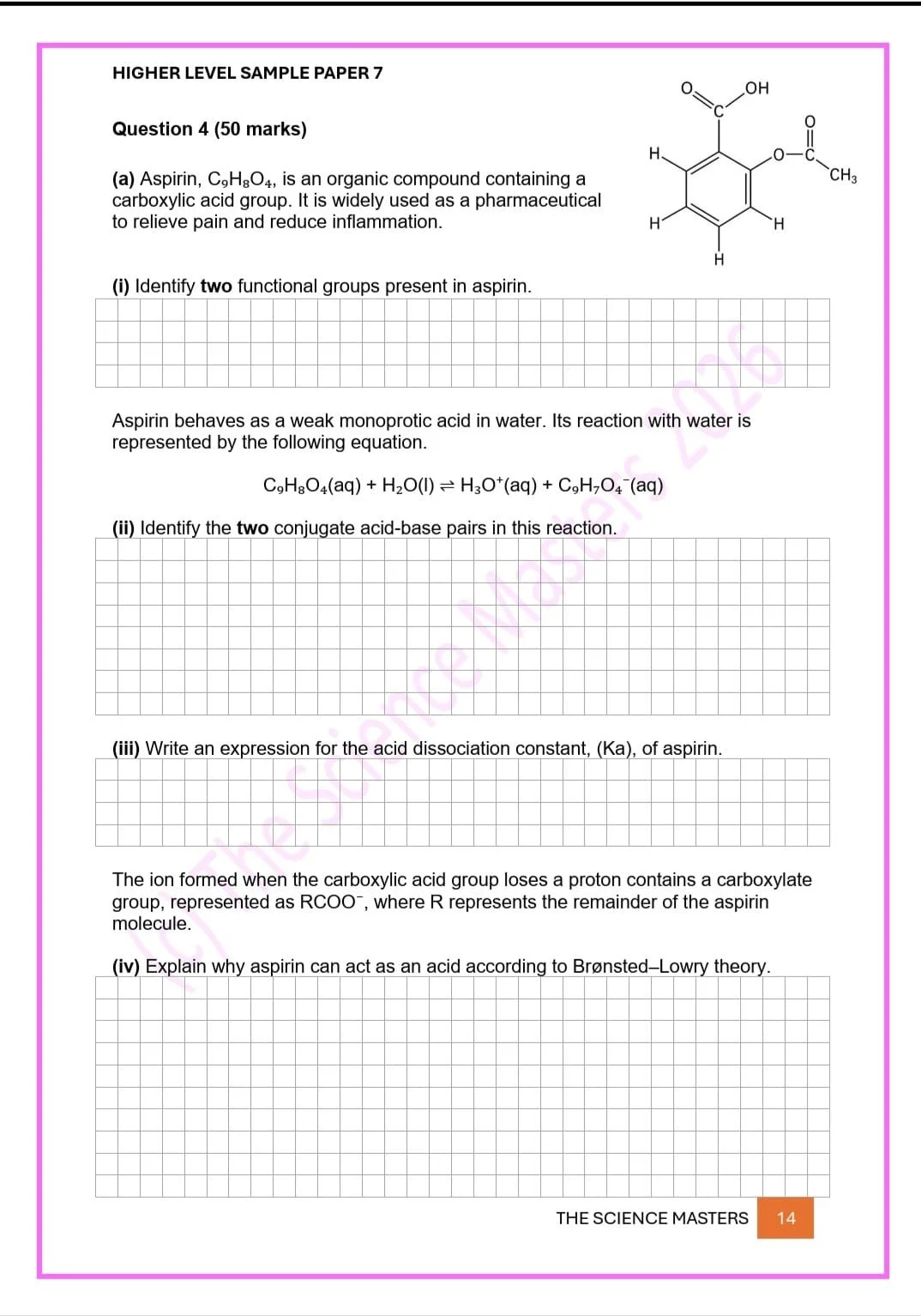
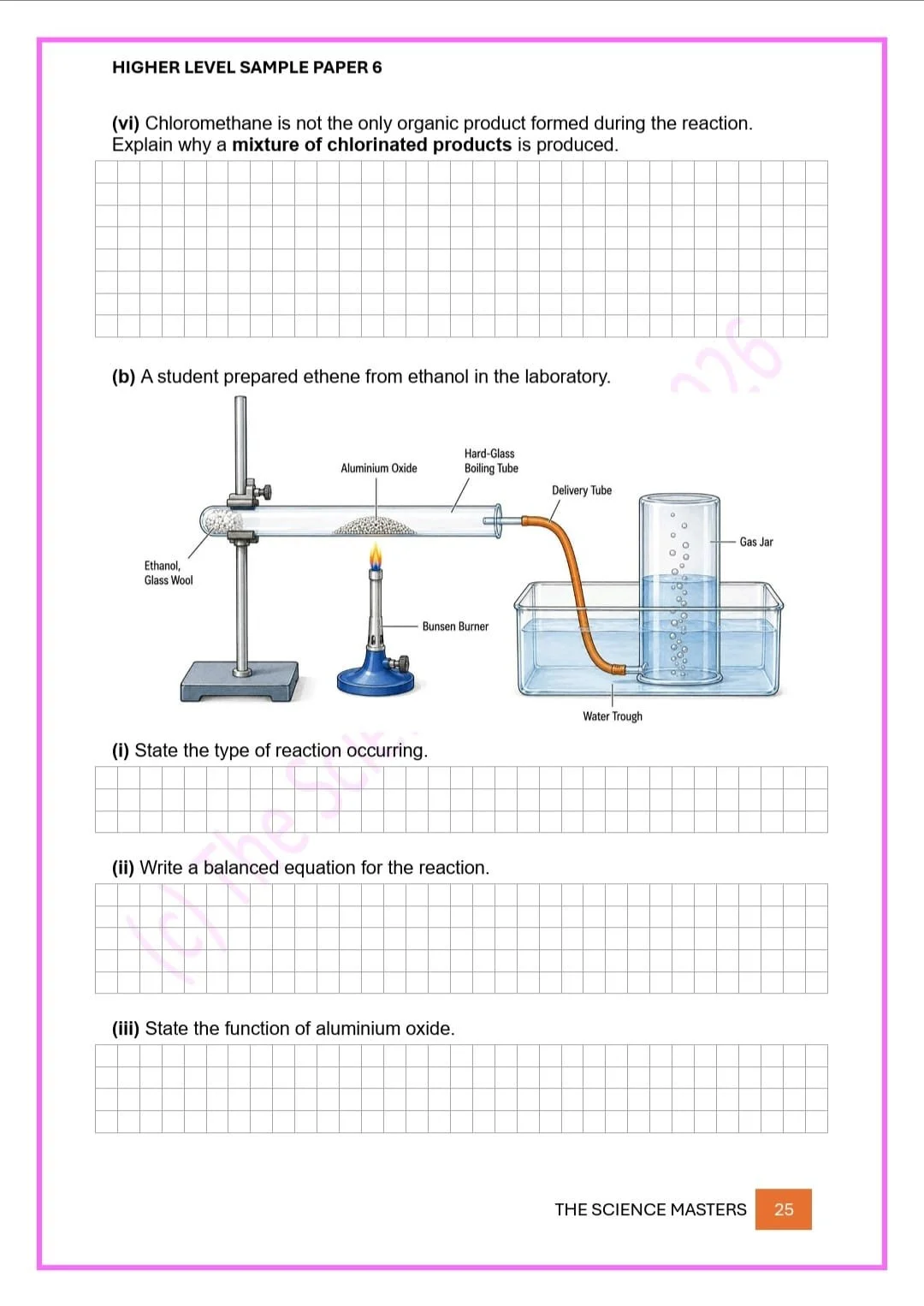
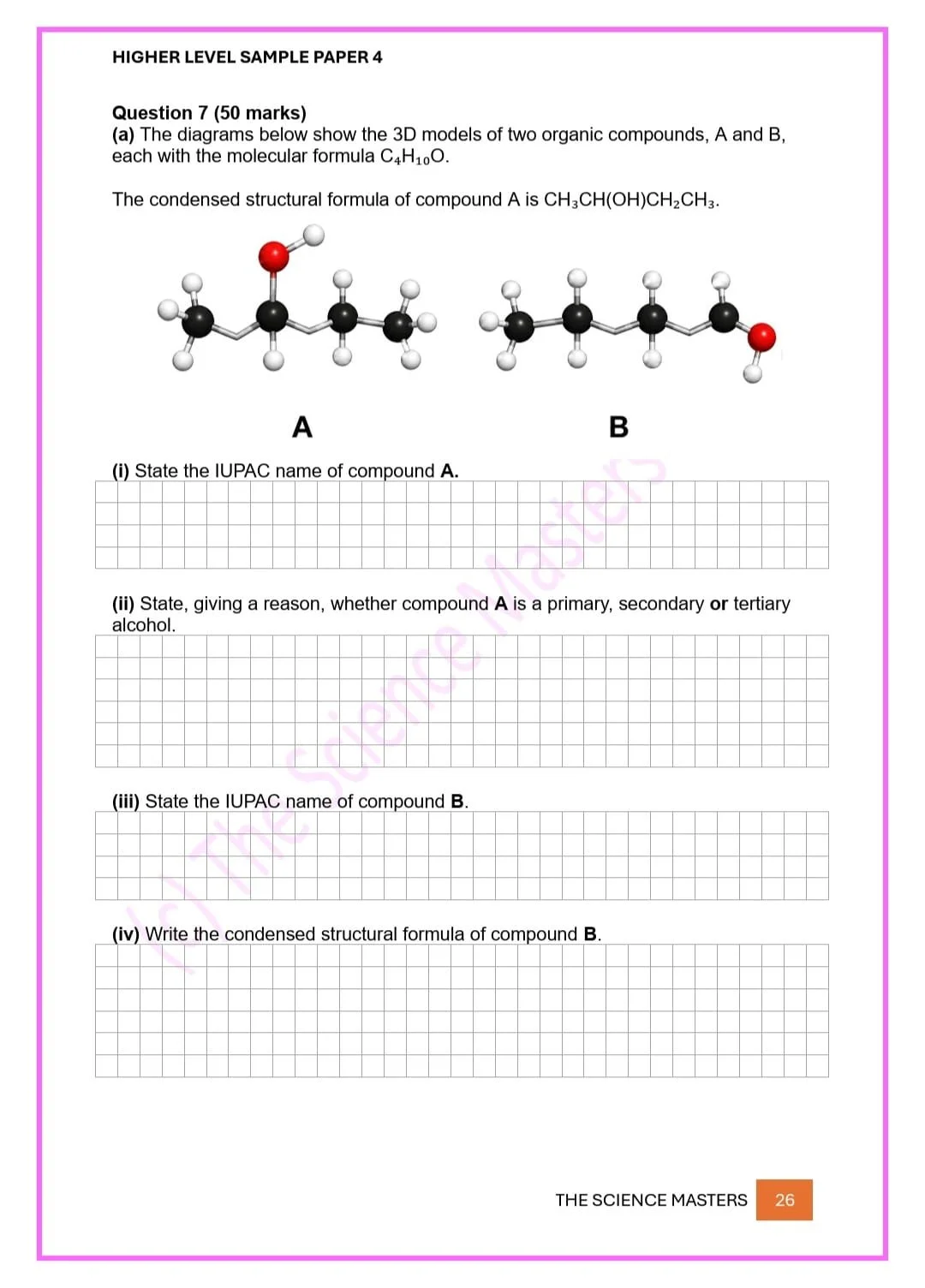
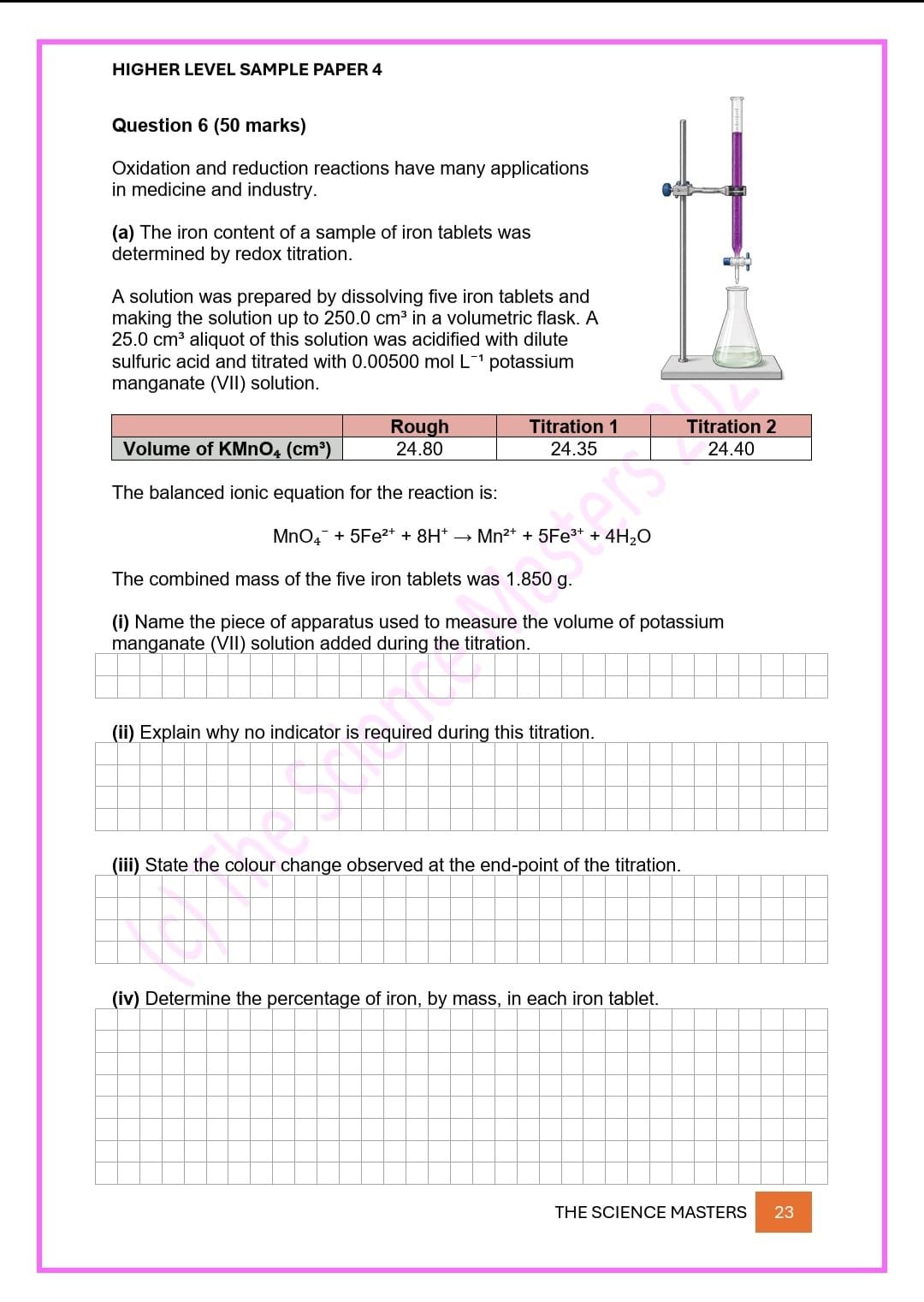
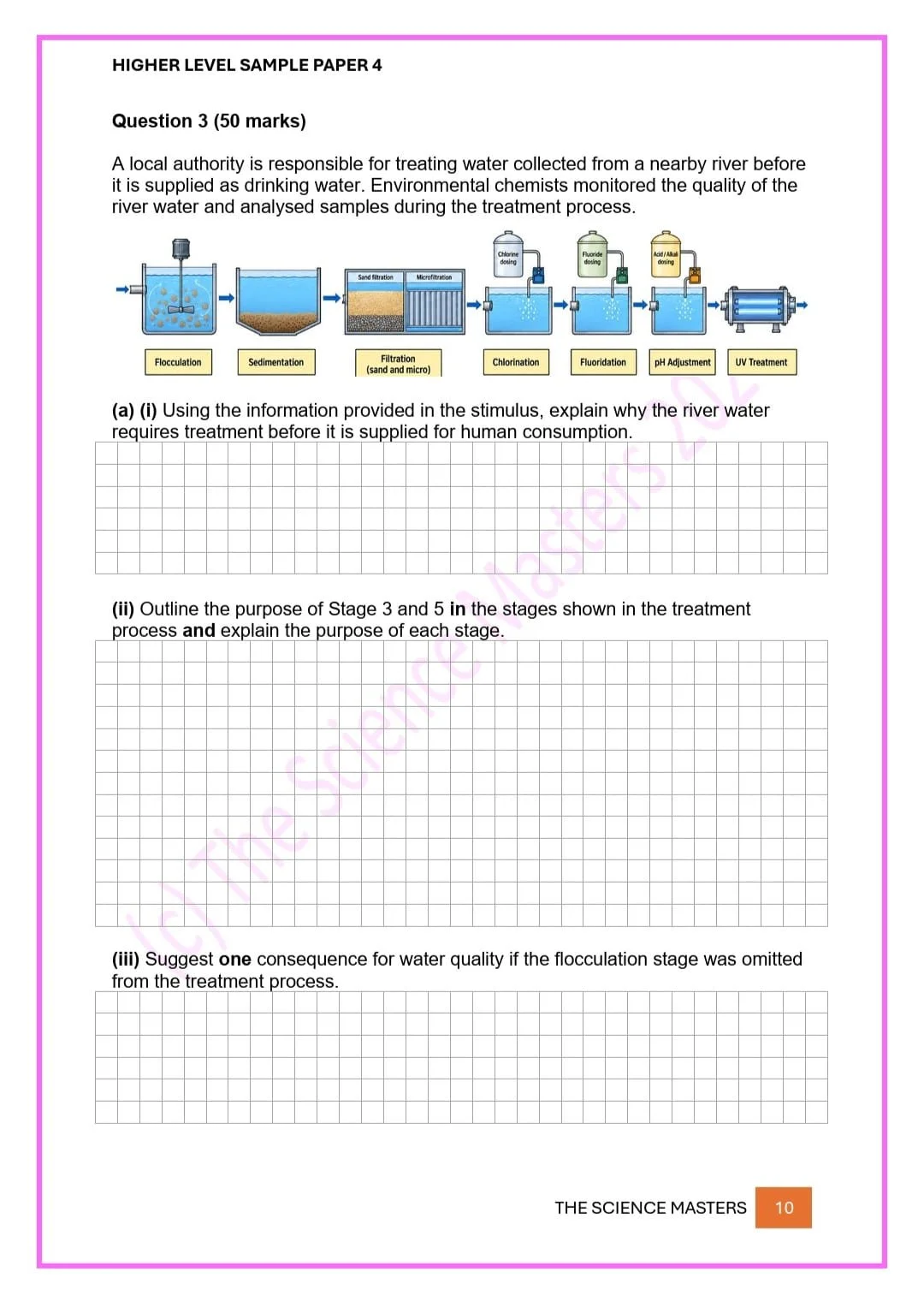
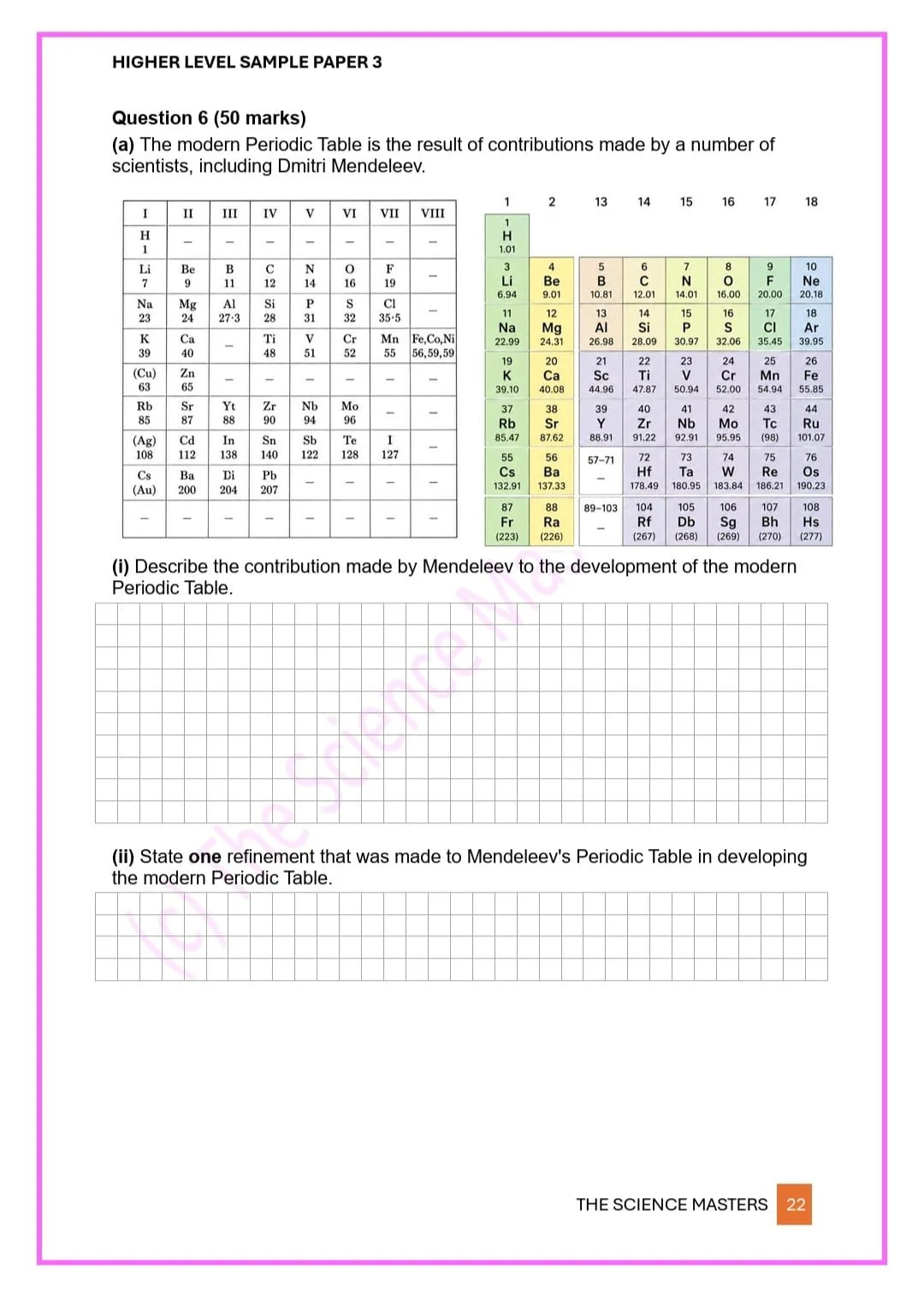
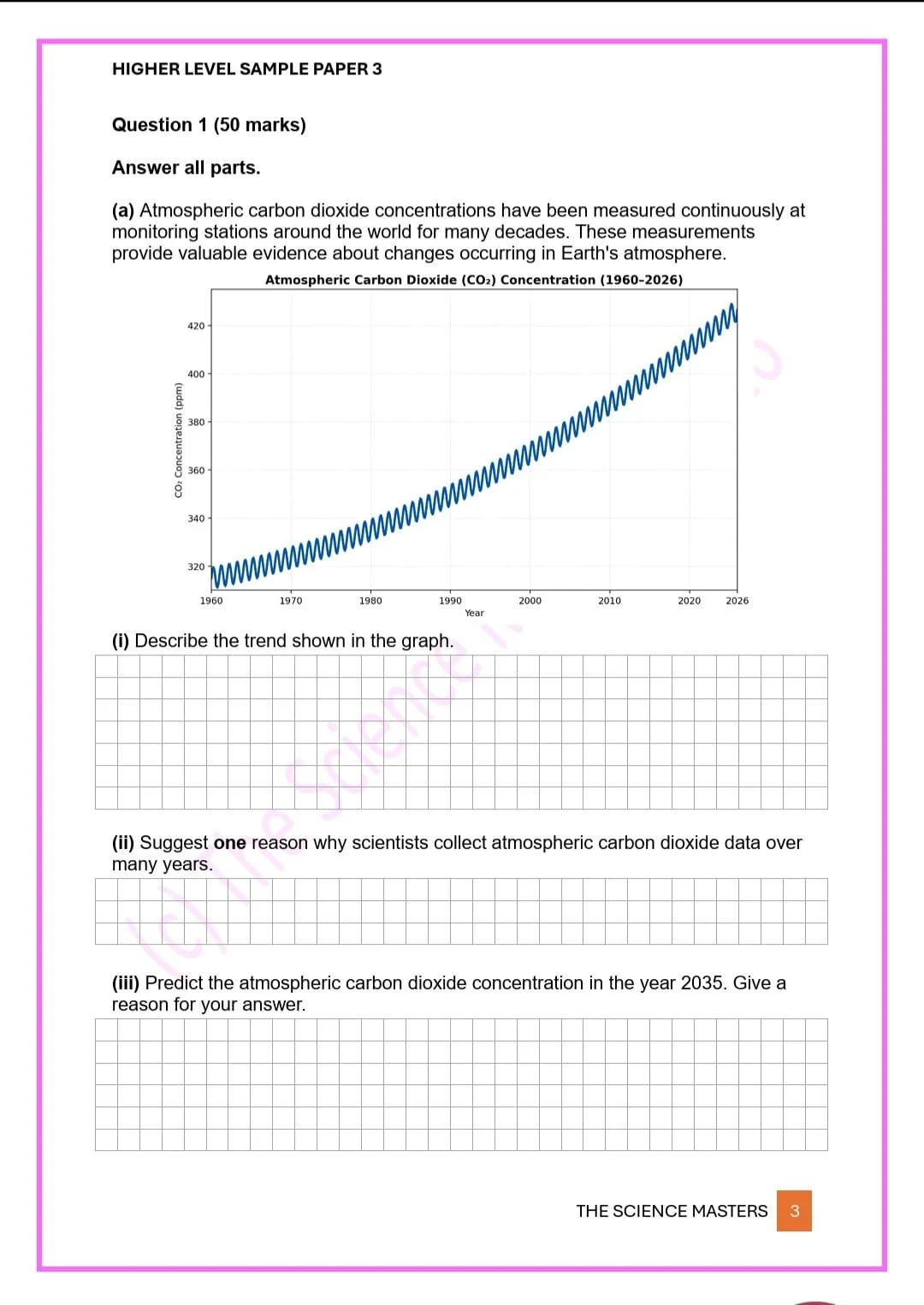
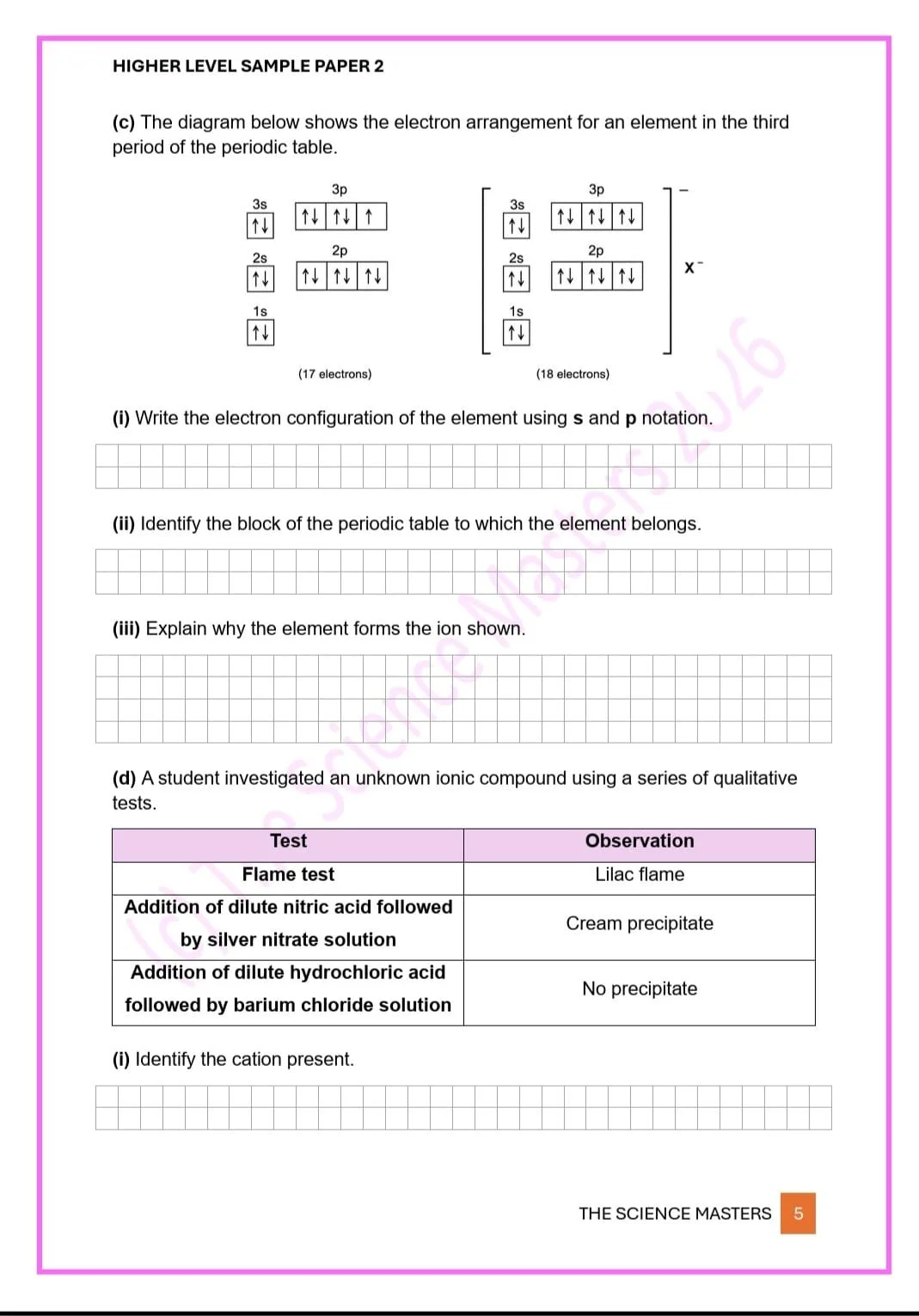
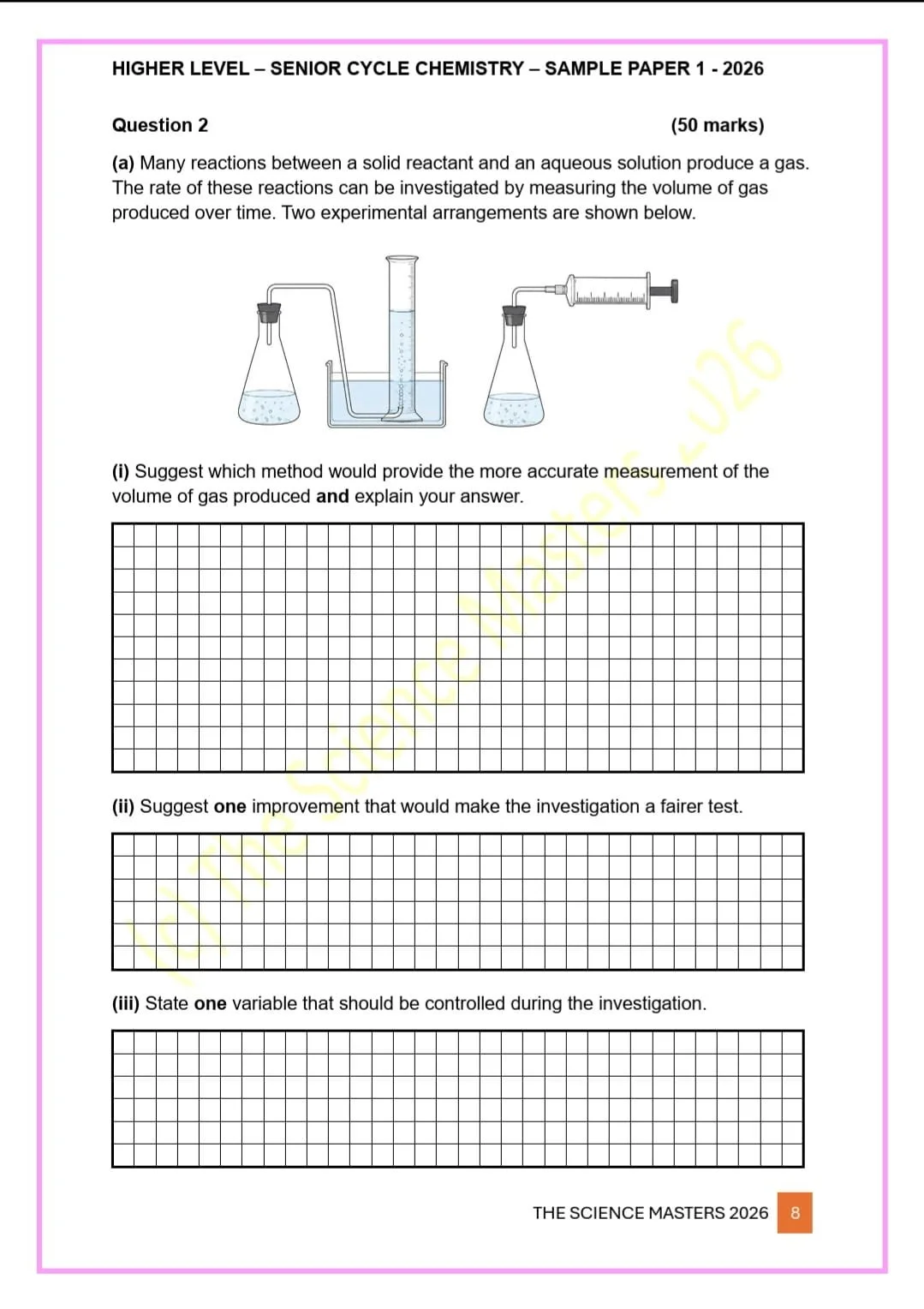
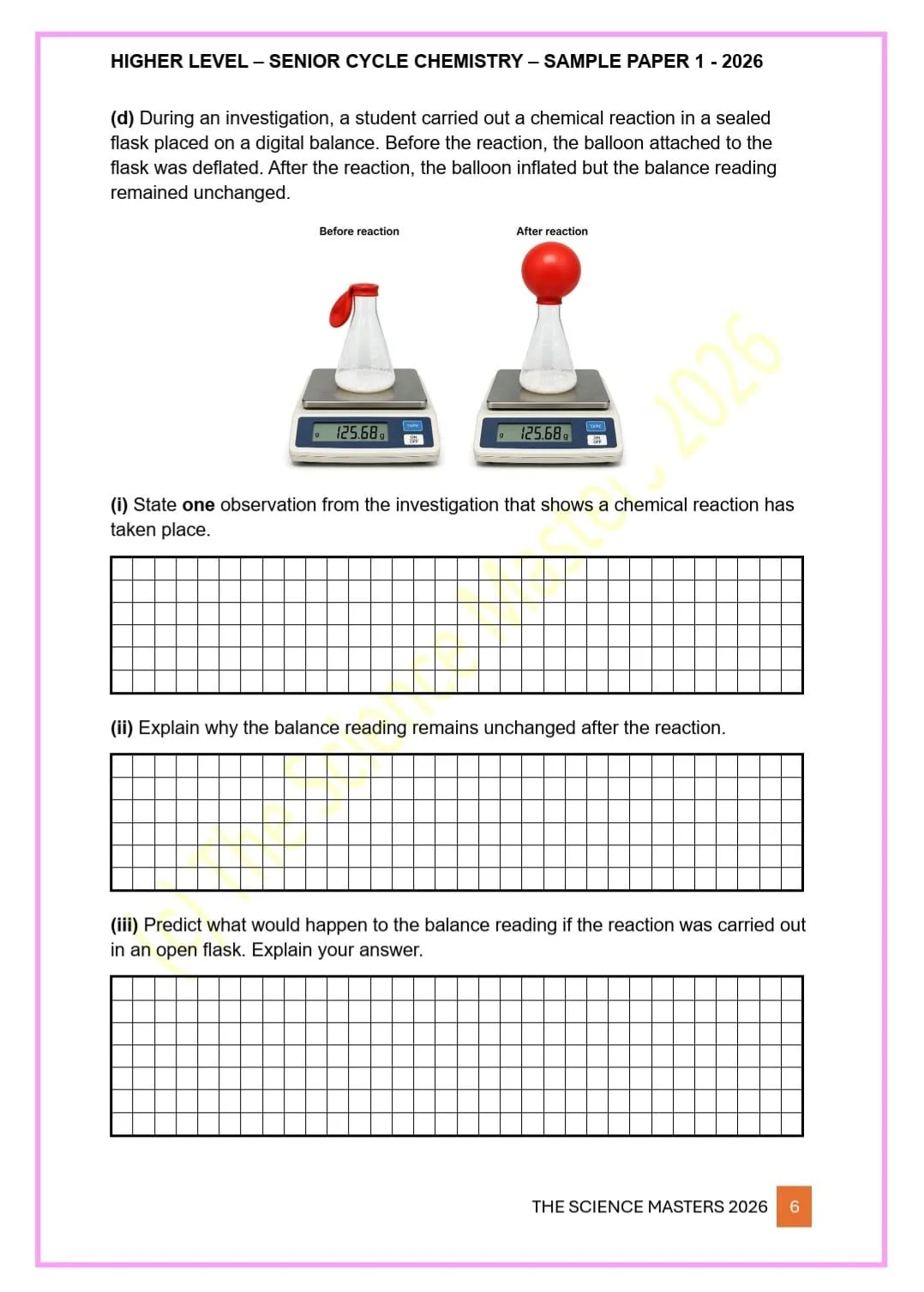
Prepare with confidence for Leaving Certificate Higher Level Chemistry using this collection of 10 original sample examination papers, created to support students studying the current Senior Cycle Chemistry specification.
This resource provides extensive examination practice across the full course, helping students develop subject knowledge, strengthen scientific skills and become familiar with the style and depth of questions encountered in Higher Level Chemistry.
Each paper has been professionally designed to provide fresh, challenging practice using original questions that assess understanding, application, analysis and evaluation across the full range of course learning outcomes.
What's Included
10 original Higher Level Chemistry sample examination papers
Comprehensive coverage of the current Senior Cycle Chemistry specification
Original questions covering all major areas of the course
Scientific investigations and practical-based questions
Chemical calculations and quantitative problem-solving
Data interpretation and graphical analysis
Modern chemical contexts and applications
Clear, professional layouts
Instant digital PDF download
Suitable For
Leaving Certificate Higher Level Chemistry students
Sixth Year revision
Mock examination preparation
Independent study
Classroom revision
Chemistry grinds
Additional examination practice throughout the school year
Whether you're revising individual topics or preparing for your final examination, these sample papers provide valuable opportunities to practice answering original Chemistry questions, complete examination-style calculations and build confidence throughout the course.
Please note: The matching marking guide is available separately.
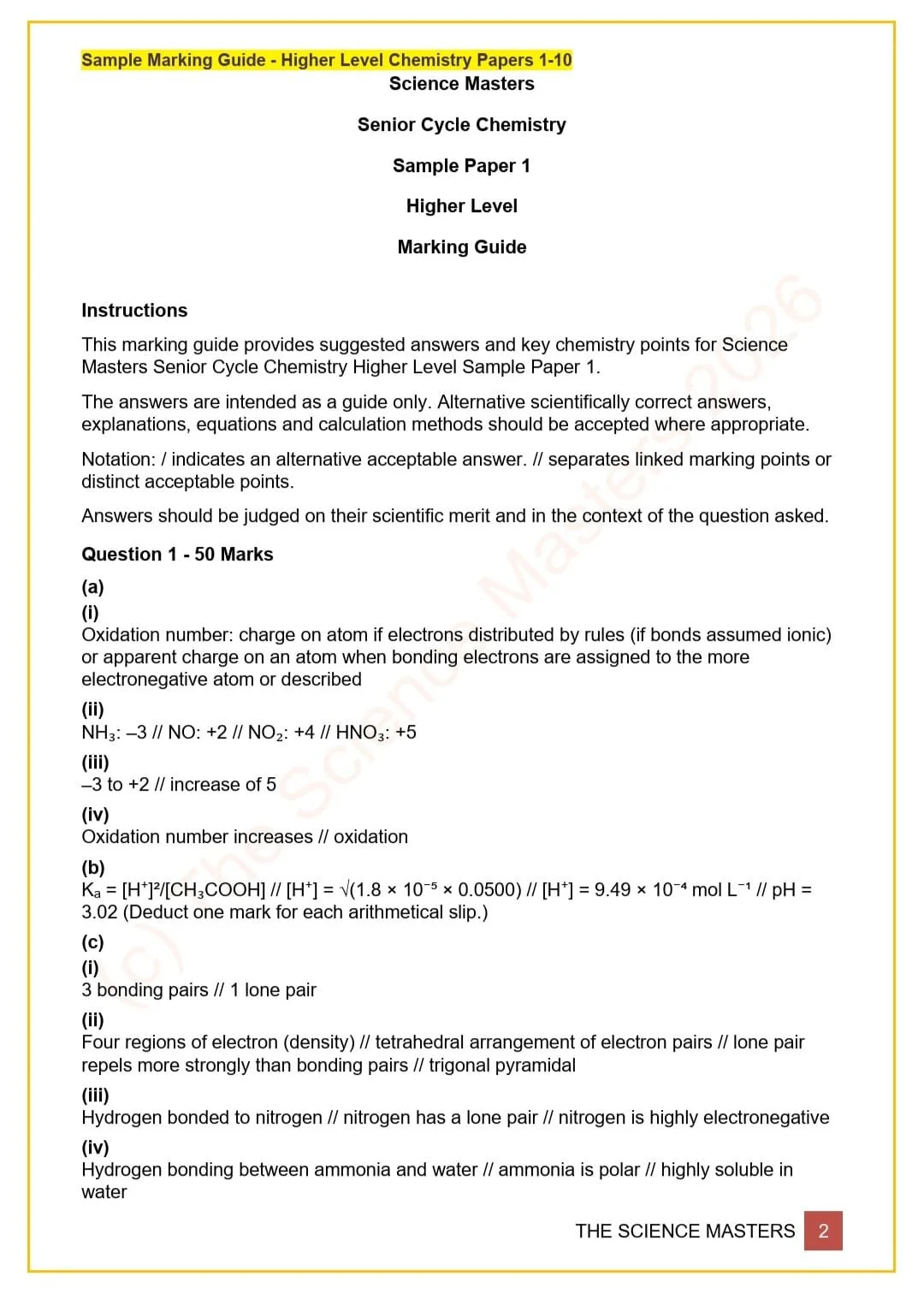
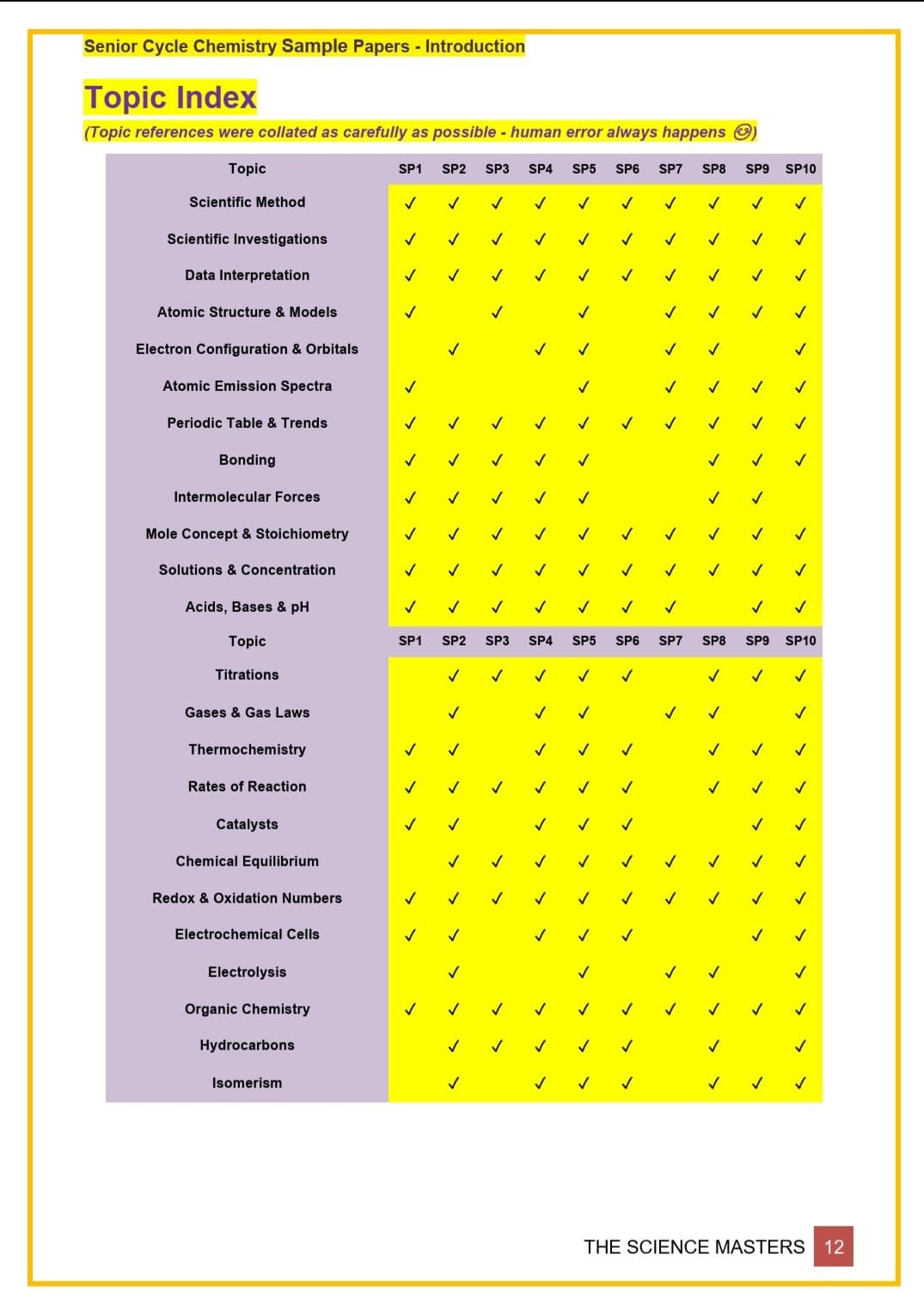
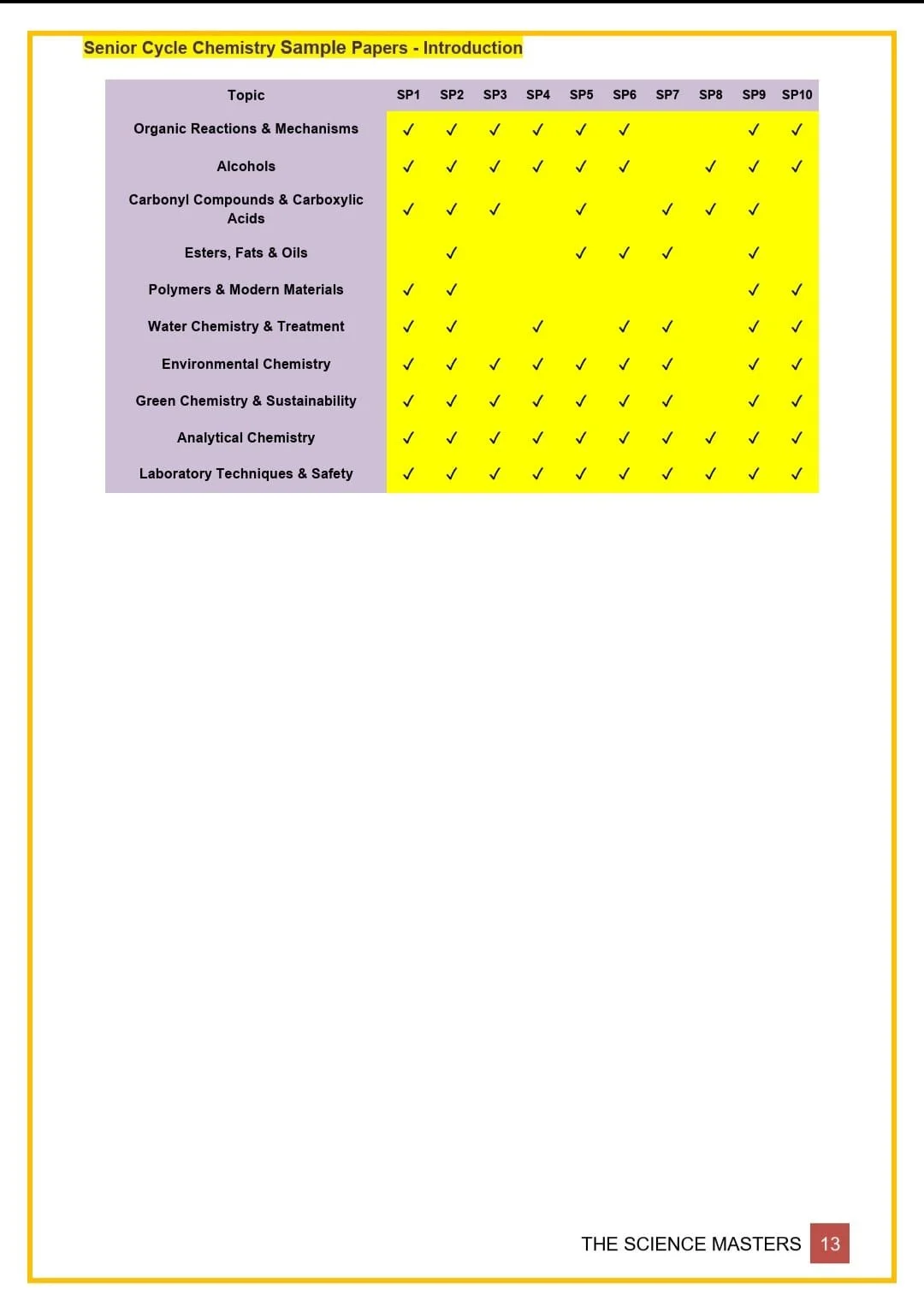
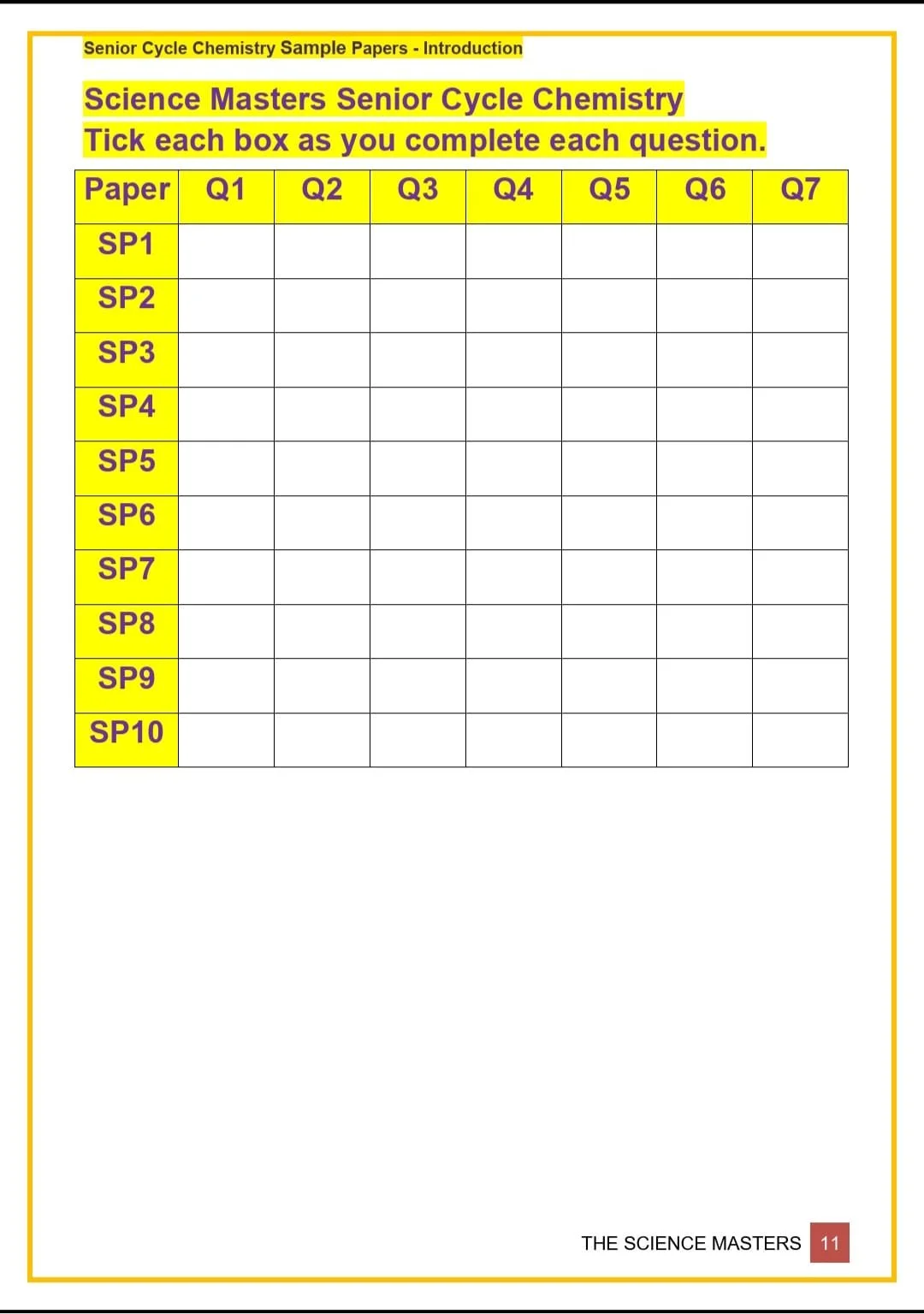
This resource contains the complete marking guide for all 10 Higher Level Chemistry Sample Examination Papers.
Designed to accompany The Science Masters Higher Level Chemistry Sample Examination Papers, this detailed marking guide allows students and teachers to review answers, check calculations, assess progress and understand the scientific knowledge required across every question.
Ideal for self-assessment, classroom correction, Chemistry grinds and revision, the marking guide provides clear guidance while supporting effective examination preparation.
What's Included
Complete marking guide for all 10 sample examination papers
Detailed model answers
Fully worked chemical calculations
Balanced equations and key scientific points
Acceptable alternative responses where appropriate
Professionally presented layouts
Instant digital PDF download
Ideal For
Leaving Certificate Higher Level Chemistry students
Chemistry teachers
Chemistry grinds
Independent revision
Classroom assessment
Mock examination correction
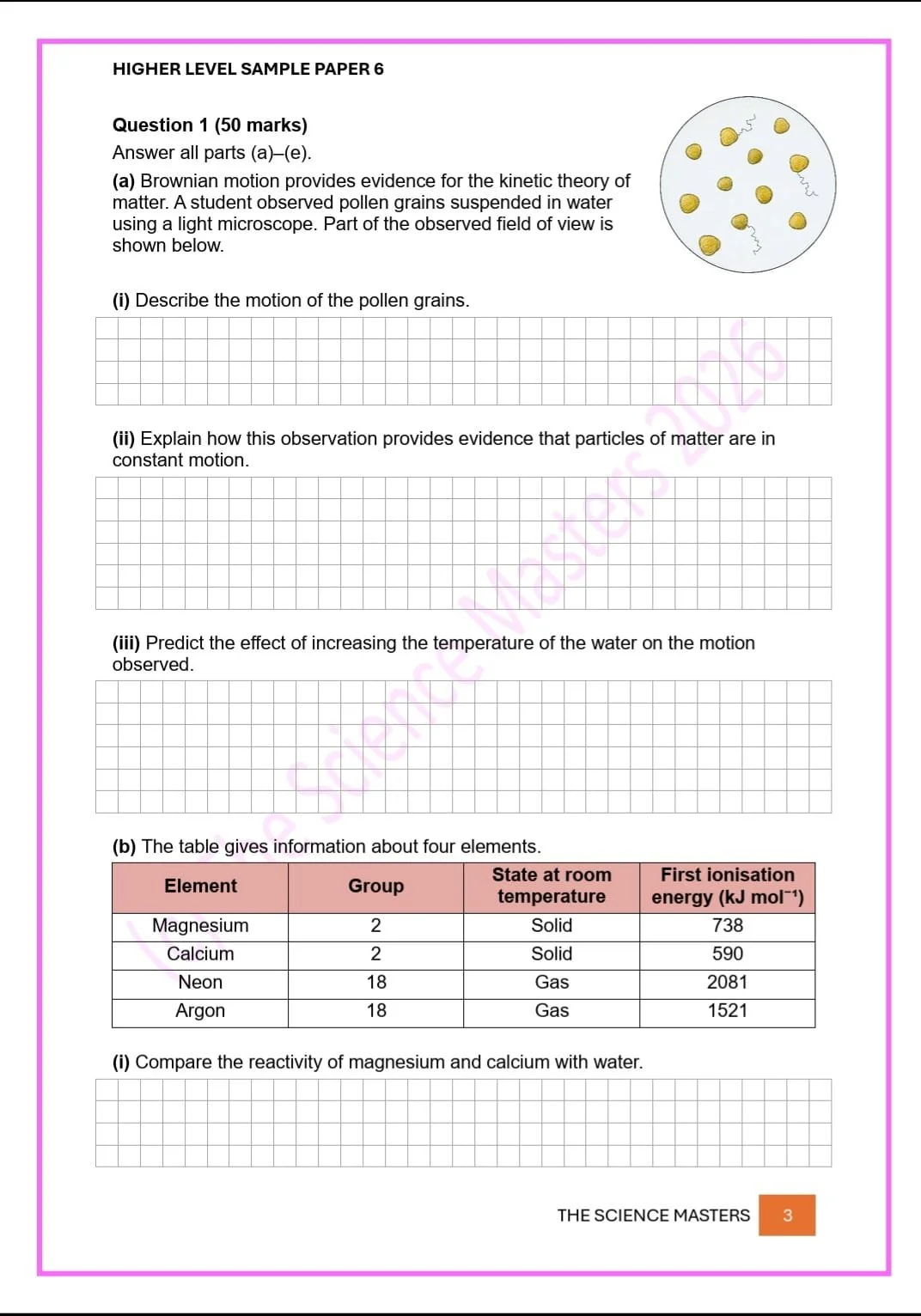
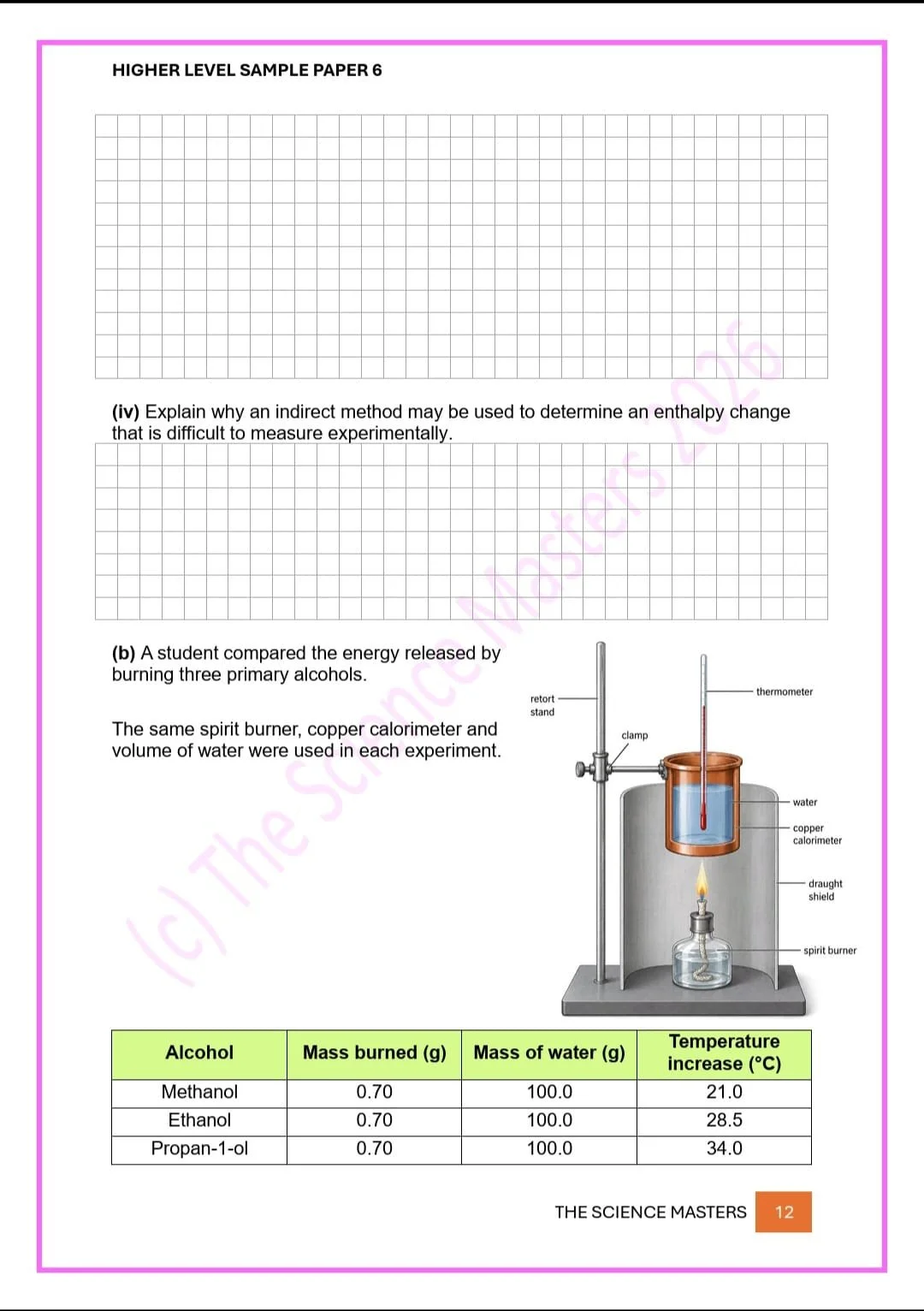
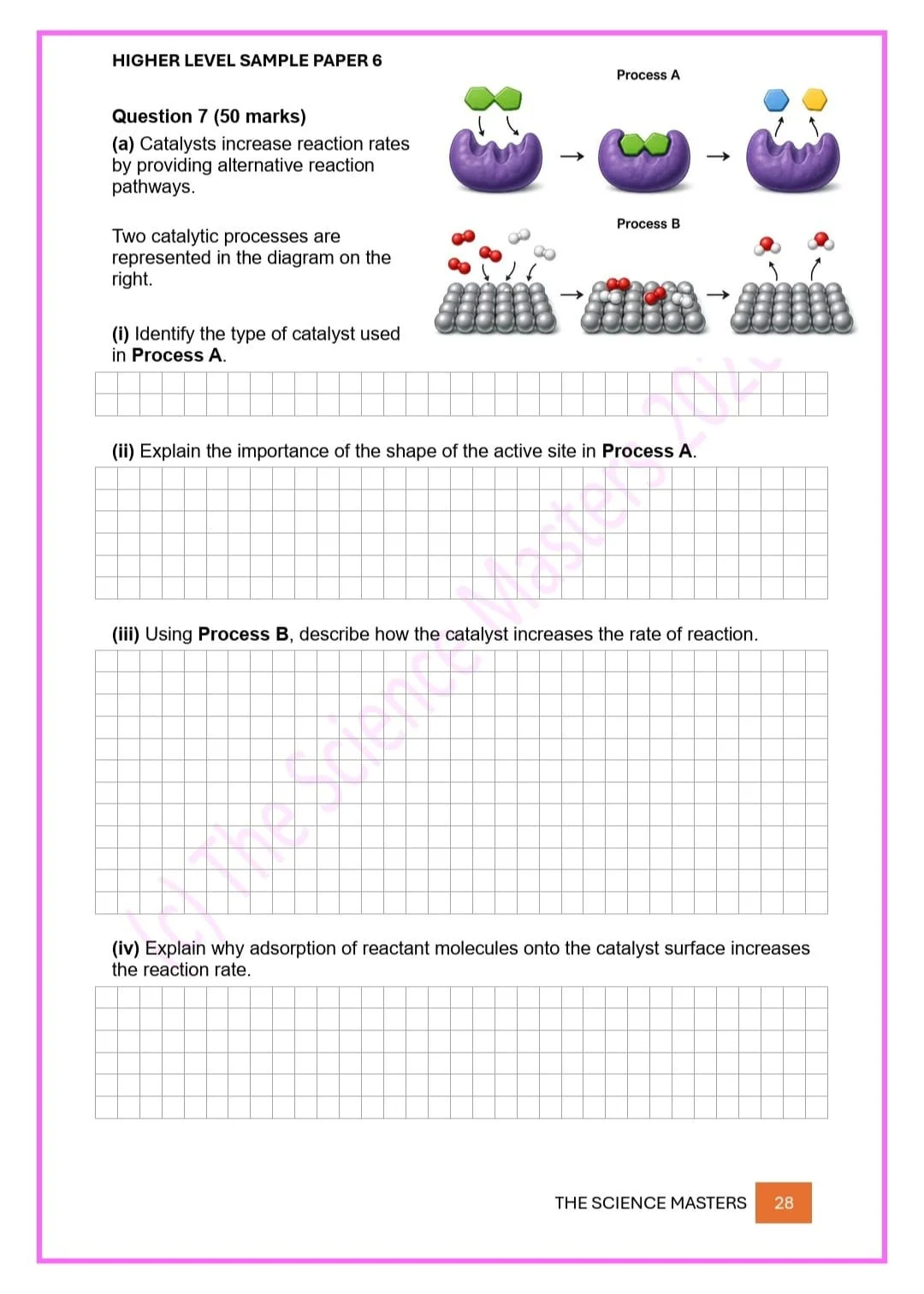
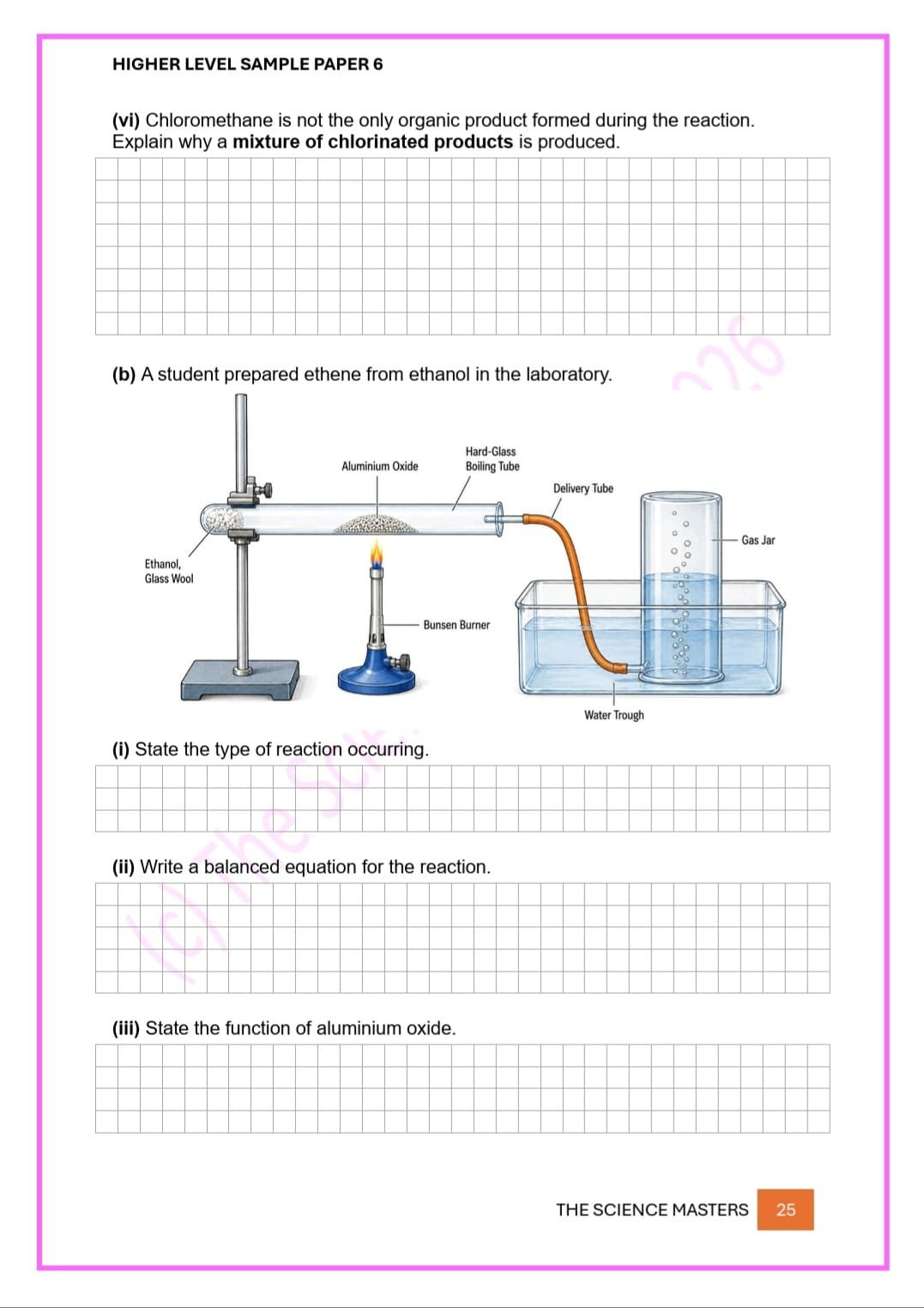
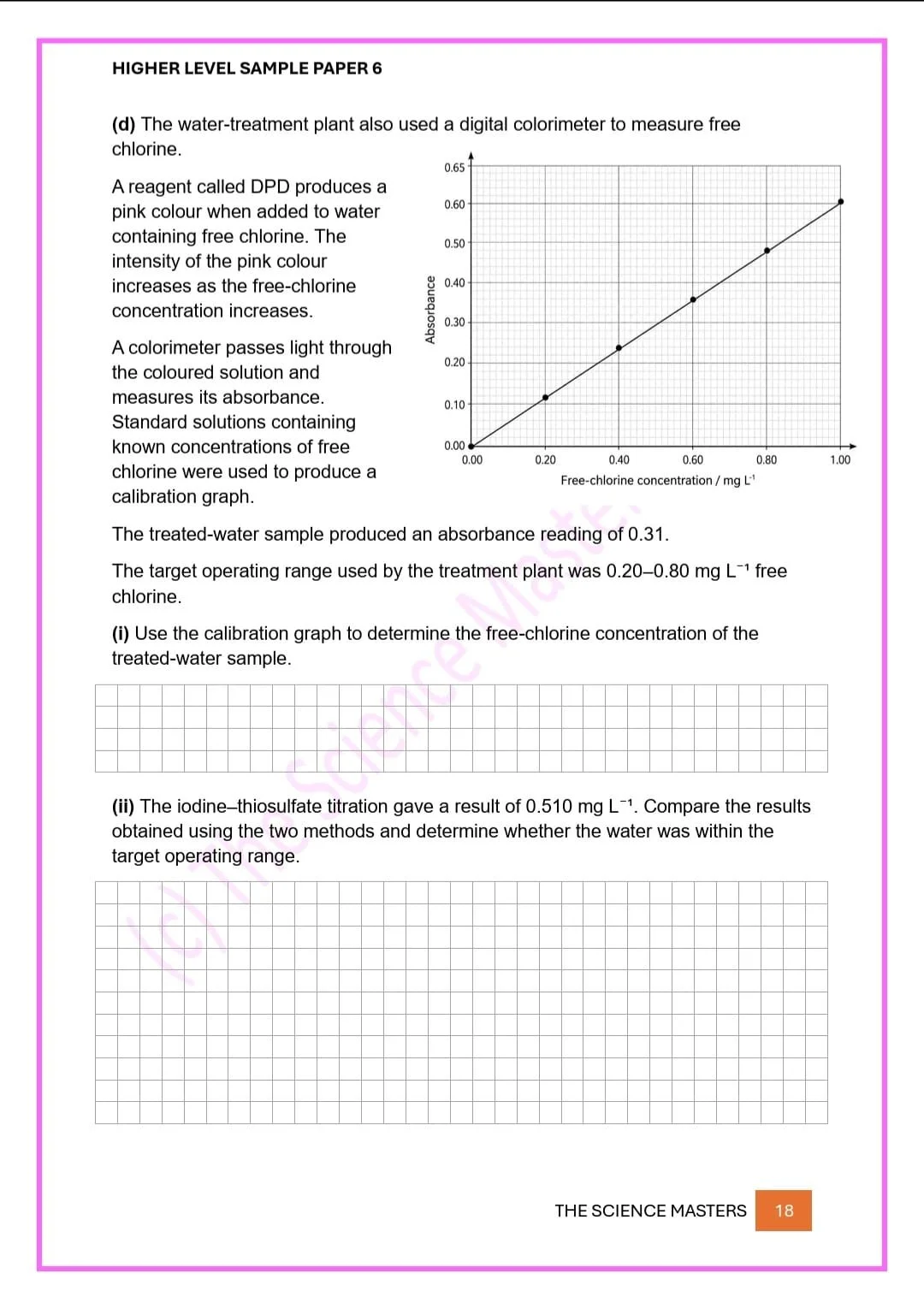
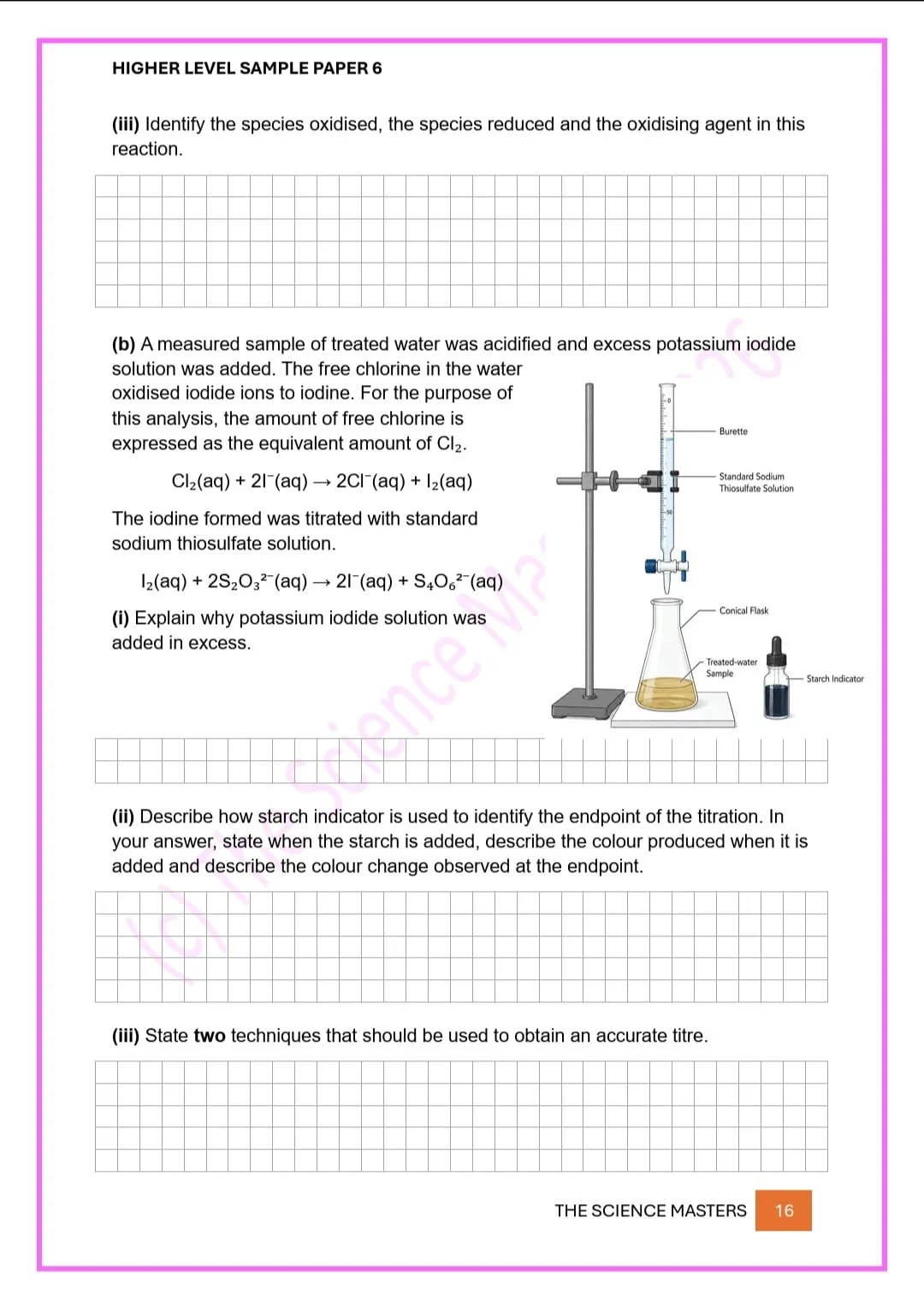
Prepare students for the new Higher Level Senior Cycle Chemistry examination with this original, full-length sample paper from The Science Masters.
This 300-mark examination provides a complete 2-hour 30-minute assessment experience. Students answer compulsory Question 1 and any five of the remaining six questions, following the structure presented in the State Examinations Commission sample material.
Sample Paper 6 combines essential chemical knowledge with experimental work, multi-stage calculations, interpretation of unfamiliar information and contemporary applications of chemistry. Its carefully varied questions assess whether students can apply their understanding—not merely reproduce learned definitions.
The paper includes:
Particle theory, periodic trends and molecular structure
Quantitative chemistry and molecular-formula calculations
Gravimetric analysis of sulfate ions
Limiting-reagent and percentage-yield calculations
Hess cycles, enthalpy changes and combustion calorimetry
Halogen reactivity and oxidation–reduction
Water chlorination and iodine–thiosulfate titration
Digital colorimetry and calibration graphs
Ammonia equilibrium, KbK_bKb, pH and titration curves
Free-radical substitution and organic reaction mechanisms
Laboratory preparation of ethene
Soap formation and the chemistry of cleaning
Homogeneous, heterogeneous and enzyme catalysis
Lithium-ion batteries, recycling and sustainable chemistry
Evaluation of scientific reports and experimental evidence
The paper contains chemical equations, apparatus diagrams, data tables, calibration graphs and extensive answer space. Students must select relevant information, show calculations clearly, explain chemical observations and evaluate evidence using appropriate scientific language.
Sample Paper 6 is particularly suitable for students who need practice connecting traditional chemical principles with the investigative, analytical and real-world contexts emphasised in the new specification. It can be used as a full mock examination, a classroom assessment, a revision paper or a source of individual questions for homework and examination preparation.
This resource has been independently developed by The Science Masters. It is not an official State Examinations Commission paper and is not affiliated with or endorsed by the SEC, NCCA or Department of Education.
Marking guidance and sample answers will be available separately.
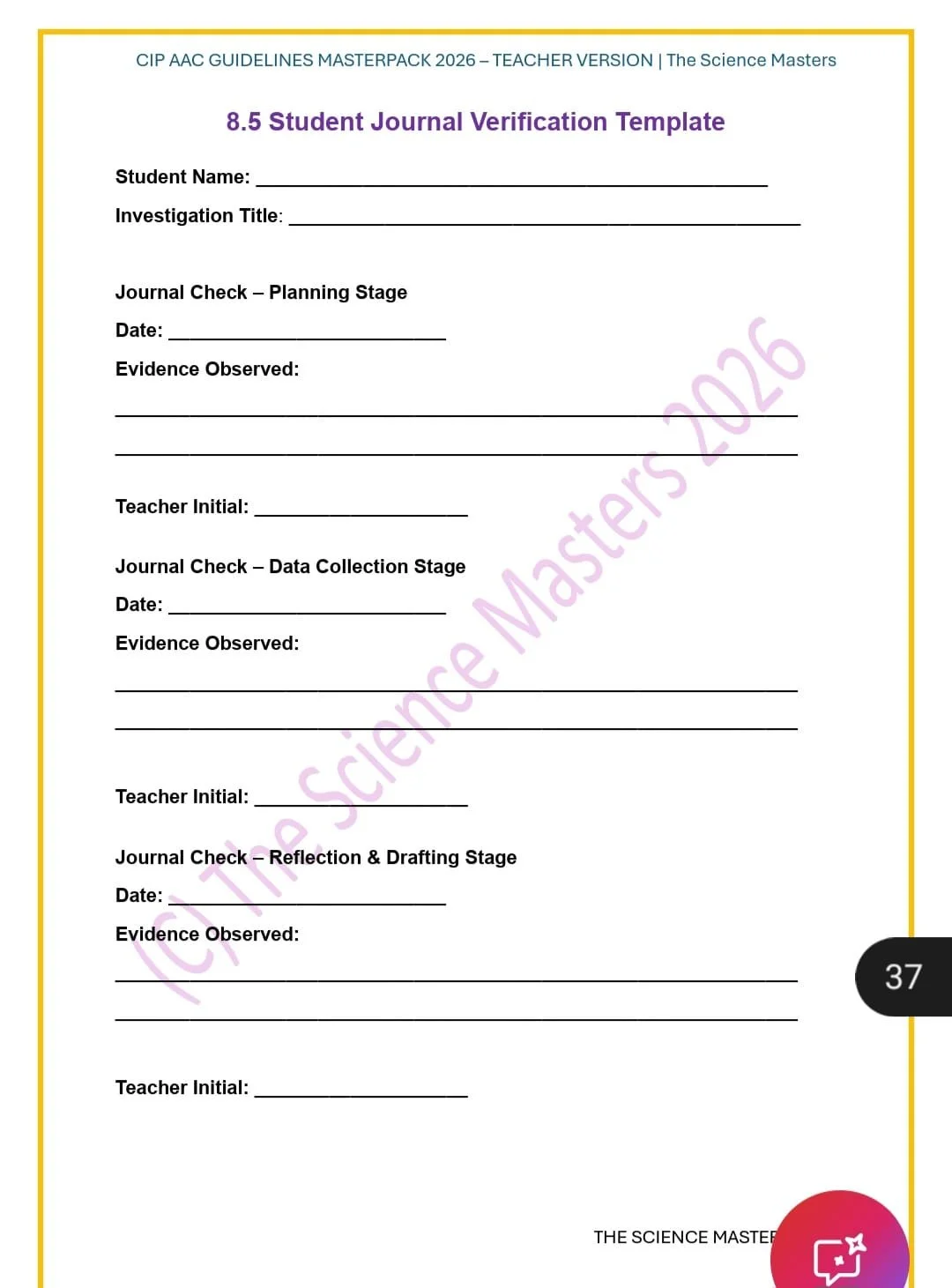
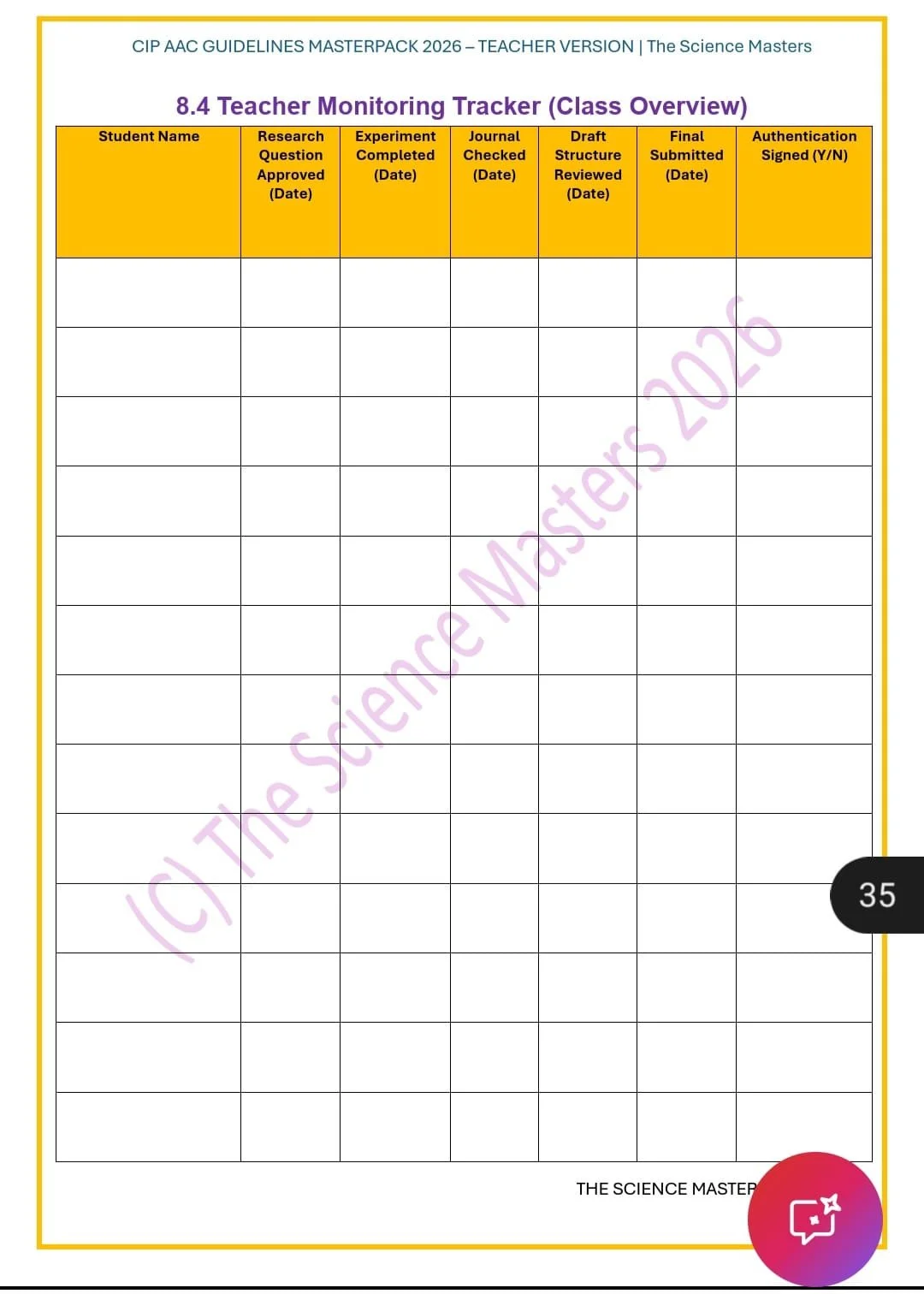
This independently developed Teacher Guidance & Compliance Masterpack is designed to support teachers in interpreting and implementing the publicly available Chemistry in Practice (CIP) brief.
The resource provides structured guidance to assist with:
Understanding the requirements of the 2027 brief
Supporting students in developing clear investigative structure
Reinforcing scientific standards in research, design, data analysis and evaluation
Maintaining appropriate supervision and authentication procedures
Promoting consistency and clarity in investigative practice
The pack includes structured section-by-section guidance, student self-monitoring tools, supervision templates, and clarification prompts aligned with the official brief.
This resource is intended to support professional practice and structured supervision. It does not replace official SEC documentation and does not provide corrective feedback guidance or draft-editing support. All assessment decisions remain subject to official marking schemes and regulations.
Designed by an experienced teacher, this pack aims to provide practical, balanced and compliance-focused support for schools overseeing the Chemistry in Practice investigation.
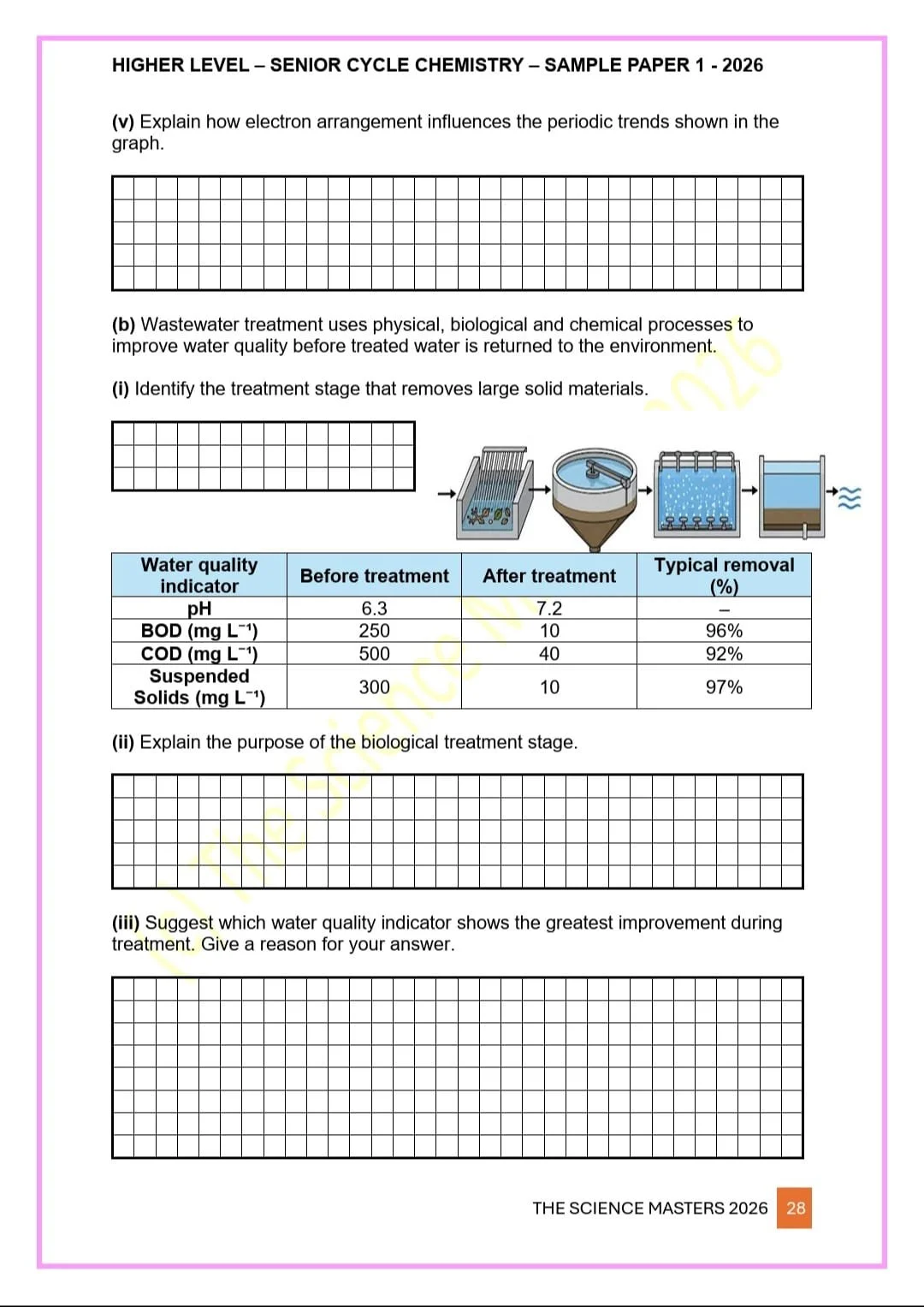
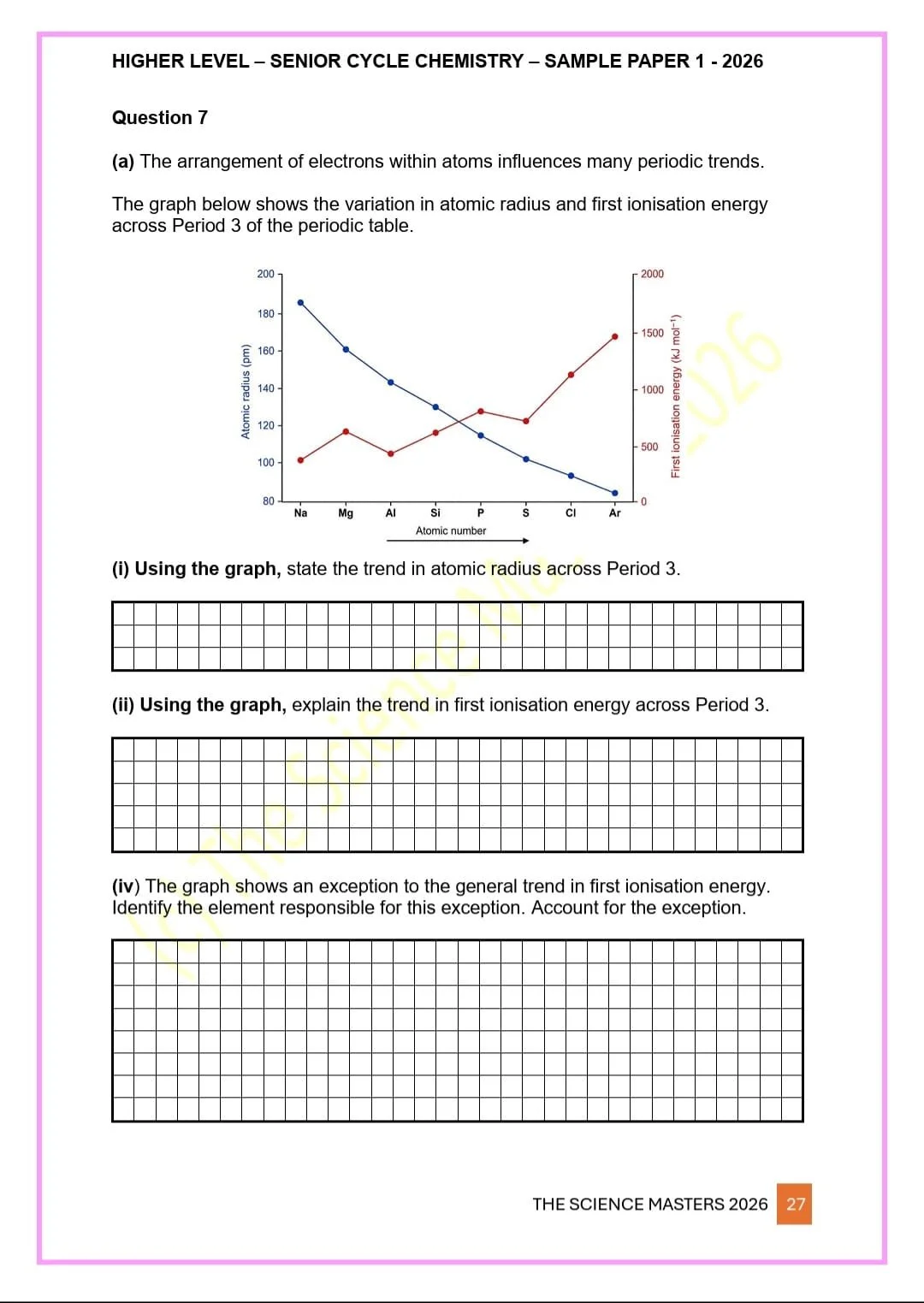
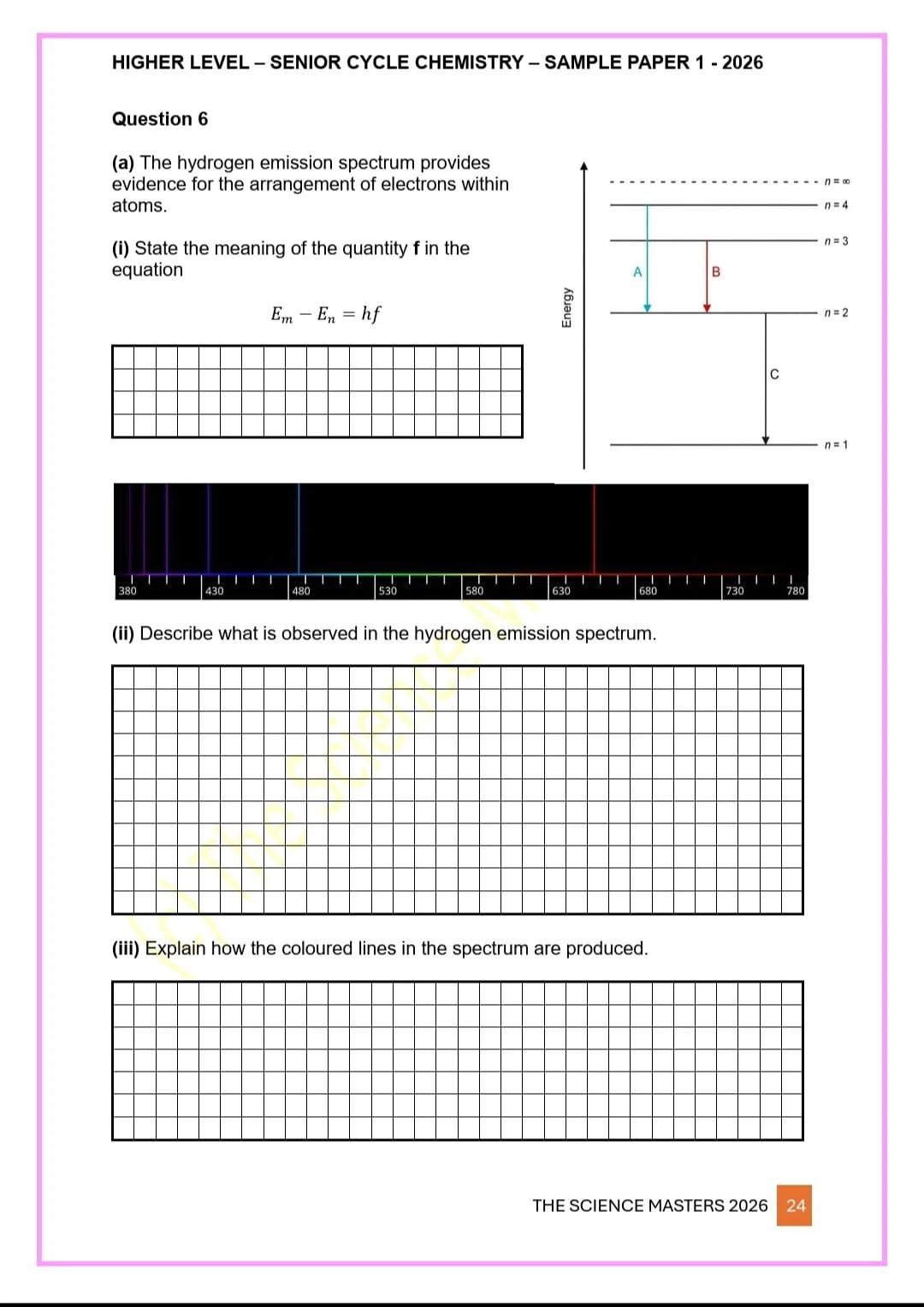
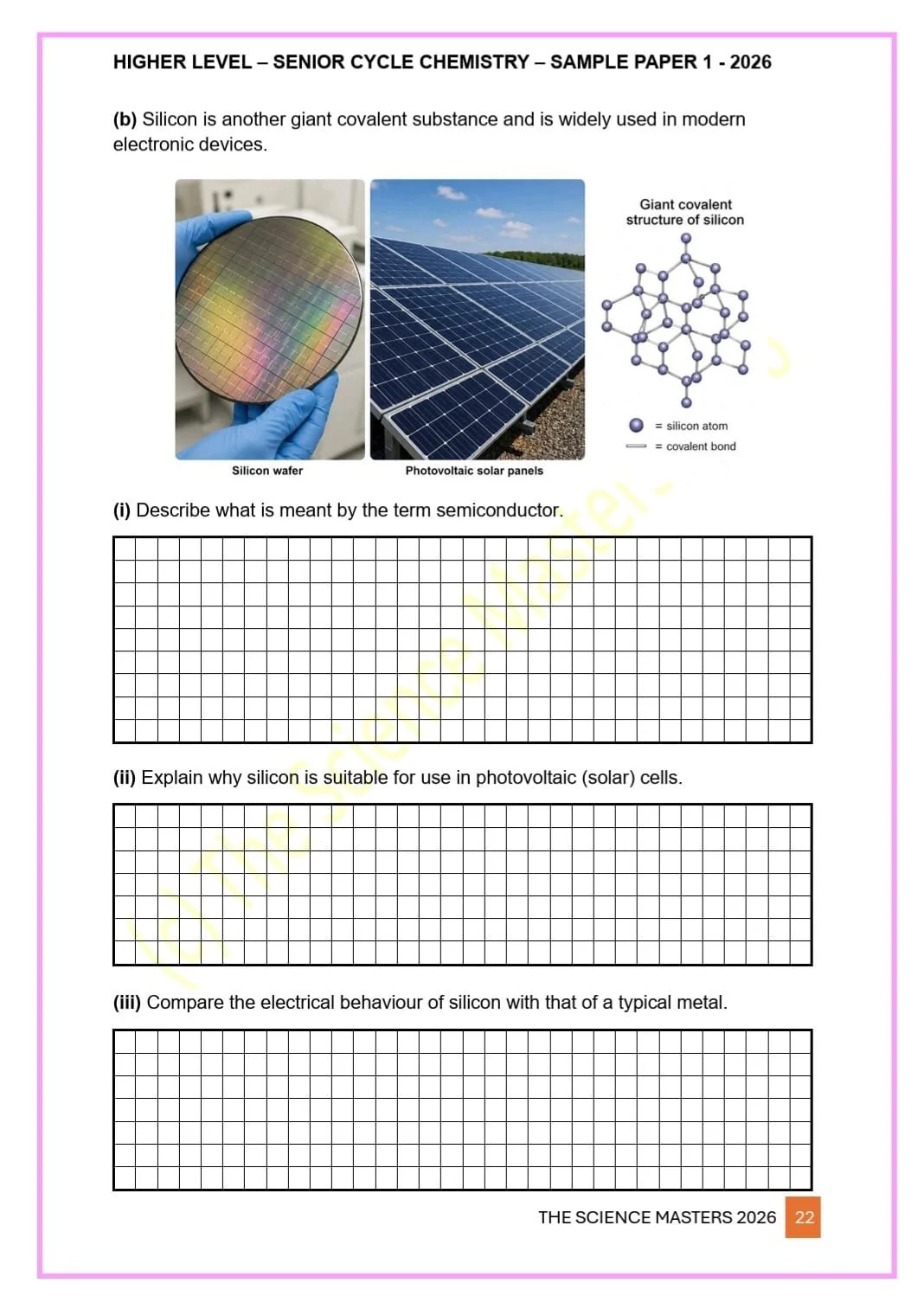
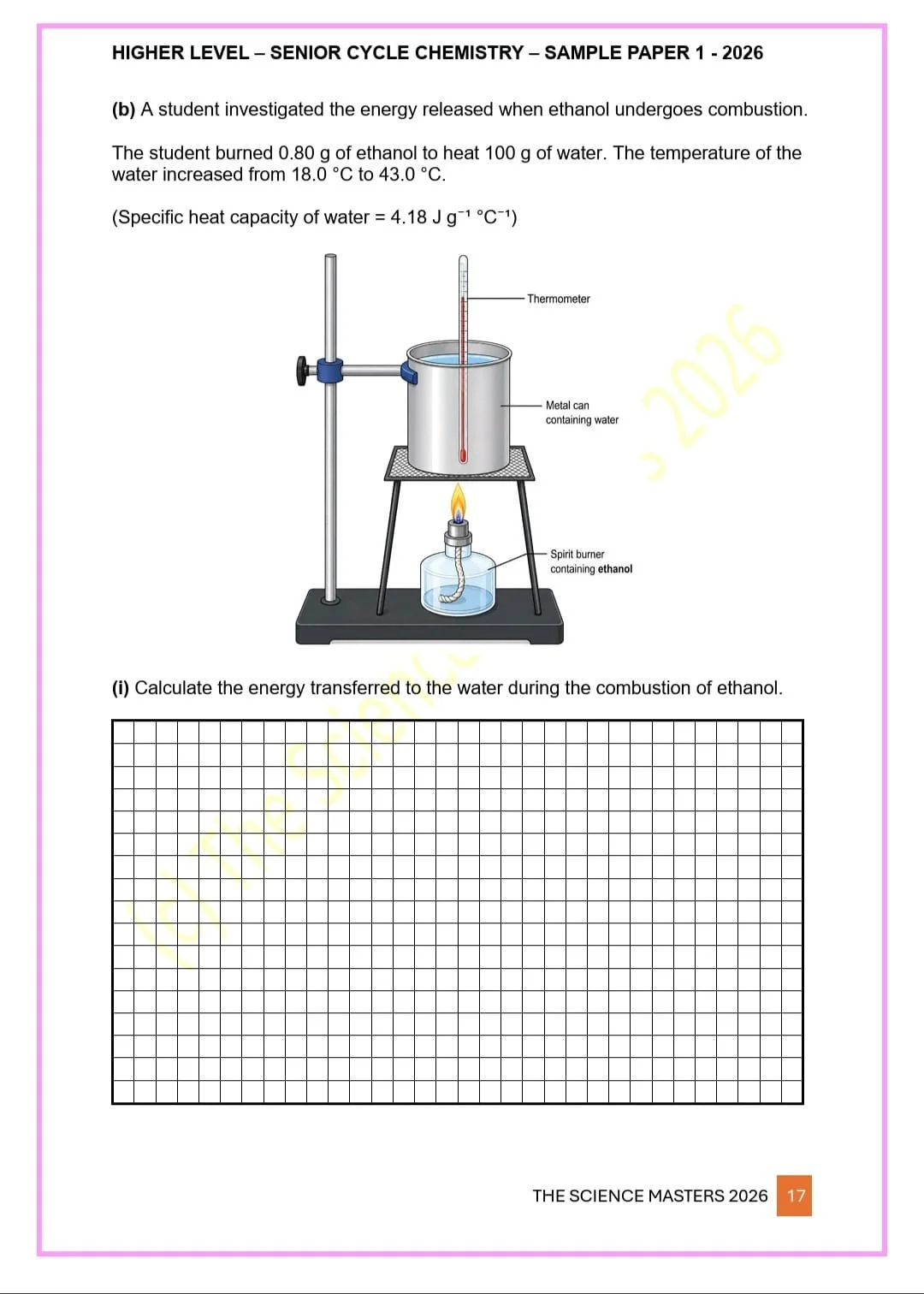
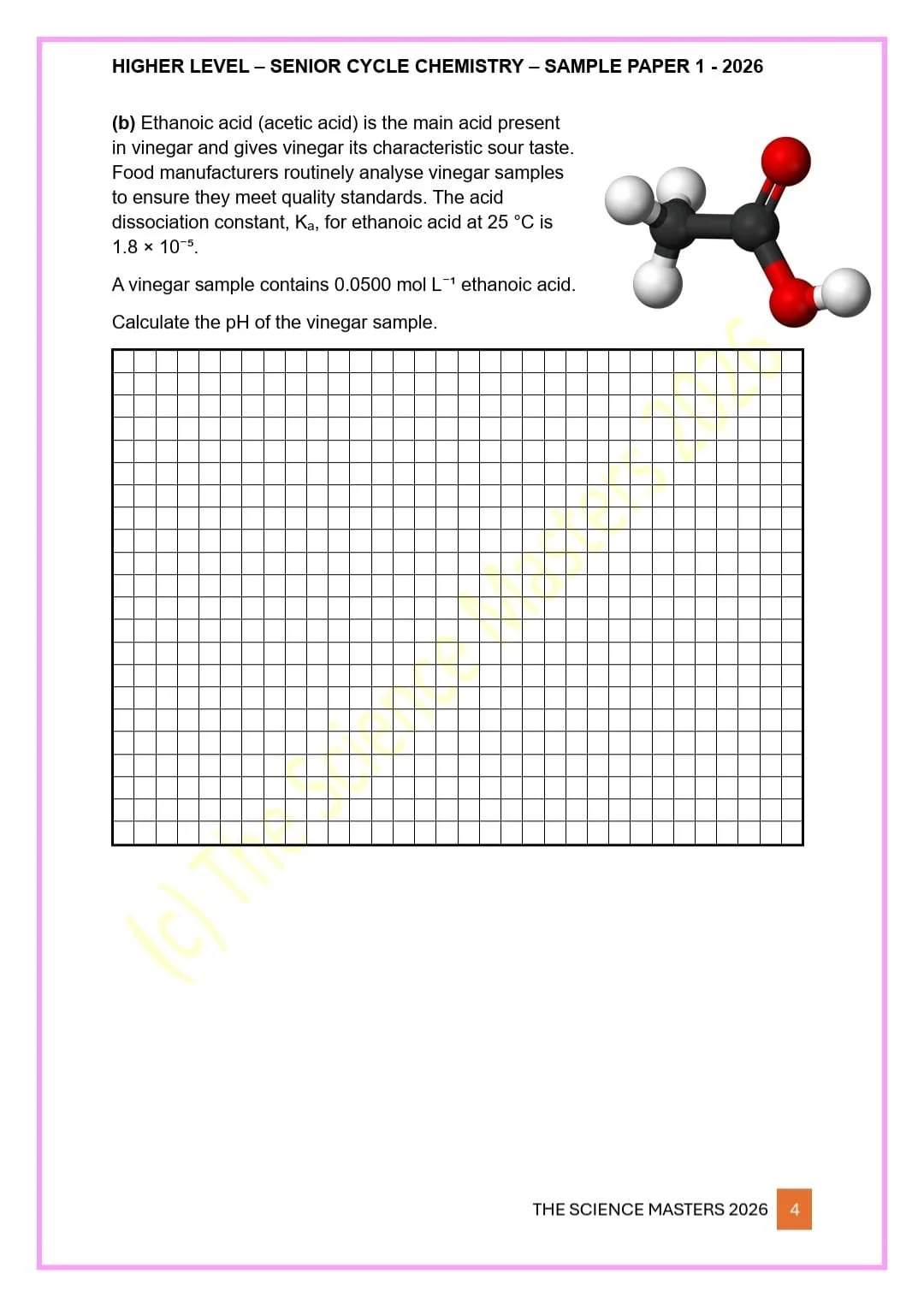
Prepare with confidence using a professionally written Higher Level Senior Cycle Chemistry Sample Paper designed to reflect the style, structure and assessment approach of the new 2027 Senior Cycle Chemistry specification.
This downloadable PDF has been carefully developed to mirror the language, layout and question style of the official sample papers while providing students with a fresh and challenging examination experience.
✔ Full Higher Level Chemistry Sample Paper (300 marks)
✔ Detailed sample marking guide
✔ Seven examination questions
✔ Practical investigations
✔ Calculations
✔ Organic chemistry
✔ Periodicity
✔ Bonding and structure
✔ Rates of reaction
✔ Electrochemistry
✔ Modern materials
✔ Environmental chemistry
✔ Atomic structure
✔ Sustainable chemistry contexts
Higher Level Senior Cycle Chemistry students
Classroom revision
Independent study
Mock examination preparation
Teacher revision resources
This resource has been written in the style of the new Senior Cycle Chemistry assessment and provides realistic examination practice across the full range of learning outcomes.
Digital PDF download.
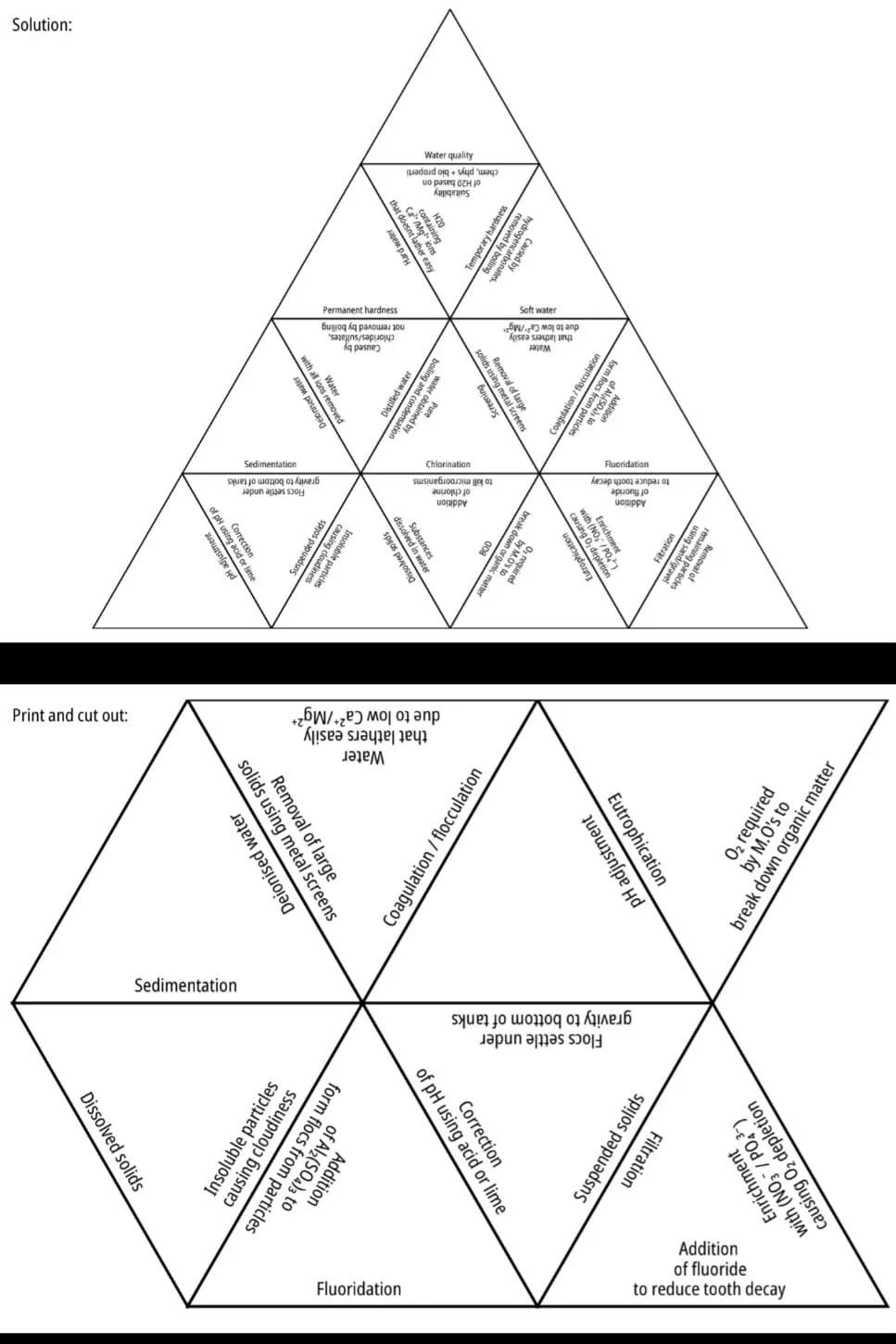
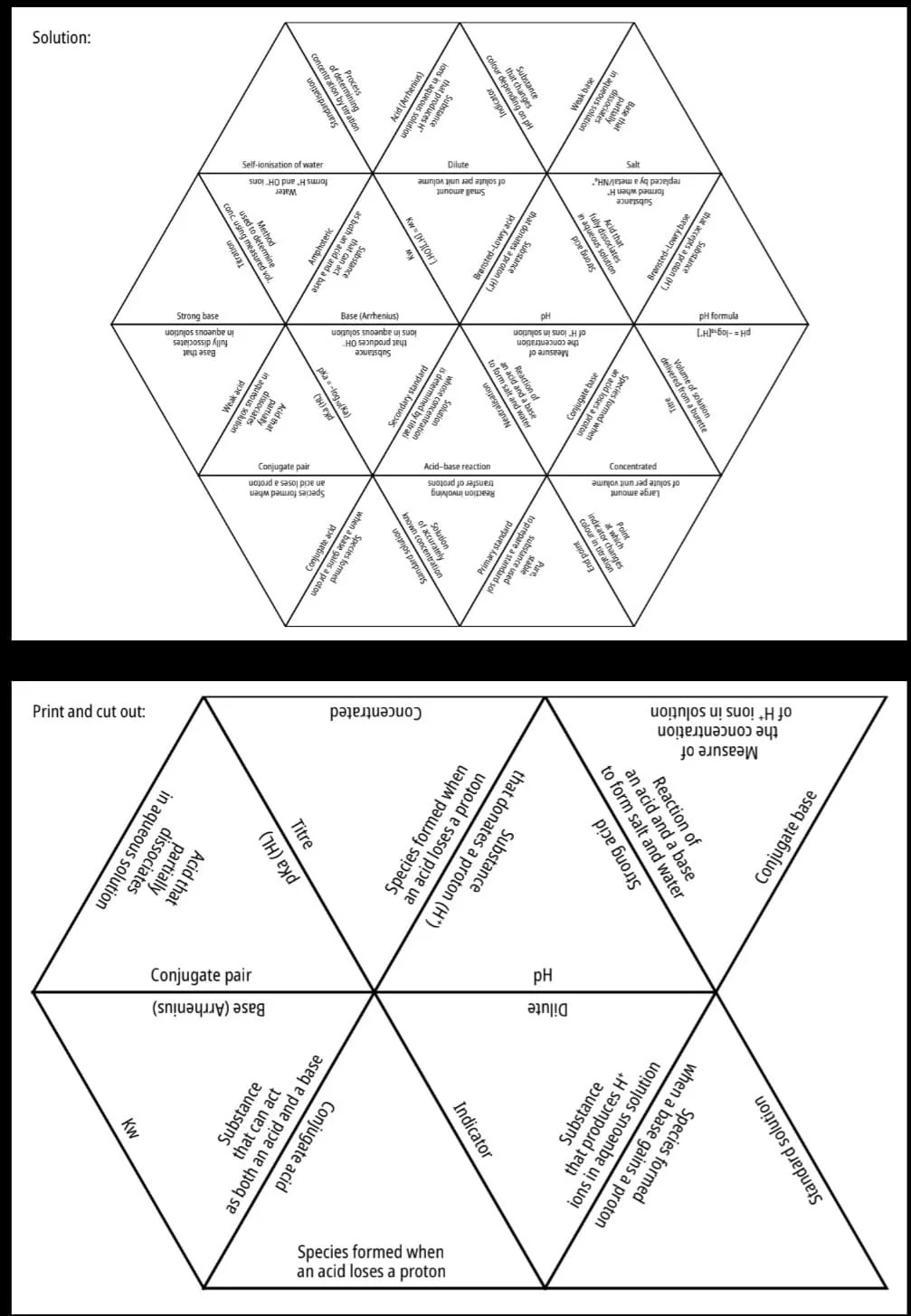
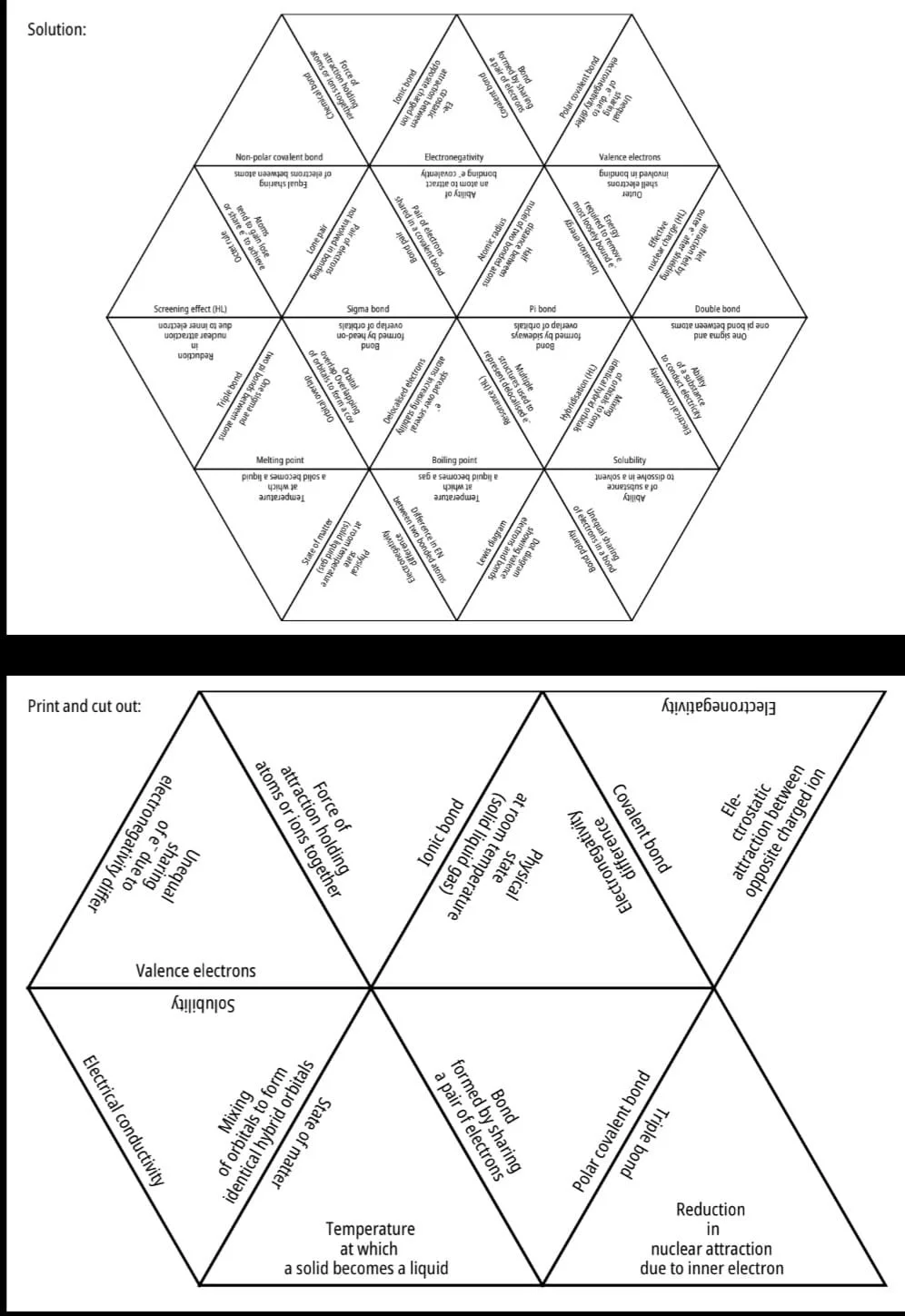
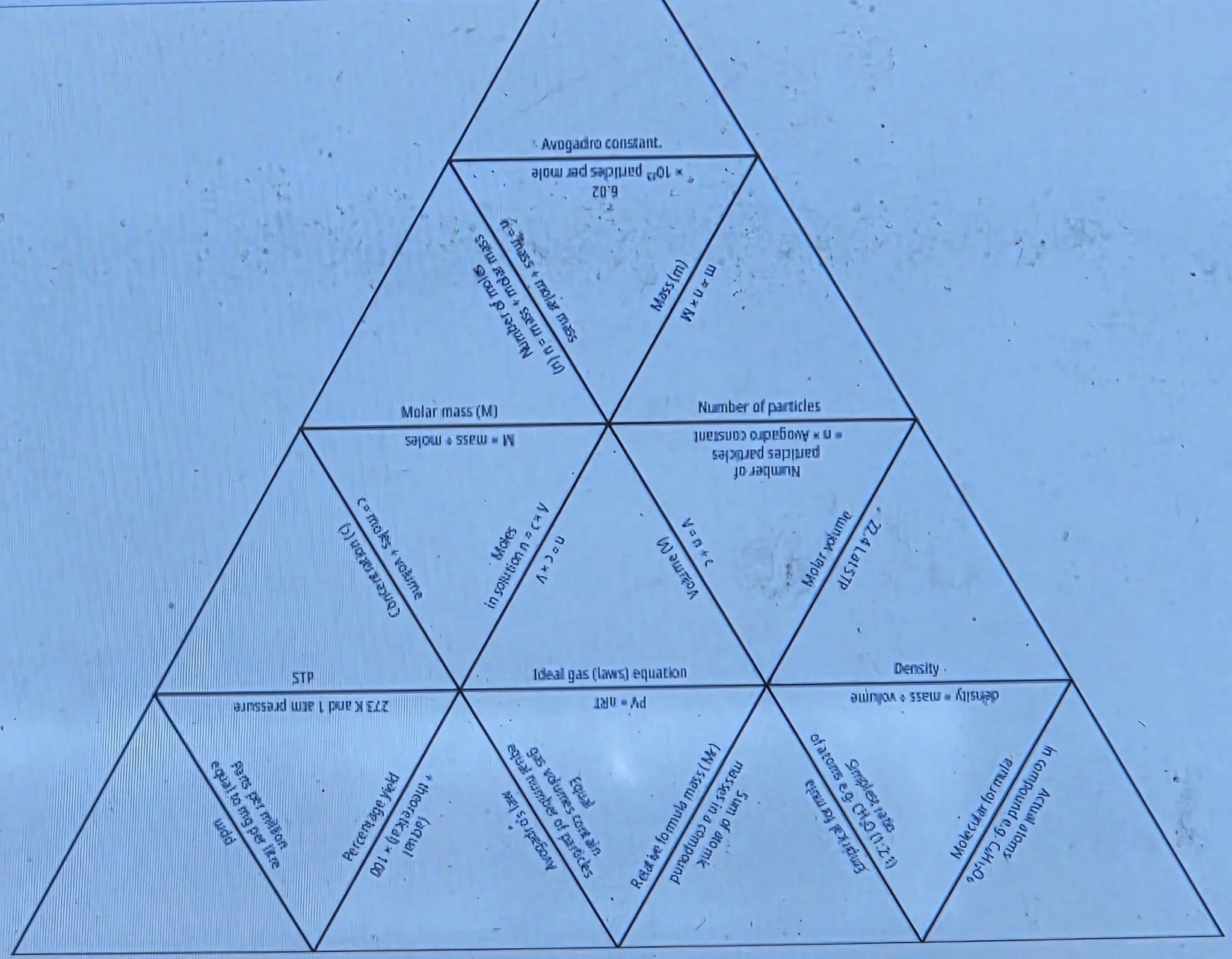
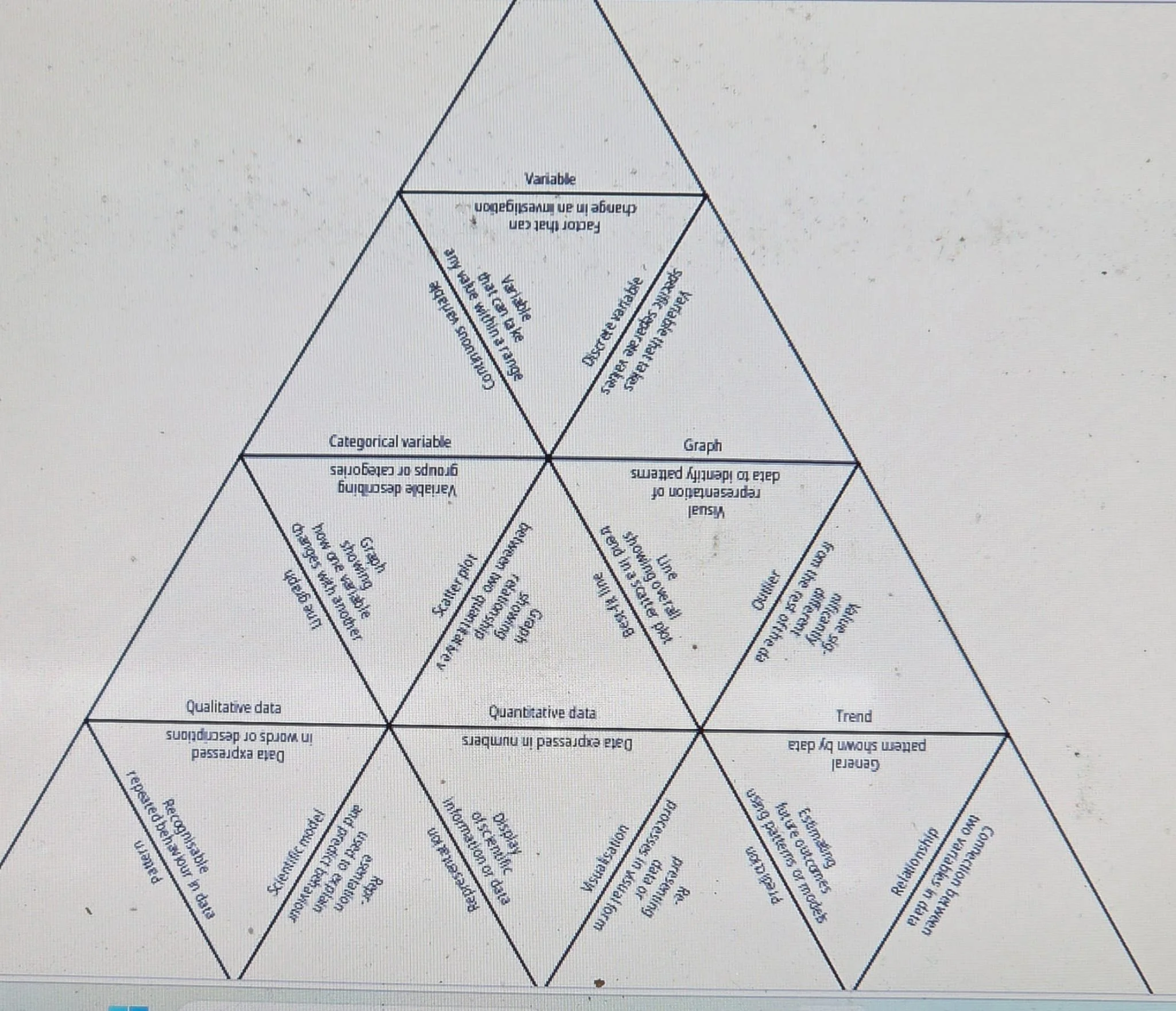
Complete Leaving Cert Chemistry Tarsia Bundle – All Strands Covered
This comprehensive Tarsia pack includes all strands of the Senior Cycle Chemistry course, designed to support active learning, exam preparation and long-term retention. Each activity is carefully structured using clear, exam-focused definitions and key concepts to help students build confidence across the full course.
What’s included:
Full set of Tarsia activities for all strands:
Unifying Strand
Strand 1: Nature of Matter
Strand 2: Behaviour of Matter
Strand 3: Interactions of Matter
Strand 4: Matter in Our World
Multiple Tarsia sets per strand, covering core topics and applications
Exam-aligned terminology and definitions throughout
Printable PDF format for classroom or independent use
Full solutions included
Topics covered:
Atomic structure, bonding and the periodic table
Chemical reactions, rates and equilibrium
Acid–base chemistry and electrochemistry
Organic chemistry and polymers
Volumetric analysis and laboratory techniques
Environmental chemistry and sustainability
Ideal for:
Leaving Cert Chemistry students (5th and 6th year)
Teachers seeking structured revision and active learning tools
Exam preparation, group work and independent study
Why use this resource:
Reinforces key concepts through active recall
Supports deeper understanding, not just memorisation
Covers the full course in a structured and consistent way
Designed using clear, exam-standard language
Instant digital download – ready to print and use
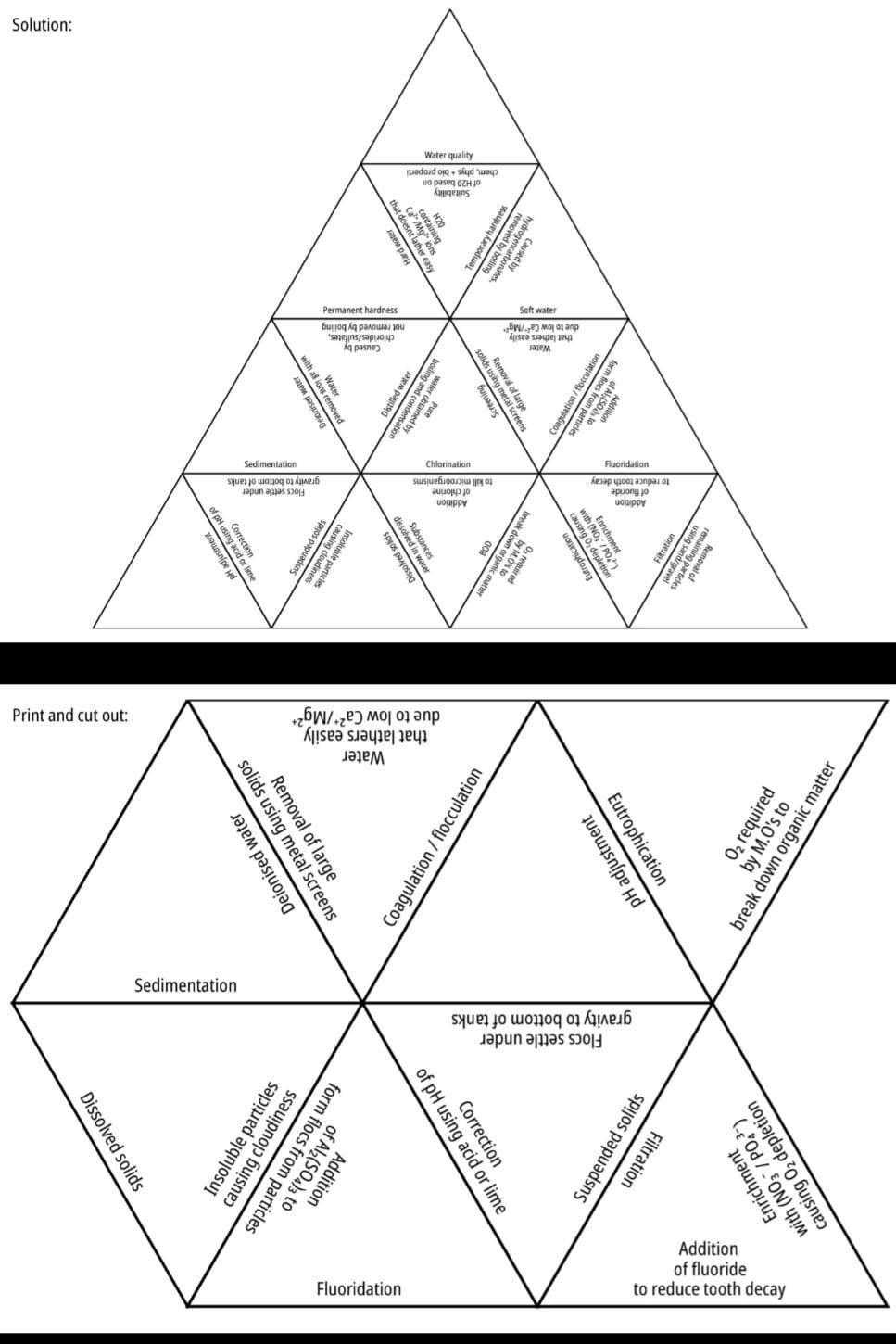
Complete Strand 4 Revision – Organic Chemistry and Real-World Applications
This Strand 4 Tarsia pack is designed to support students in mastering the most applied and exam-relevant areas of Senior Cycle Chemistry. It focuses on organic chemistry, volumetric analysis, environmental chemistry and modern materials, helping students connect core concepts to real-world contexts.
What’s included:
5 structured Tarsia activities covering Strand 4 topics
Exam-focused definitions using clear and consistent language
Coverage of both core concepts and applied chemistry
Full solutions included for each activity
Printable PDF format for classroom or independent study
Topics covered:
Volumetric analysis (titration, standard solutions, laboratory equipment)
Organic chemistry and polymers (functional groups, reactions, polymerisation)
Water treatment and water quality
Atmospheric chemistry and pollution (greenhouse effect, ozone, acid rain)
Materials and sustainability (allotropes, batteries, recycling, life cycle assessment)
Ideal for:
Senior Cycle Chemistry students (5th and 6th year)
Teachers looking for structured revision and active learning resources
Exam preparation, group work and concept reinforcement
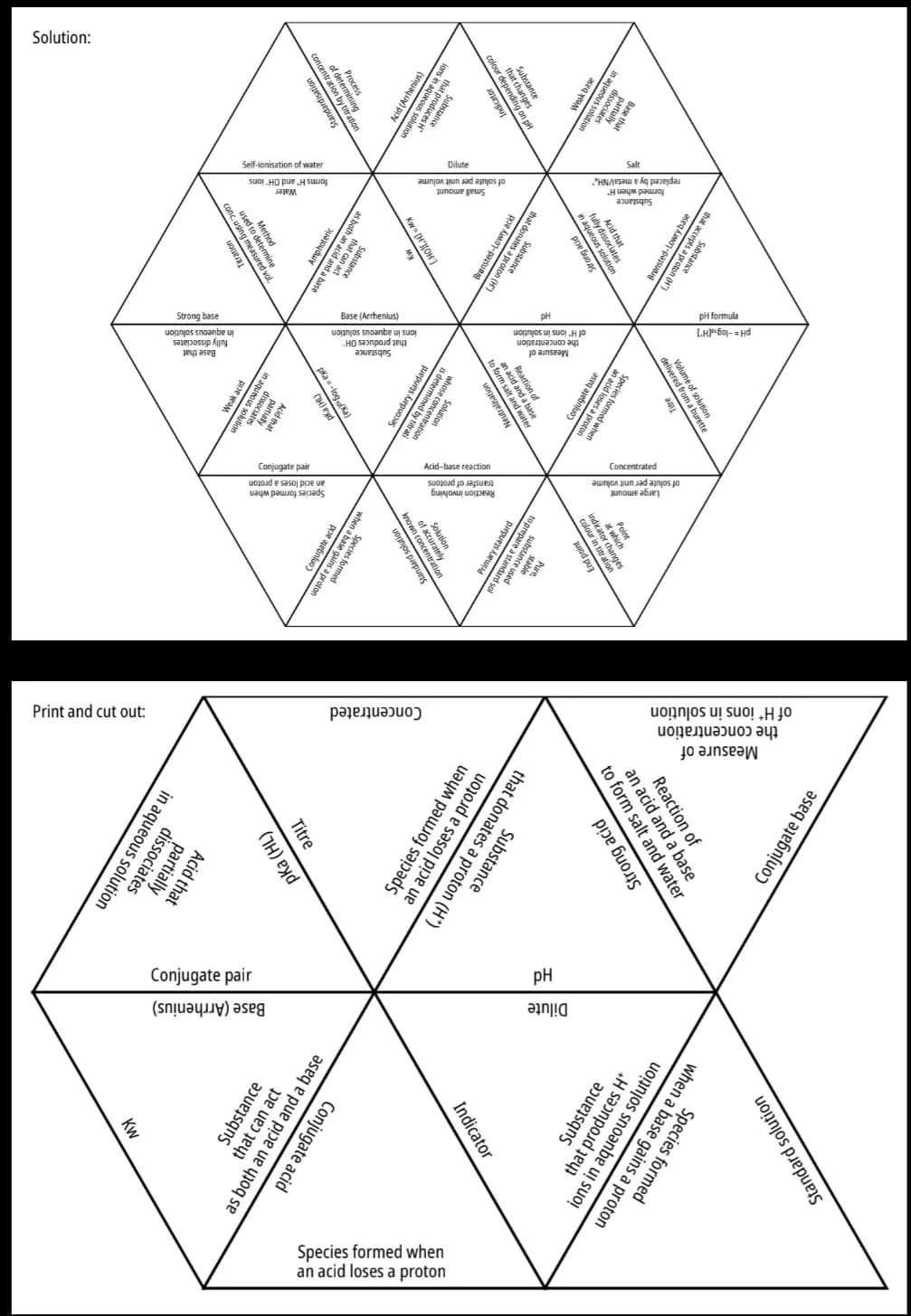
Complete Strand 3 Revision – Active Learning for Senior Cycle Chemistry
This Strand 3 Tarsia pack is designed to support students in mastering key concepts through structured, exam-focused revision. Covering Thermochemistry, Rates of Reaction, Chemical Equilibrium, Acid–Base Systems and Electrochemistry, this resource promotes active recall, collaboration and deeper understanding.
What’s included:
5 structured Tarsia activities covering all Strand 3 topics
Exam-aligned definitions and key concepts
A dedicated miscellaneous Tarsia focusing on applications and common exam questions
Full solutions for each Tarsia
Printable PDF format for classroom or home use
Topics covered:
Thermochemistry (enthalpy, exothermic/endothermic reactions, Hess’s law)
Rates of reaction (collision theory, activation energy, catalysts)
Chemical equilibrium (dynamic equilibrium, Le Châtelier’s principle, Kc)
Acid–base systems (pH, strong vs weak acids, titrations)
Electrochemistry (redox reactions, oxidation/reduction, electrochemical cells)
Ideal for:
Senior Cycle Chemistry students (5th and 6th year)
Teachers looking for structured revision activities
Active learning, group work and exam preparation
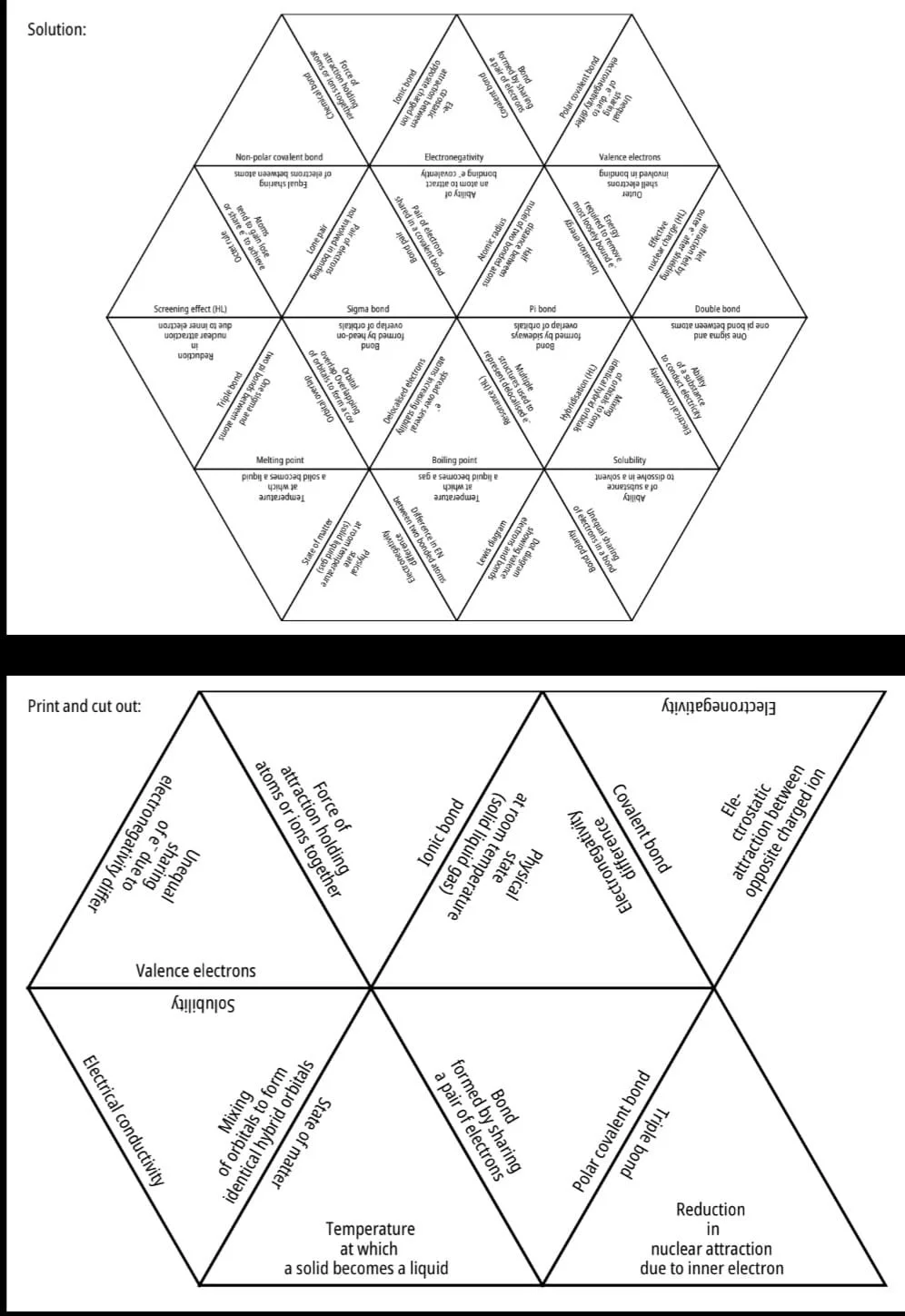
Senior Cycle Chemistry Tarsia Pack – Strand 2: Behaviour of Matter
Complete, exam-focused revision for one of the most important strands in Senior Cycle Chemistry.
This resource provides a structured set of Tarsia activities covering all key learning outcomes in Strand 2, helping students build understanding across bonding, intermolecular forces, gas behaviour and hydrocarbons.
What’s Included:
Chemical Bonding (2.1) – full coverage including HL concepts
Intermolecular Forces & Molecular Shapes (2.2)
Behaviour of Gases (2.3) including ideal gas equation
Hydrocarbons (2.4) split into structured revision sets
Additional miscellaneous Tarsia for linking key concepts
Printable, ready-to-use PDF format
Key Learning Focus:
Ionic and covalent bonding, electronegativity and polarity
Sigma and pi bonding, delocalisation and resonance
Intermolecular forces and their effect on physical properties
Molecular shapes and bond angles (VSEPR theory)
Gas laws, PV = nRT and key units
Hydrocarbon structure, reactions and classification
Why This Resource Works:
Reinforces exam-style definitions and terminology
Builds conceptual understanding and exam technique
Encourages active learning and student engagement
Saves teachers significant preparation time
Perfect For:
Senior Cycle Chemistry students (Higher Level)
Teachers looking for structured revision tools
Classroom use, homework or independent study
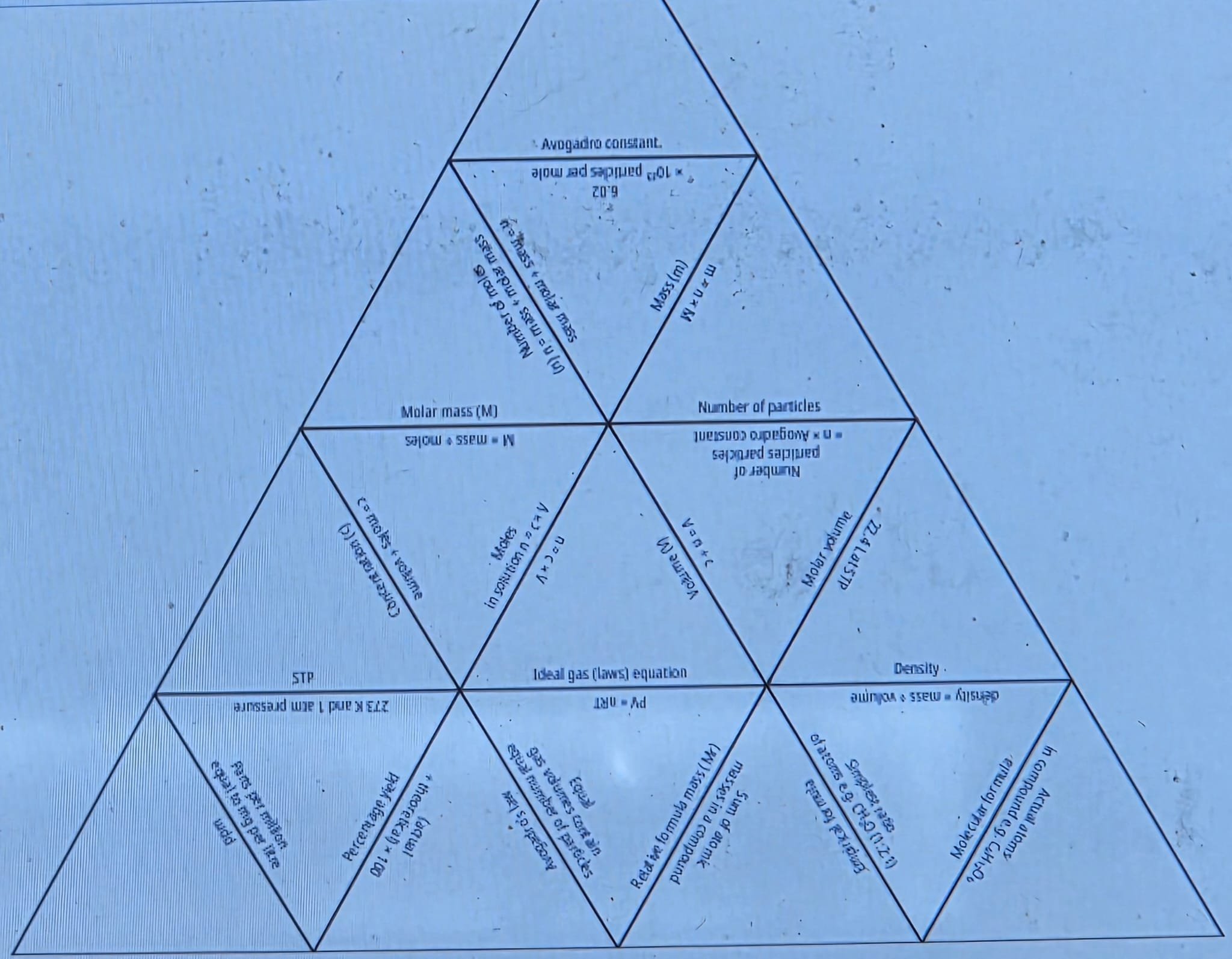
Senior Cycle Chemistry Tarsia Pack – Strand 1: Nature of Matter
Complete coverage of one of the most important strands in Senior Cycle Chemistry.
This pack provides targeted, curriculum-focused Tarsia activities covering all key topics in Strand 1, helping students build strong conceptual understanding, scientific literacy, and calculation skills through active learning and revision.
• Matter (1.1) — states, particle theory, and changes of state
• Atomic Structure (1.2) — subatomic particles, spectra, orbitals, and electronic structure
• Periodic Table (1.3) — trends, groups, patterns, and chemical properties
• Mole Concept Theory (1.4)
• Mole Calculations Tarsia activities (numerical focus)
• Mixed revision and consolidation set
• Atomic theory and electronic structure
• Periodic trends and chemical properties
• Mole calculations and Avogadro’s constant
• Empirical and molecular formulas
• Units, equations, and Chemistry problem-solving skills
• Combines theory and calculations in an engaging format
• Reinforces scientific terminology, formulas, and key concepts
• Promotes active learning through problem-solving activities
• Ideal for revision, consolidation, and classroom engagement
• Supports confidence with Chemistry numeracy and application skills
• Senior Cycle Chemistry Higher Level students
• Teachers building structured revision lessons
• Students needing additional practice with Chemistry calculations
• Classroom revision, homework, and independent study
Science Masters
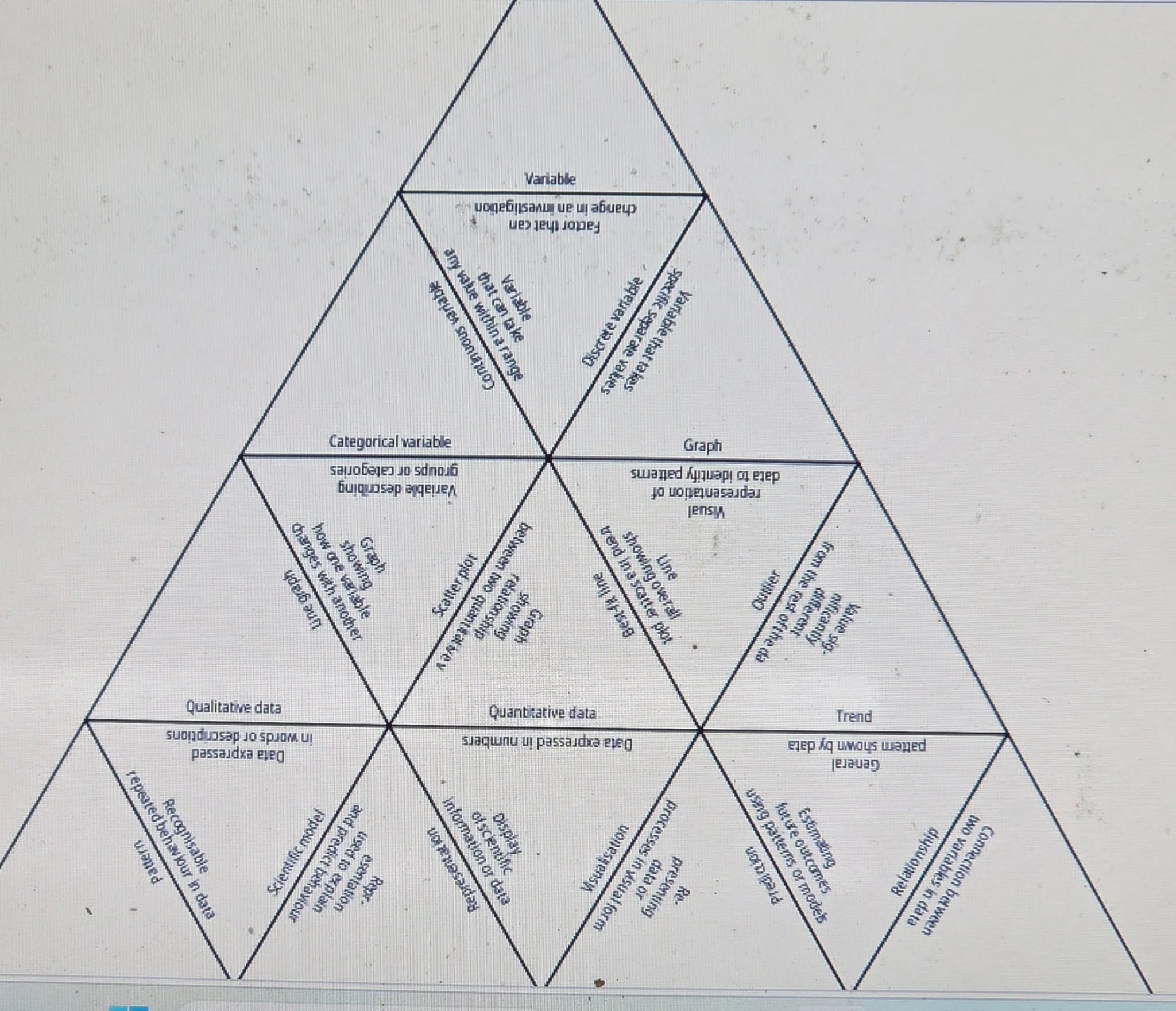
Senior Cycle Chemistry Tarsia Pack – Unifying Strand (U1–U4)
Build essential scientific skills with structured, exam-focused Tarsia activities.
This comprehensive resource targets the Unifying Strand of the Senior Cycle Chemistry specification, helping students master the core skills that underpin all exam questions.
What’s Included:
Scientific Investigations (U1 focus)
Scientific Thinking & Society (U2/U3 focus)
Data & Graphs (U4 focus)
Additional Miscellaneous Tarsia for full coverage
Printable and editable formats
Ready-to-use classroom resources
Key Learning Focus:
Scientific method and hypothesis formation
Data analysis, patterns, and anomalies
Graph interpretation and trends
Validity, reliability, and accuracy
Communication of scientific findings
Why This Resource Works:
Designed for active learning and engagement
Reinforces exam terminology and definitions
Ideal for revision, group work, and retrieval practice
Covers high-frequency exam concepts
Perfect For:
Senior Cycle Chemistry students
Teachers looking for structured revision tools
Classroom or independent study
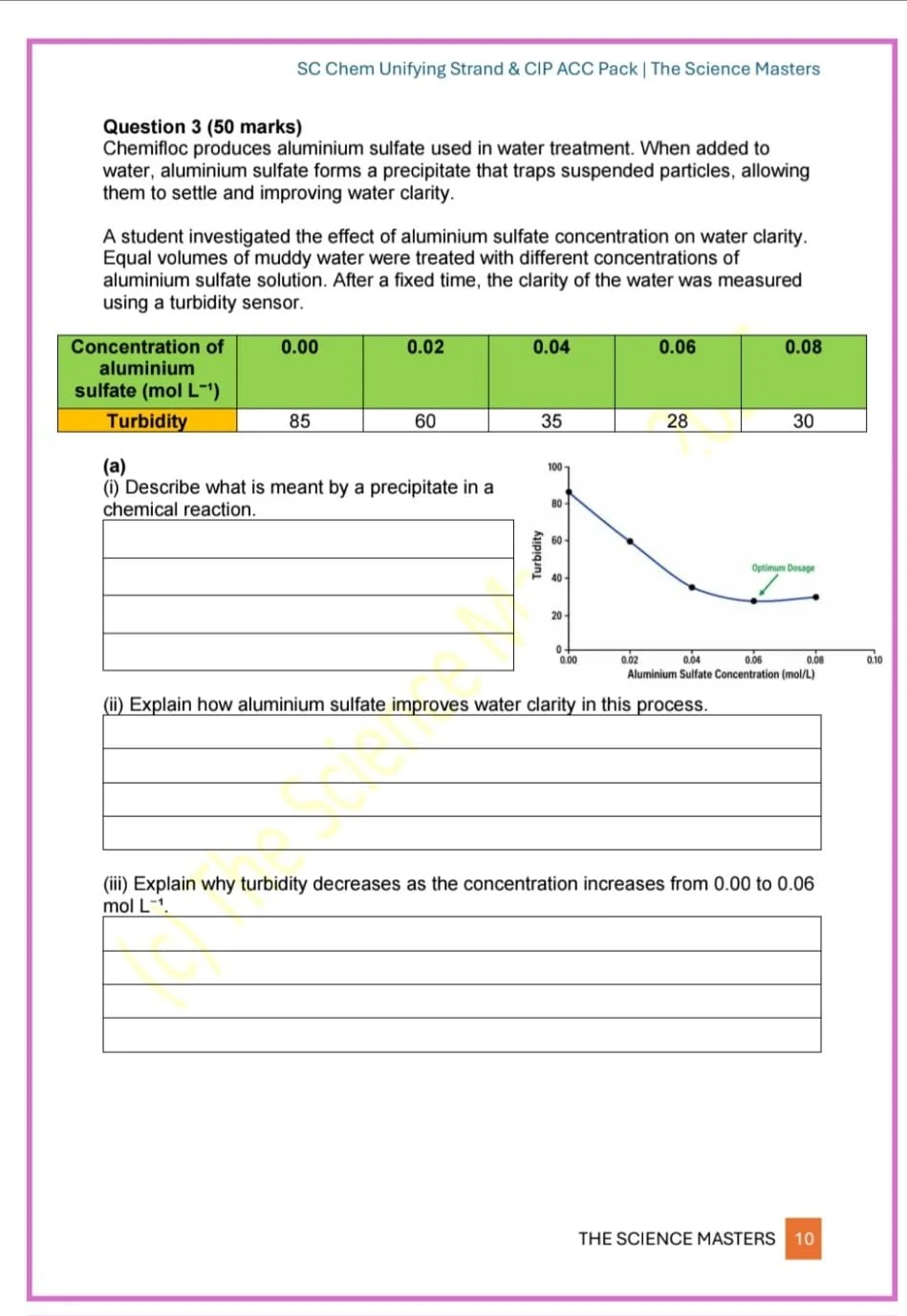
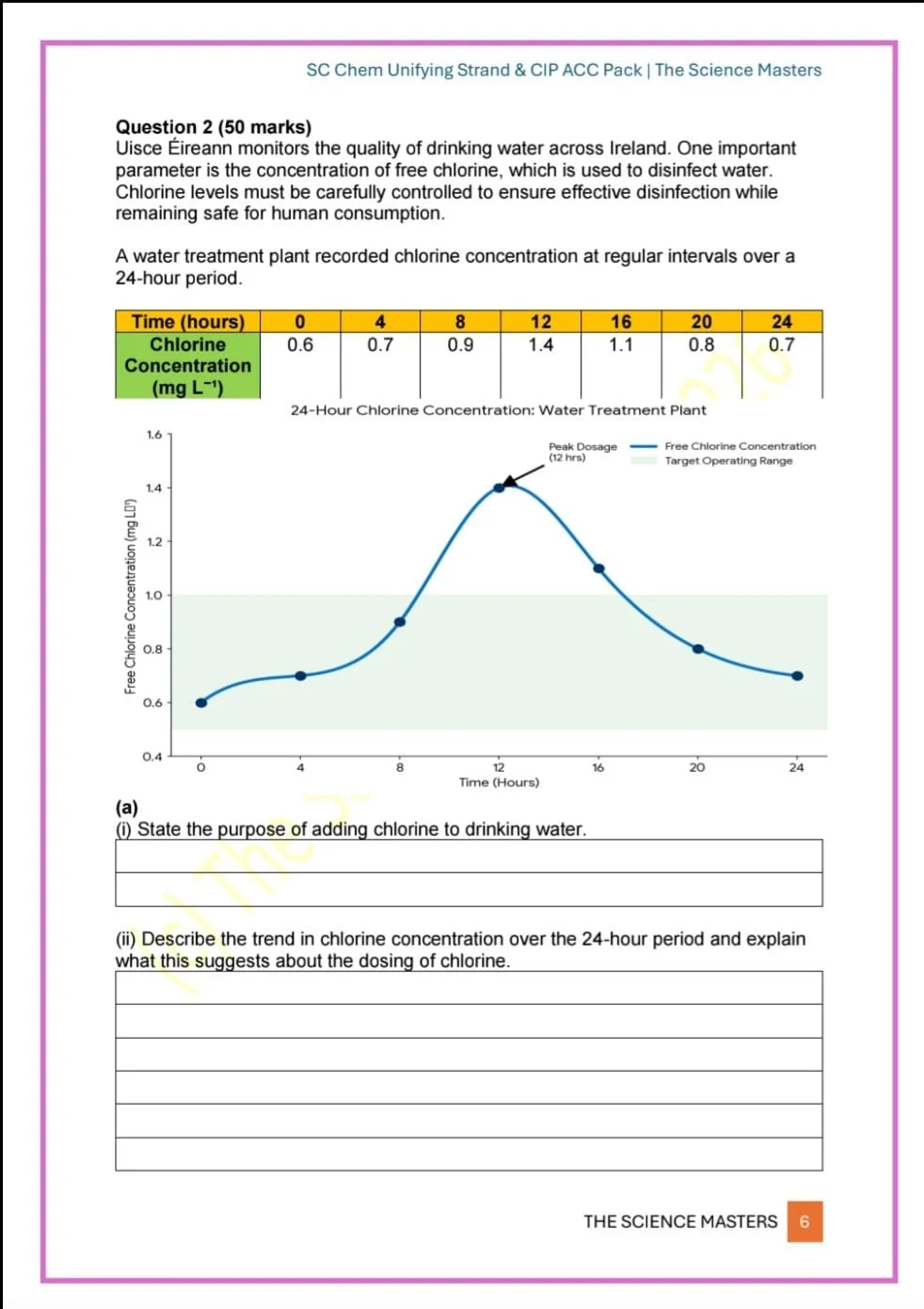
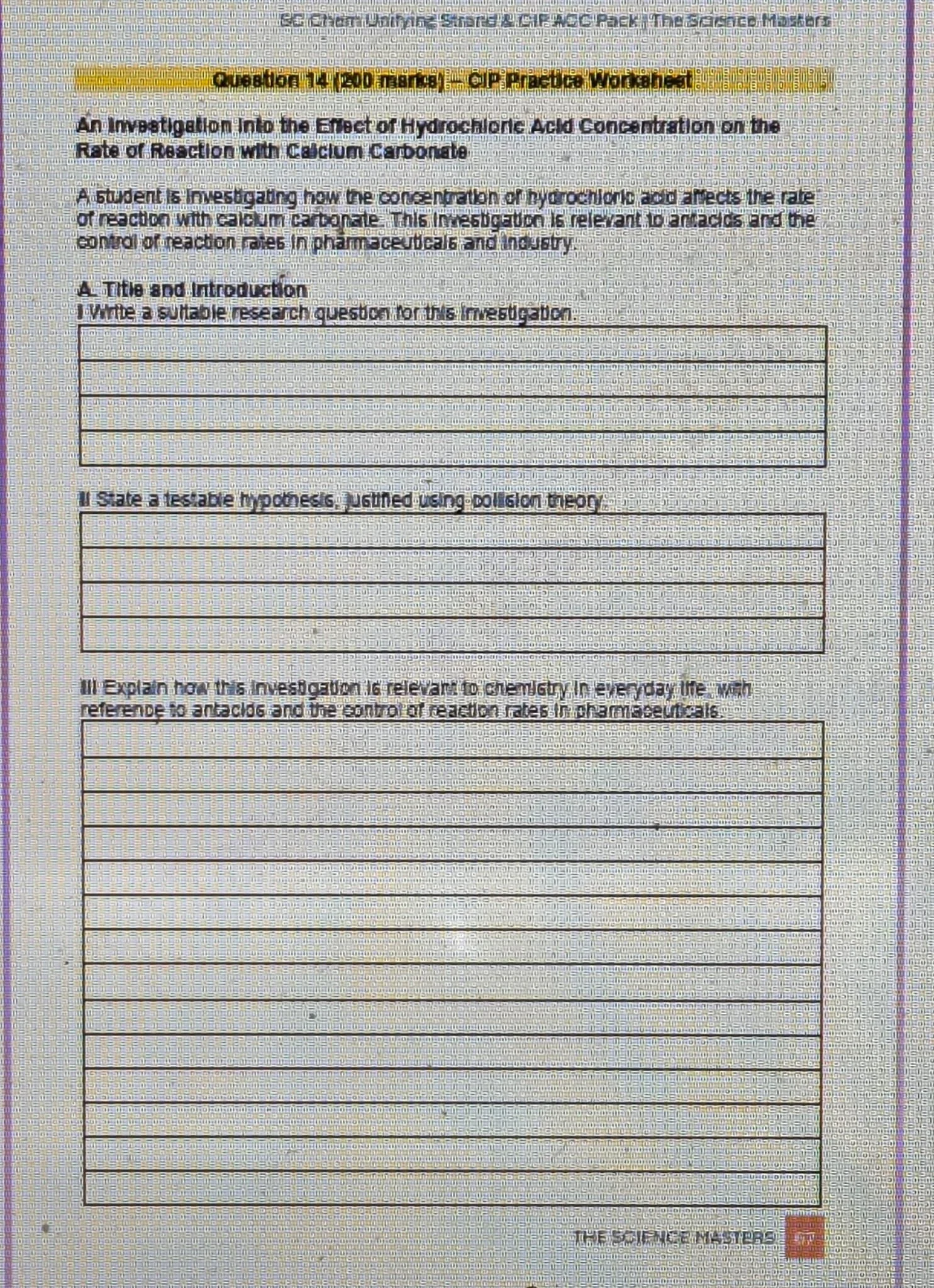
Senior Cycle Chemistry Unifying Strand & CIP Exam Practice Pack
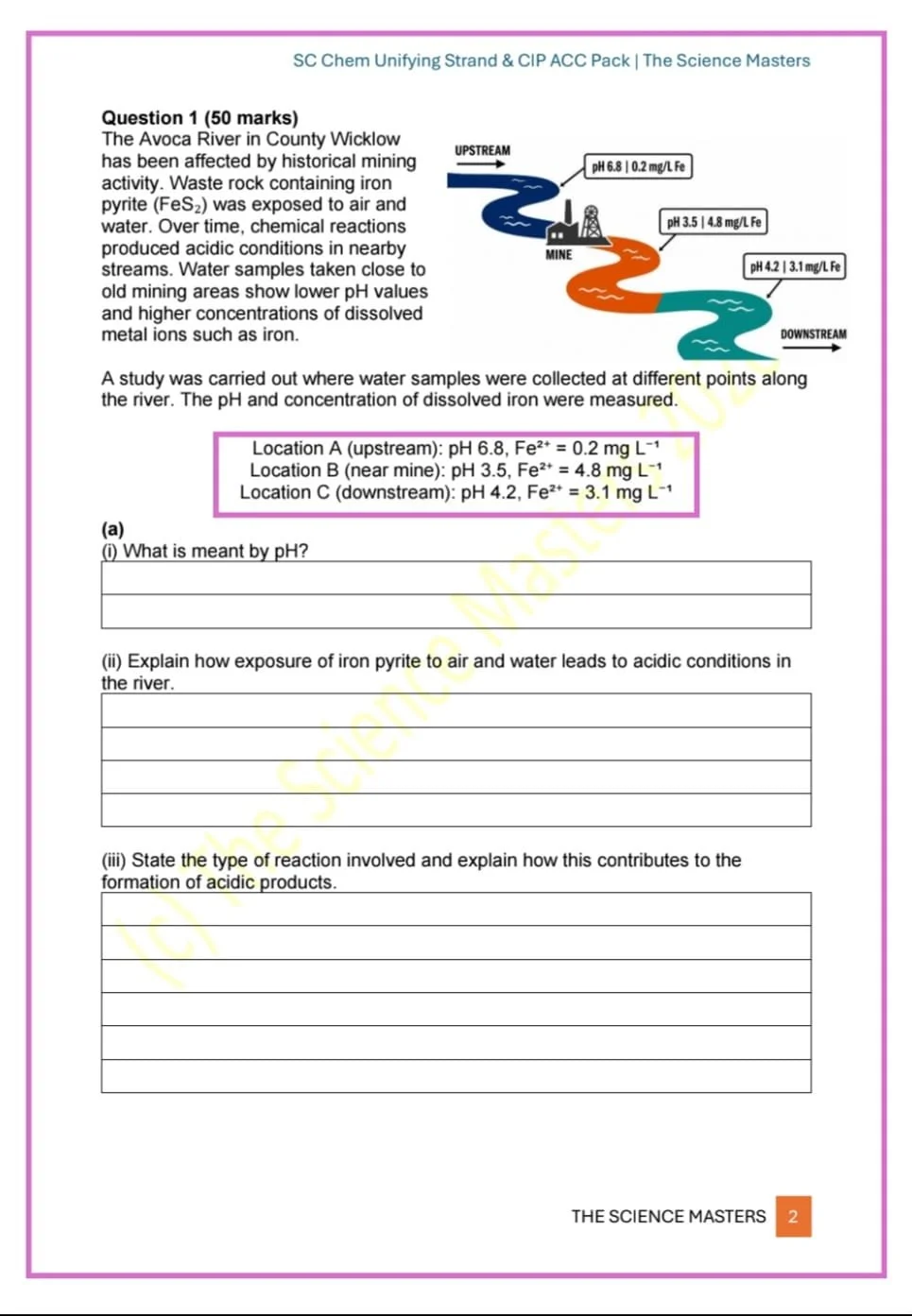
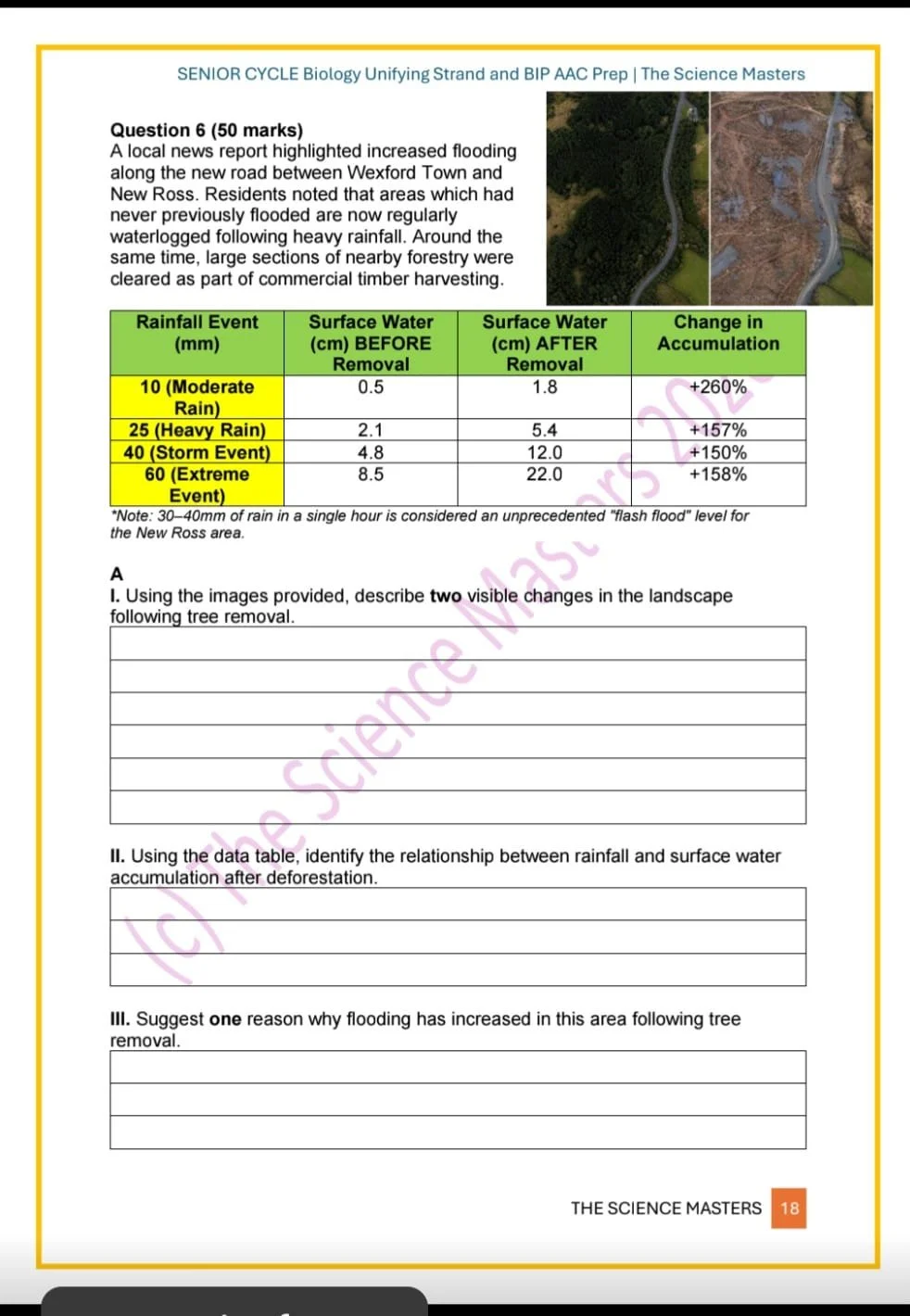
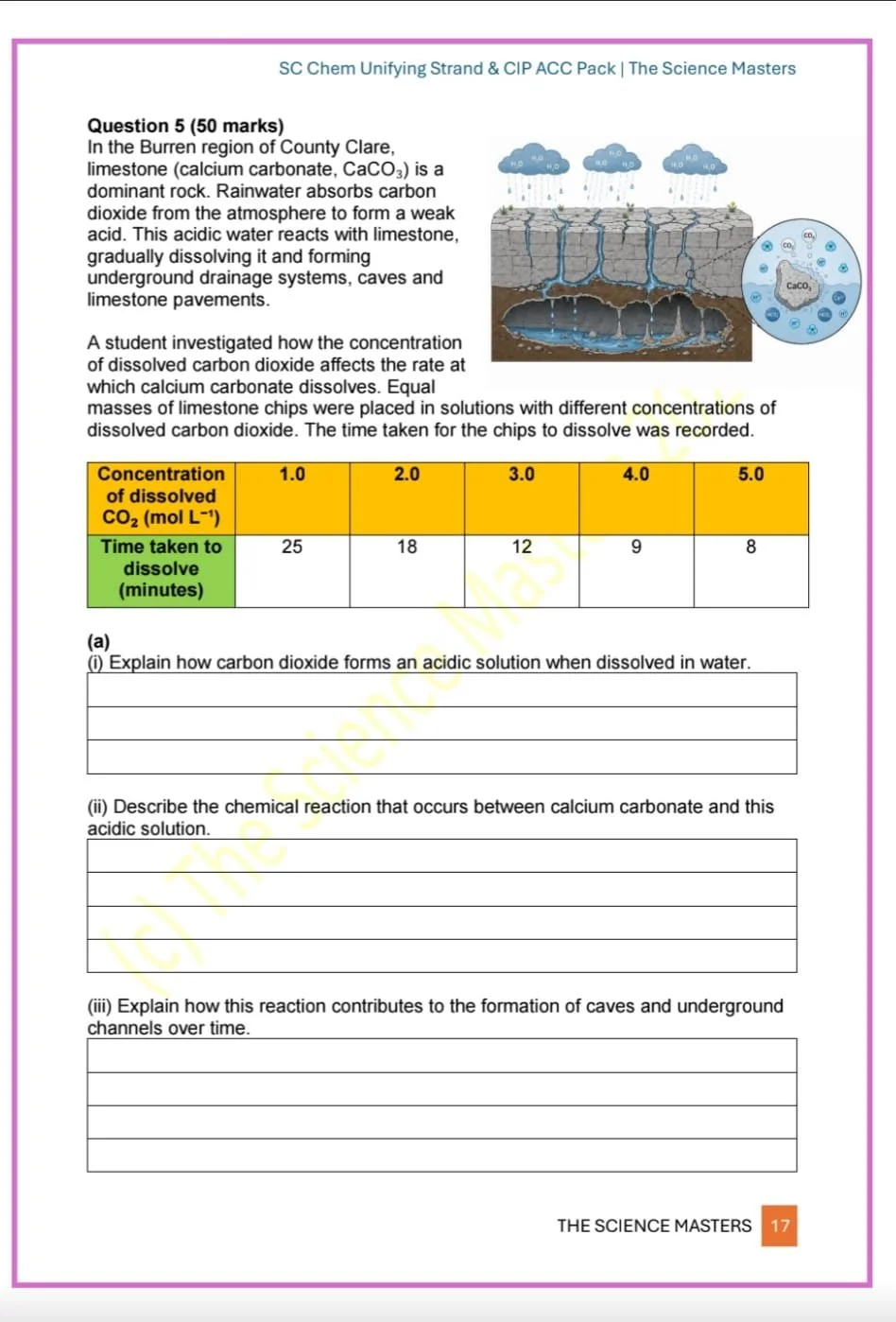
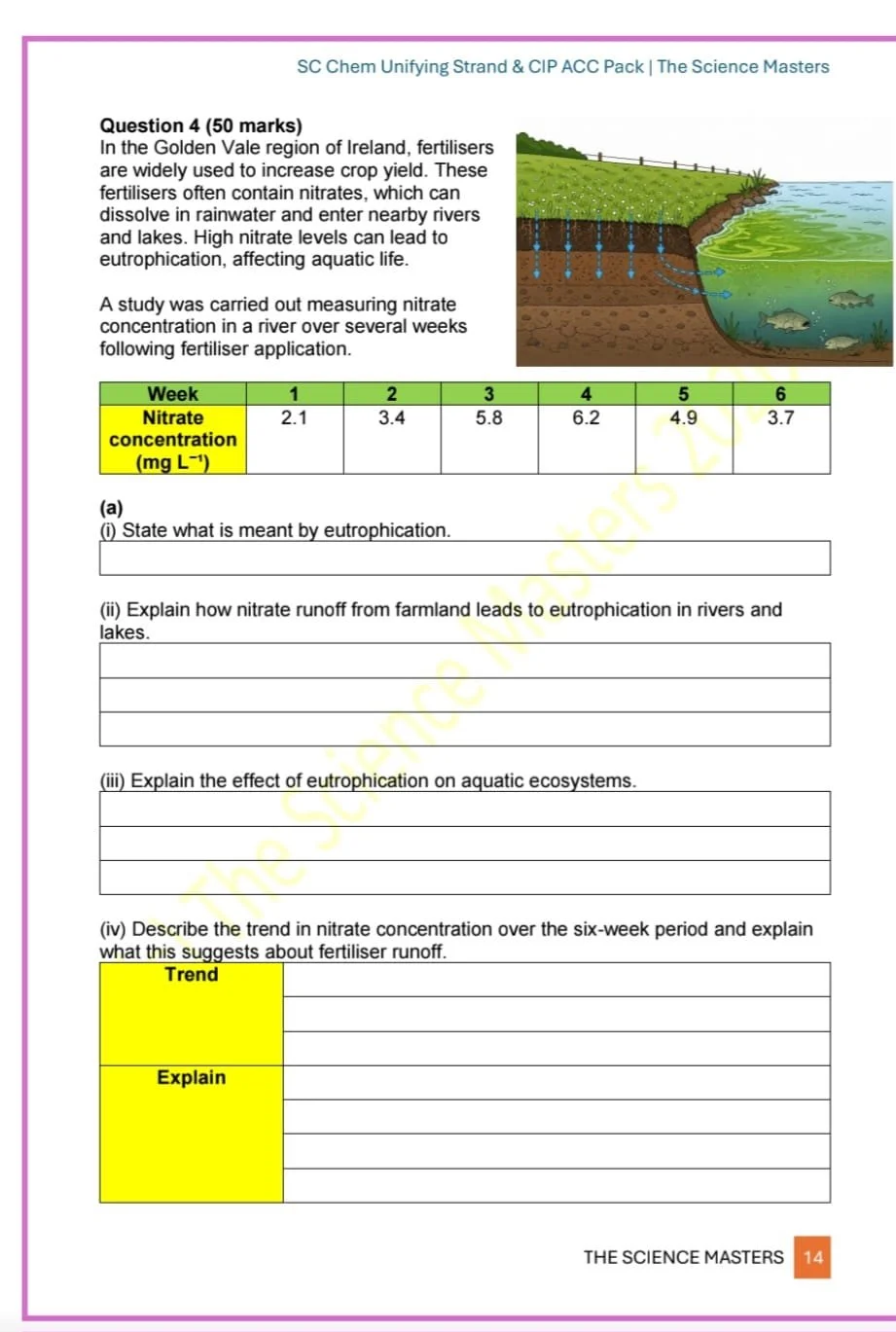
This downloadable PDF is designed to help students and teachers prepare for the new Senior Cycle Chemistry 2025 specification, with a strong focus on the Unifying Strand: Nature of Science and CIP-style exam questions.
The pack includes extended, exam-style questions based on real-world chemistry contexts such as water treatment, environmental chemistry, pharmaceuticals, microplastics, carbon dioxide removal, limestone erosion, and chemical manufacturing.
What is included:
86-page downloadable PDF
Senior Cycle Chemistry 2025 specification focus
Unifying Strand practice questions
CIP-style extended-response questions
50-mark exam-style questions
Graphs, tables, data analysis and case-study questions
Full marking schemes included
Higher Level focused
Ideal for classroom use, homework, revision and exam preparation
This resource helps students practise:
Scientific reasoning
Data interpretation
Graph analysis
Evaluation of investigations
Real-world chemistry applications
Communication of scientific ideas
Higher-order exam answers
Suitable for:
Senior Cycle Chemistry students
Senior Cycle Chemistry teachers
Higher Level Chemistry revision
Unifying Strand exam preparation
CIP assessment-style practice
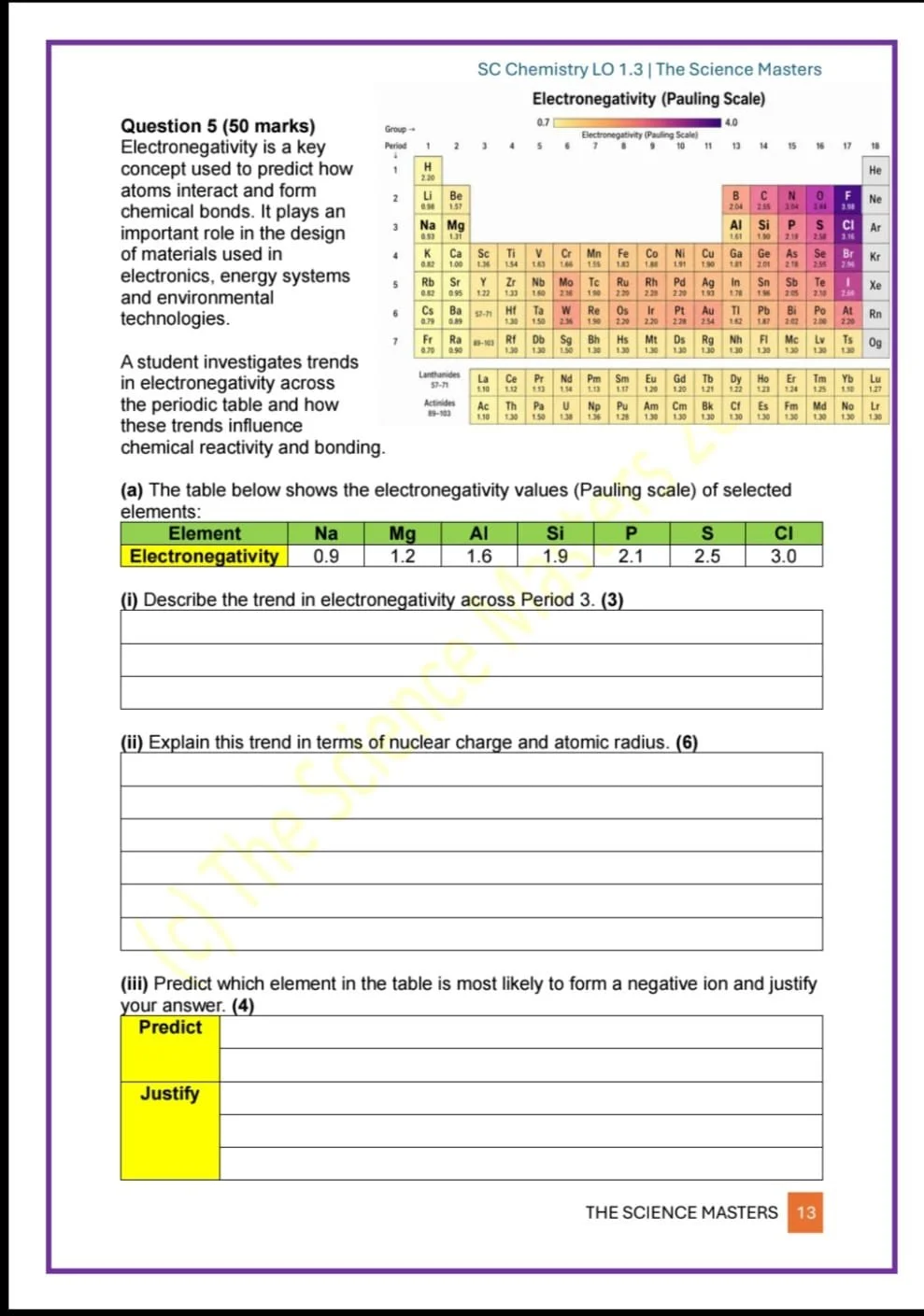
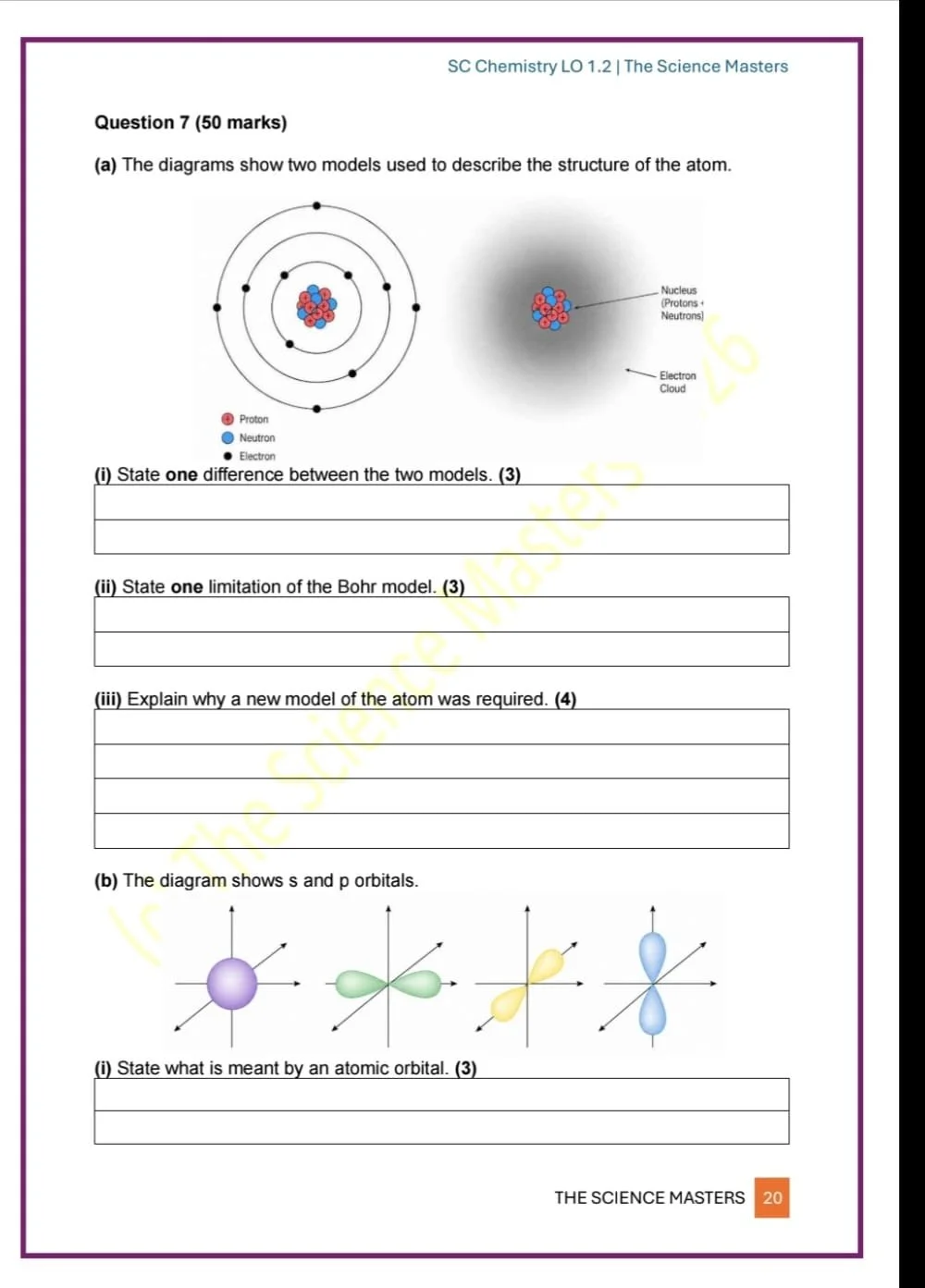
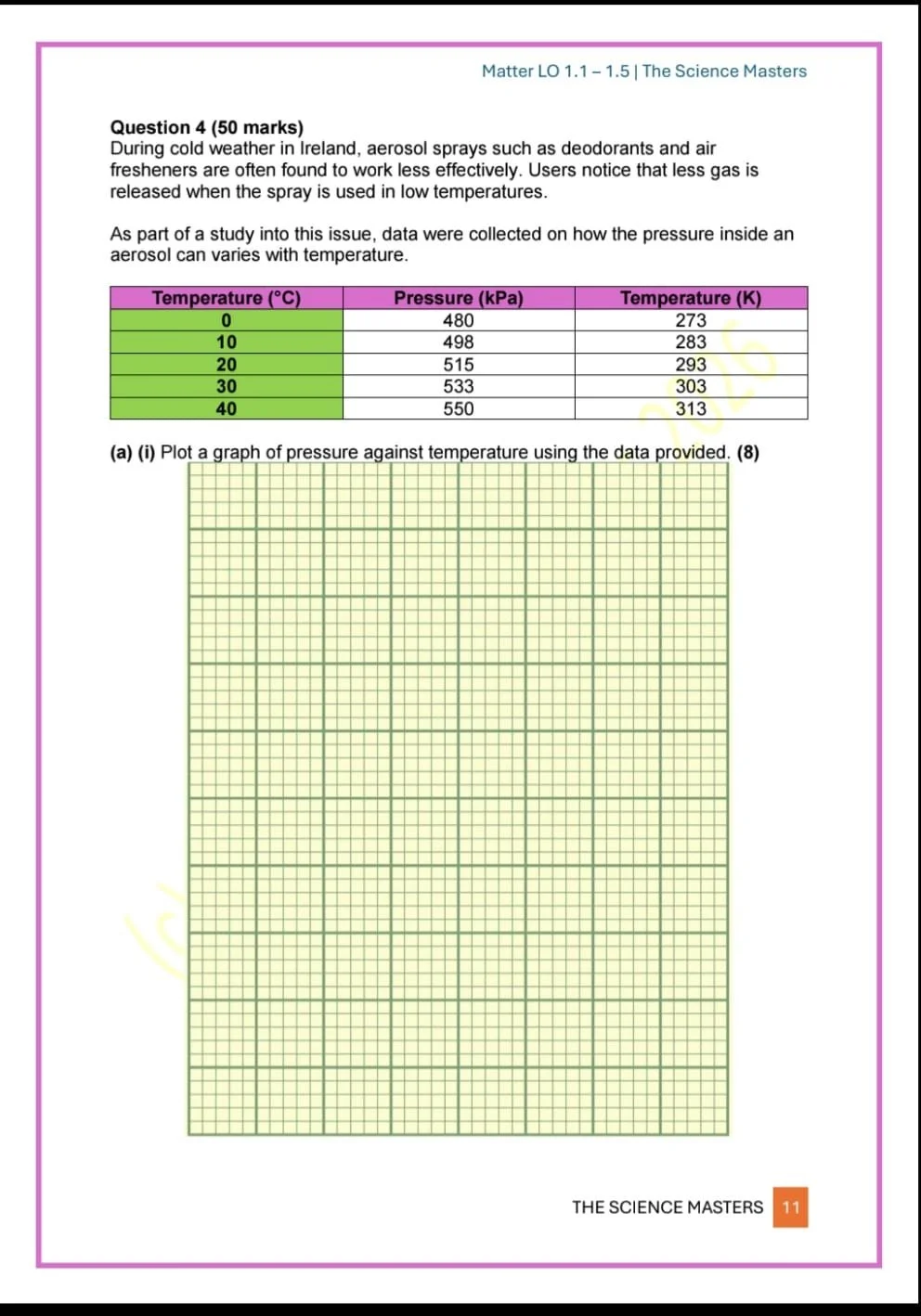
This comprehensive 230-page resource provides full coverage of Strand 1 of the new Senior Cycle Chemistry specification. It is designed to support both teaching and revision through structured, assessment-style questions and detailed marking schemes.
Each learning outcome is developed through realistic contexts, scaffolded questions, and repeated exposure to key concepts, helping students build confidence and mastery across the full strand.
• 230 pages of structured Chemistry questions and answers
• Full marking schemes for all questions
• Coverage of all Strand 1 learning outcomes
• Real-world contexts and applied Chemistry scenarios
• A mix of short-answer, structured, and extended-response questions
• Suitable for class tests, homework, revision, or mock examinations
• Particle theory of solids, liquids, and gases
• Diffusion and Brownian motion
• Effects of temperature on particle movement
• Gas pressure, volume, and temperature relationships
• Real-life applications including aerosols, tyres, and gas systems
• Experimental design and evaluation
• Structure of the atom and subatomic particles
• Isotopes and relative atomic mass
• Emission spectra and electron transitions
• Relationship between energy, frequency, and wavelength
• Mass spectrometry and data interpretation
• Development and limitations of atomic models
• Mole calculations and Avogadro’s number
• Formula units, atoms, and particles
• Balanced equations and mole ratios
• Gas volume calculations, including STP
• Conservation of mass and chemical laws
• Real-world applications in medicine, industry, and food science
• Multi-step problem-solving and calculation practice
• Structure of the periodic table (groups, periods, and blocks)
• Ionisation energy trends and explanations
• Atomic radius and shielding effects
• Electronegativity and bonding
• Reactivity of Group 1, Group 2, and Group 17 elements
• Transition metals and noble gases
• Displacement reactions and real-world applications
• Reinforces key concepts through repeated exposure in different contexts
• Develops both conceptual understanding and analytical skills
• Builds confidence with structured, scaffolded questions
• Aligns with the style and approach of the new specification
• Allows teachers to assess learning across an entire strand
• Senior Cycle Chemistry Higher Level students
• Teachers delivering Strand 1 of the new course
• Revision classes and examination preparation
• Continuous assessment and class testing
• PDF download
• Print-ready
• Can be used as a complete unit booklet or divided into topic assessments
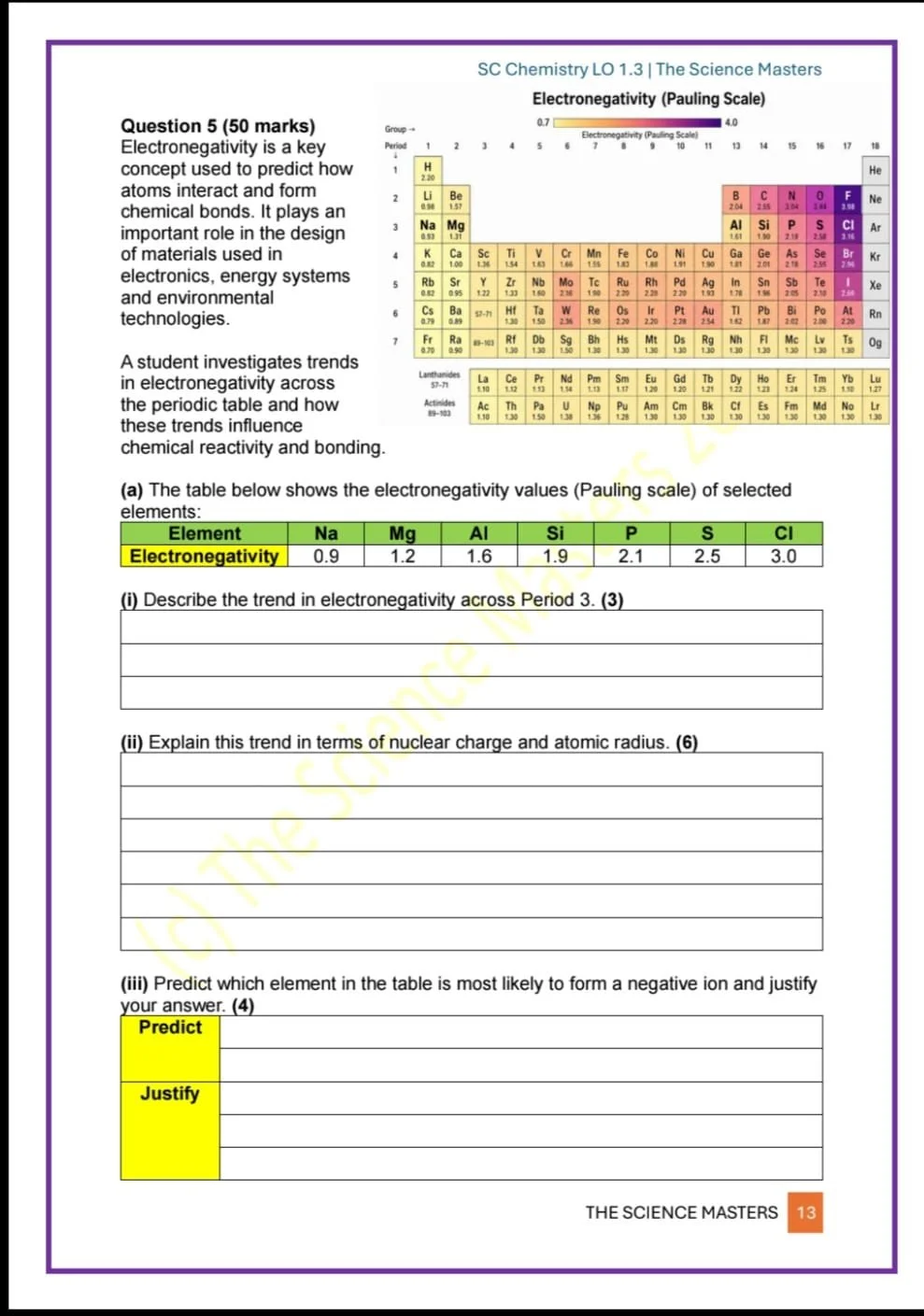
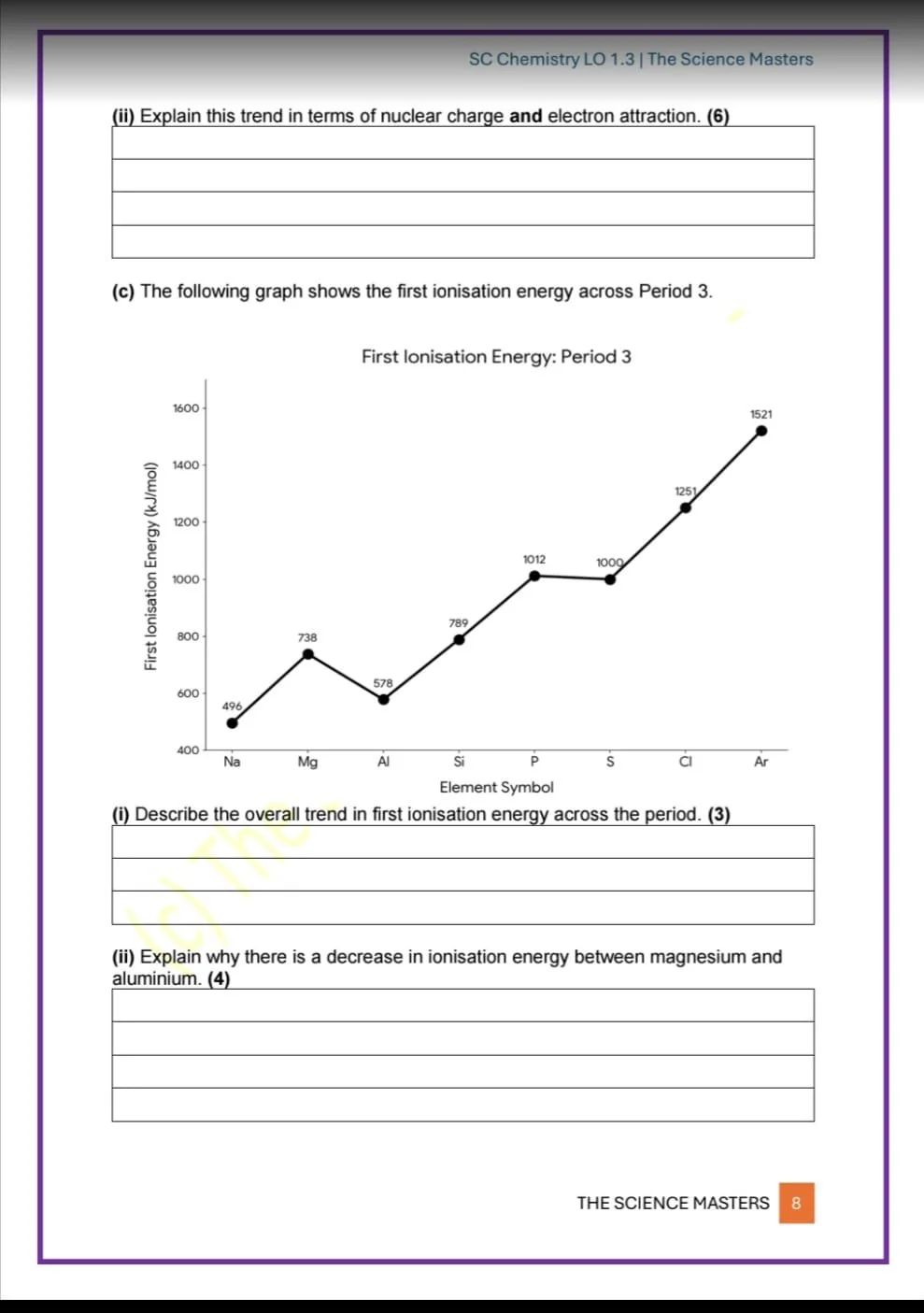
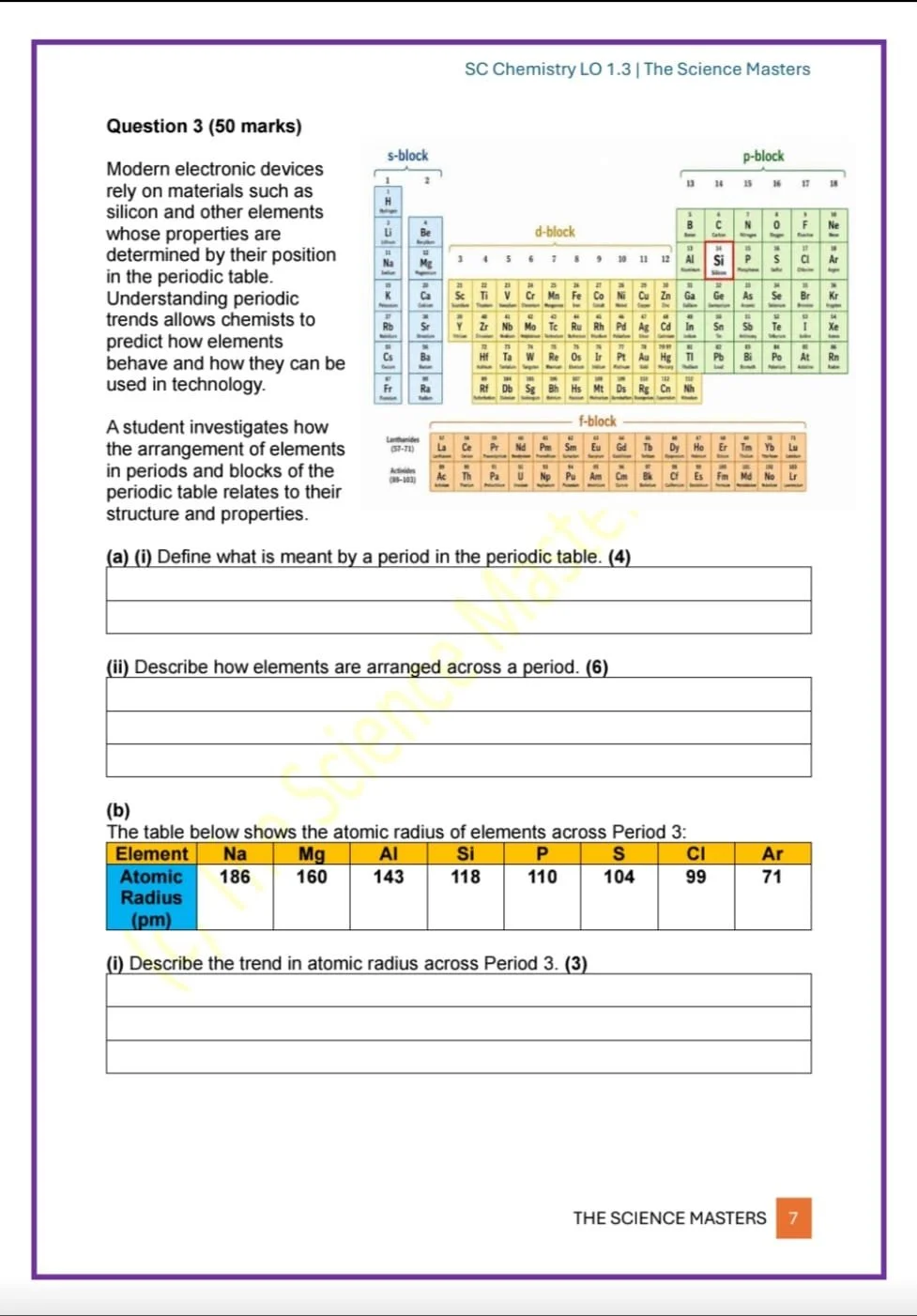
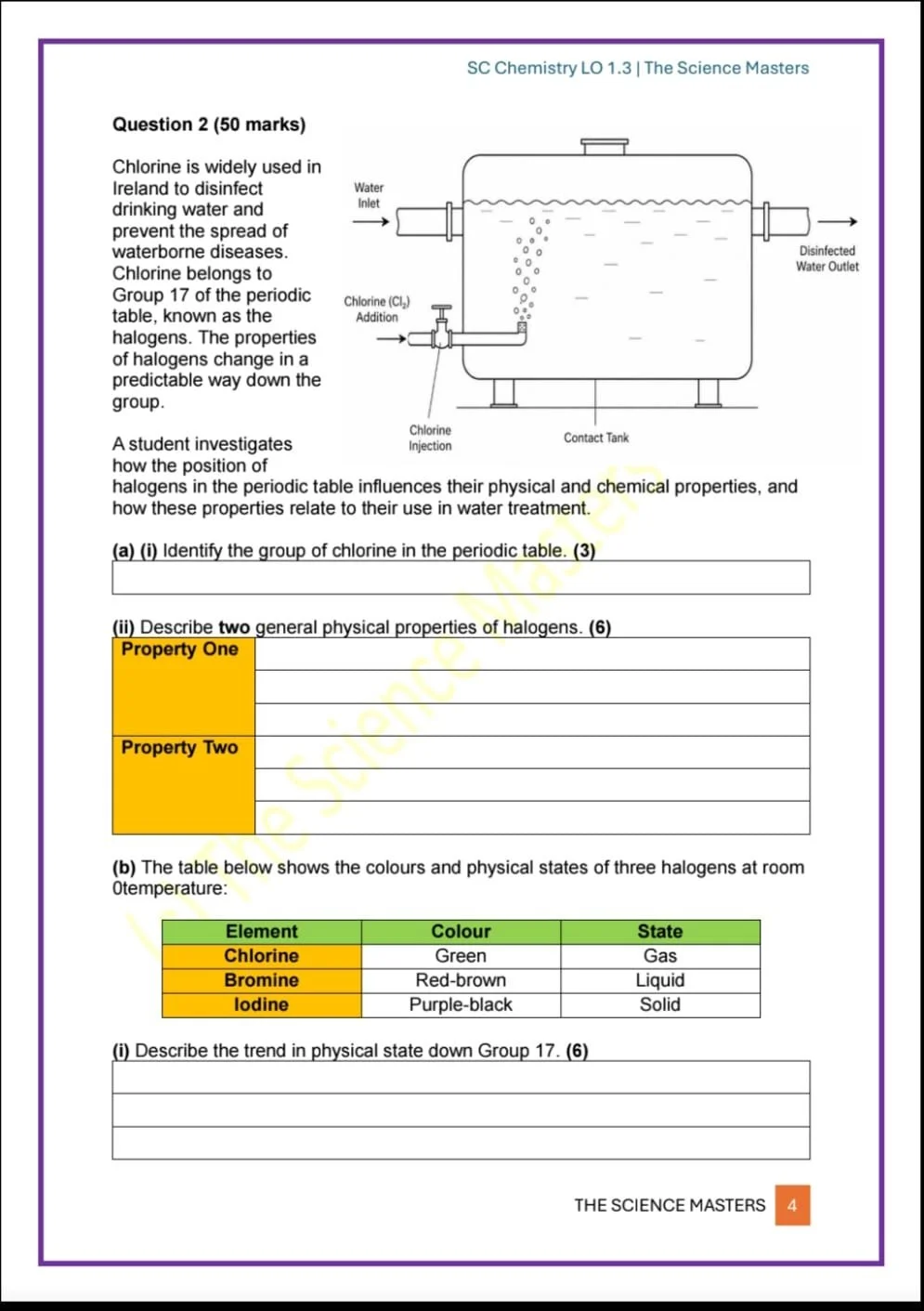
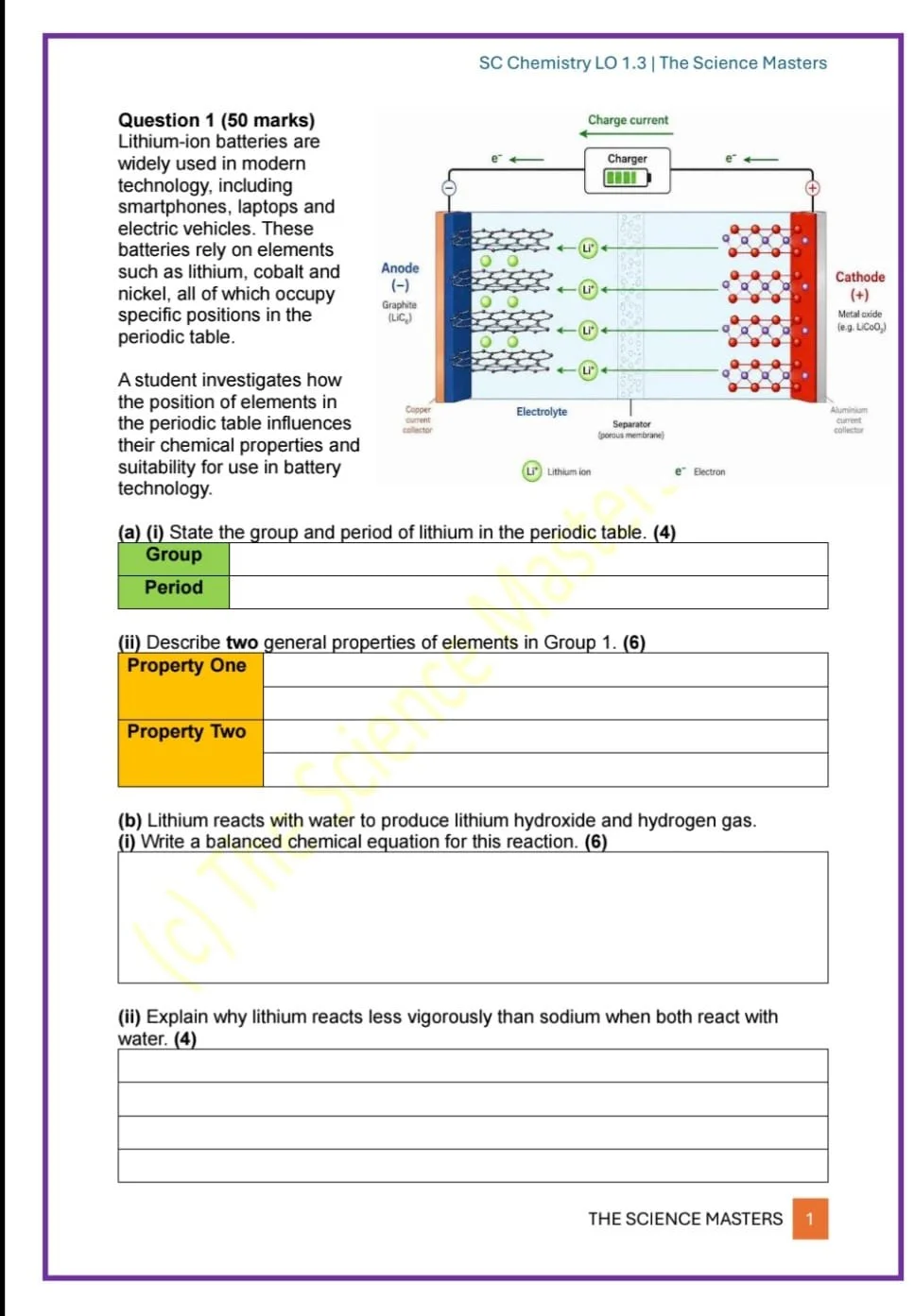
Senior Cycle Higher Level Periodic Trends Exam Pack
This comprehensive exam-style resource is designed to support students studying periodic trends under the new Senior Chemistry specification.
It provides a structured and realistic set of questions with a full marking scheme, allowing students to develop exam technique, deepen understanding, and practise key concepts in multiple contexts.
11 full exam-style questions (50 marks each)
Complete marking scheme for all questions
Coverage of key periodic trends and concepts
A mix of short-answer, structured, and extended-response questions
Designed specifically for Higher Level students
Ionisation energy trends
Atomic radius
Electronegativity
Reactivity of Group 1, Group 2 and Group 17 elements
Displacement reactions
Periodic table structure (groups, periods and blocks)
Transition metals
Noble gases
Applications in real-world contexts (batteries, water treatment, electronics)
Reinforces key concepts through repeated exposure in different question styles
Helps students recognise patterns across topics
Builds confidence with exam-style phrasing
Supports both revision and assessment
Fully aligned with the new specification approach
Senior Cycle Higher Level Chemistry students
Teachers looking for ready-to-use class tests or revision material
Students preparing for end-of-topic tests or mock exams
PDF download
Print-ready
Suitable for classroom or independent study
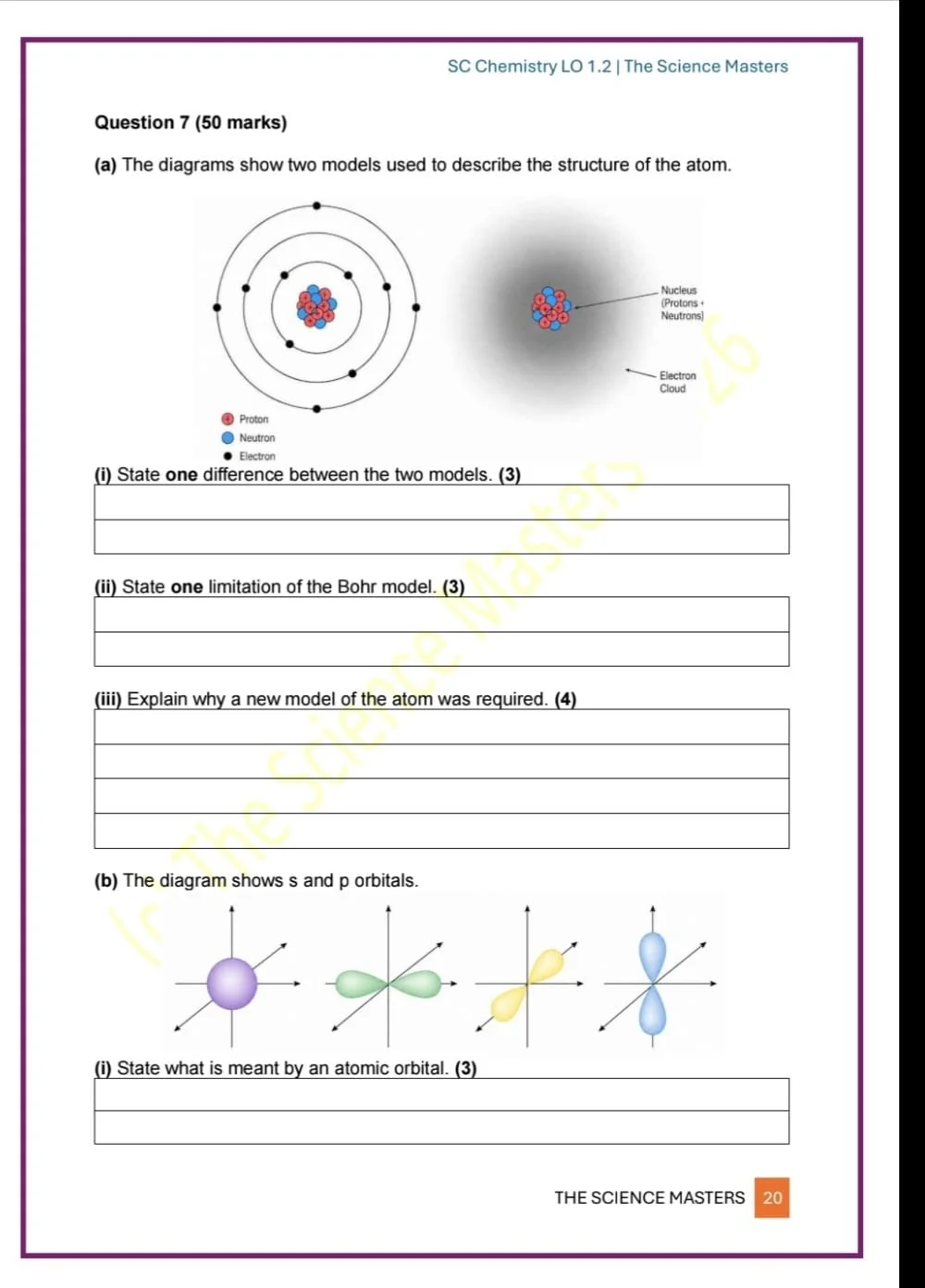
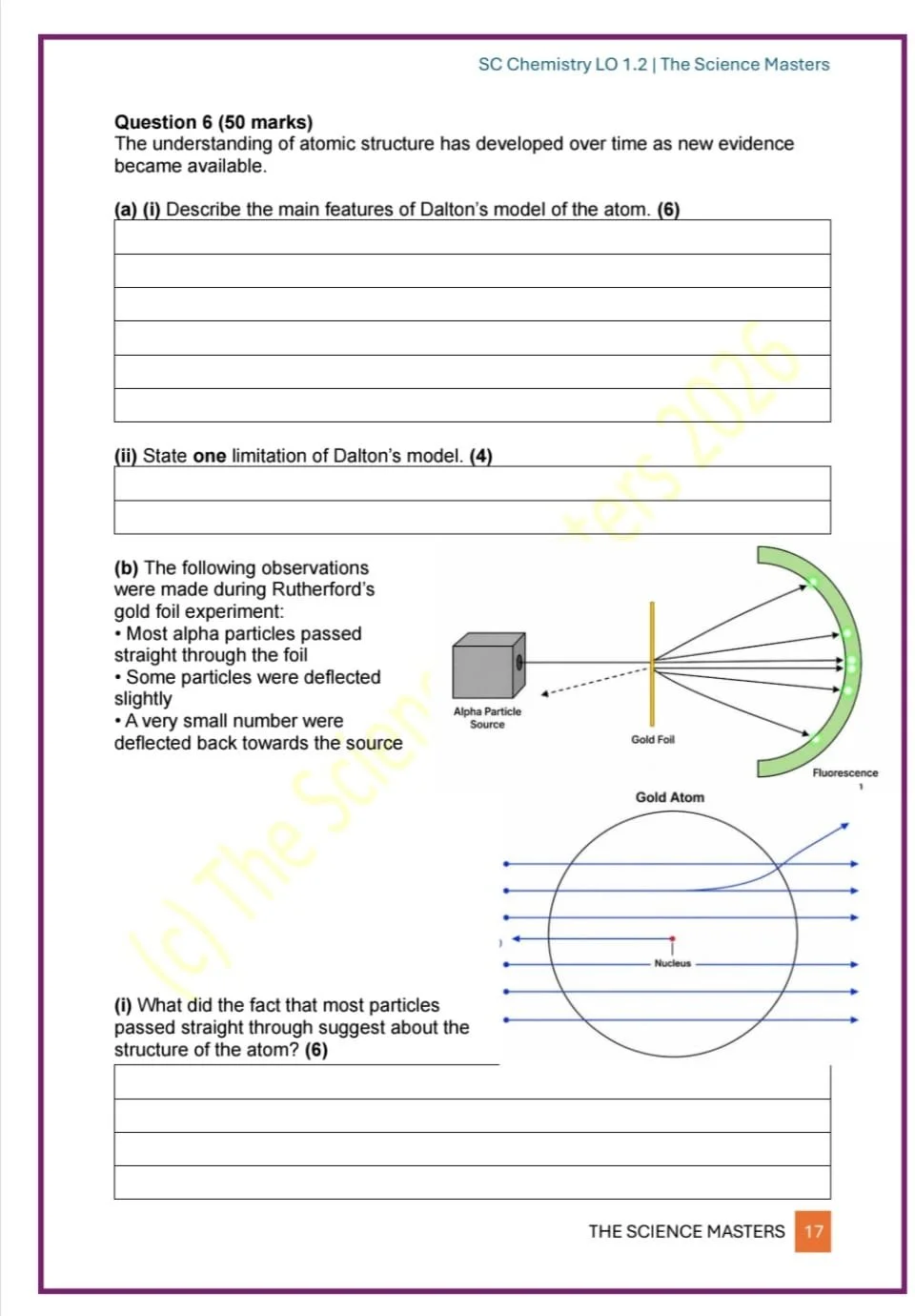
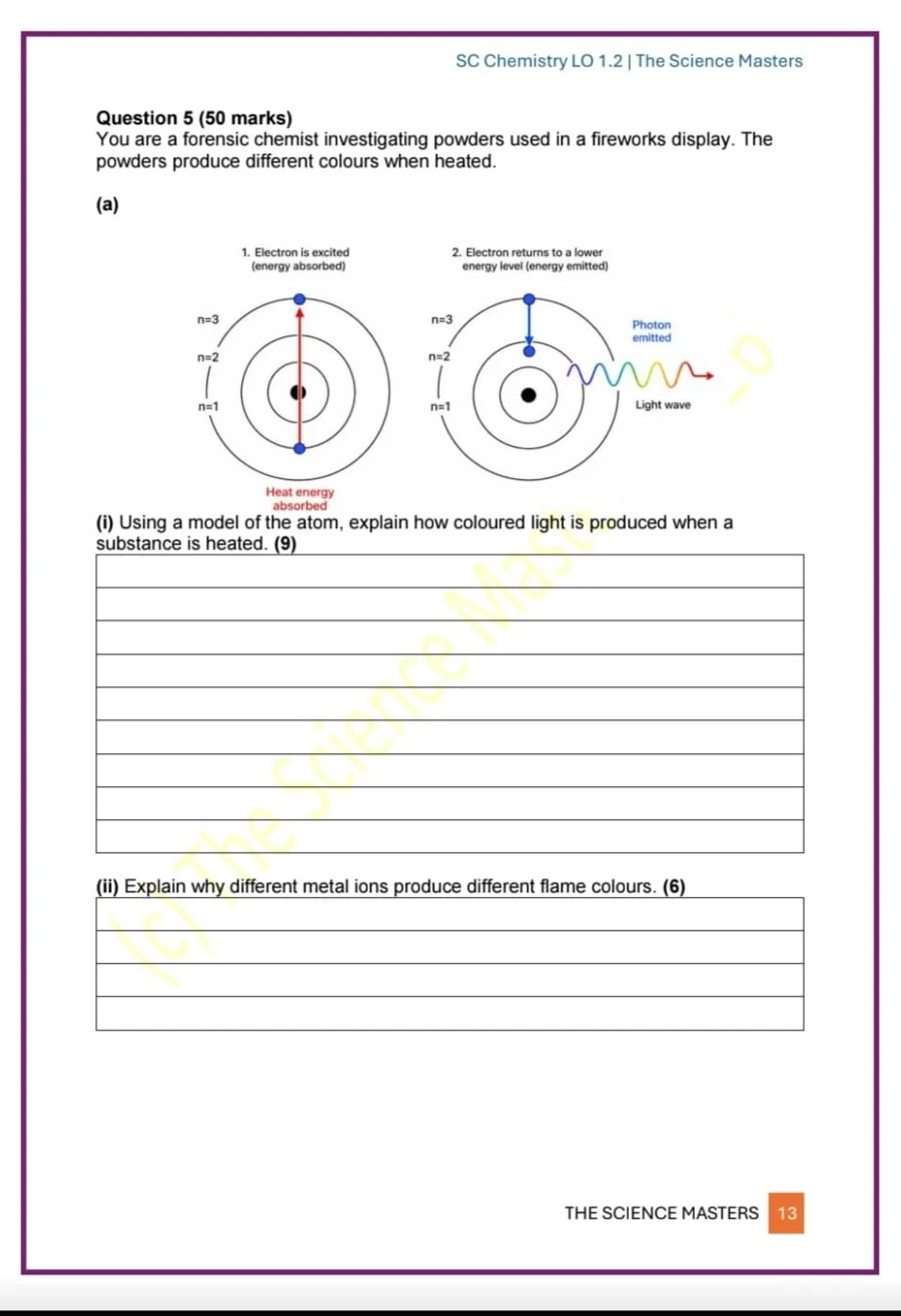
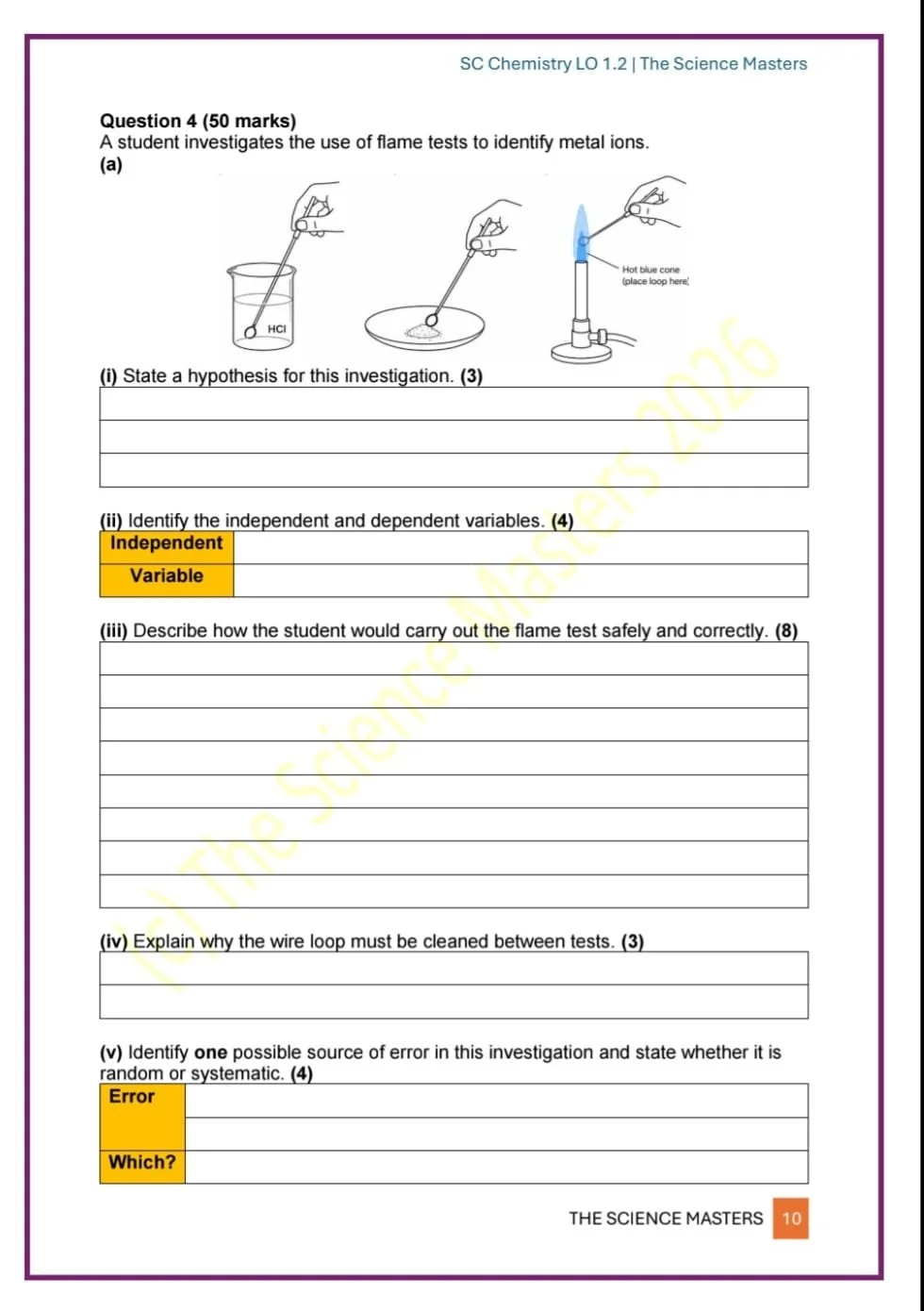
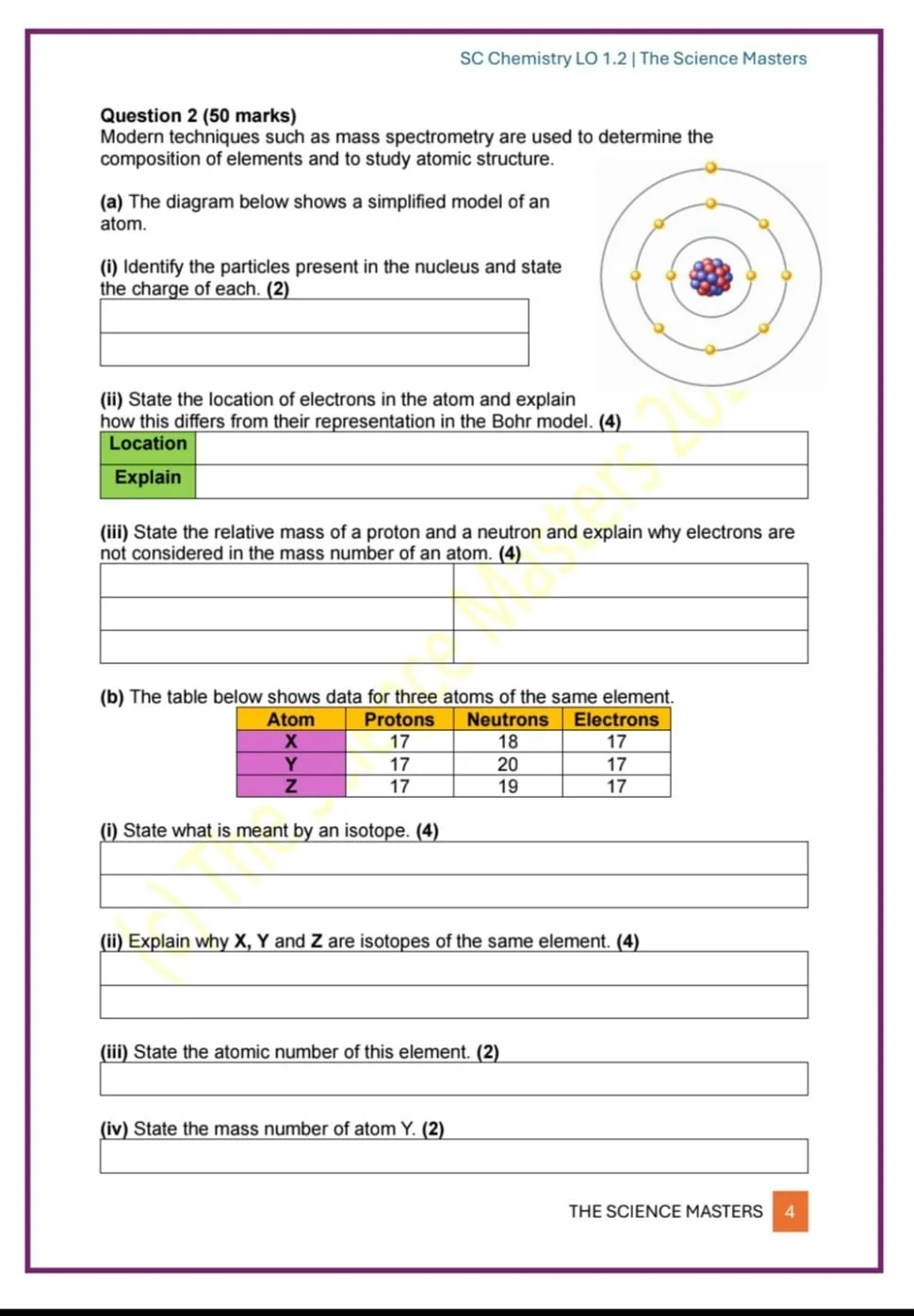
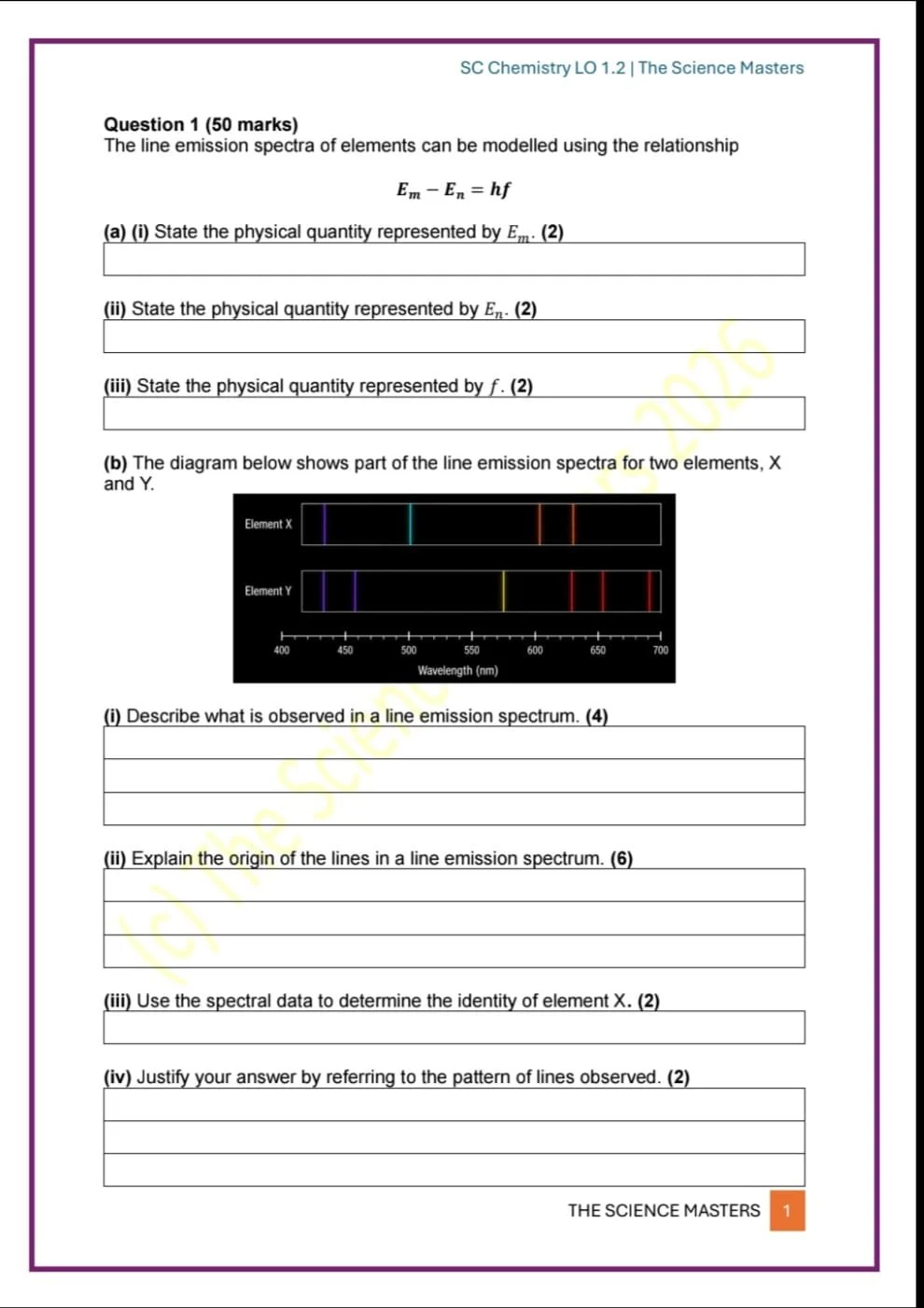
This resource is designed to support students preparing for Senior Cycle Chemistry, with a focused set of structured Chemistry questions based on key content in atomic structure and emission spectra.
All questions are written using realistic scientific language and assessment-style phrasing to help students build confidence, strengthen understanding, and develop strong written responses.
• 8 full structured Chemistry questions
• Each question worth 50 marks
• A complete marking scheme for all questions
• Clear, structured answers aligned with learning outcomes
• Higher Level standard throughout
• Structure of the atom
• Protons, neutrons, and electrons
• Bohr model and modern atomic theory
• Electron configuration
• s and p orbitals
• Emission spectra and line spectra
• Energy levels in the hydrogen atom
• Flame tests and spectroscopy
• Mass spectrometry
• Isotopes and relative atomic mass
This exam pack is designed to:
• Provide realistic assessment-style practice
• Reinforce key concepts through structured questions
• Develop clear and scientifically accurate written answers
• Support revision for class tests, mock examinations, and end-of-year assessments
• Senior Cycle Chemistry Higher Level students
• Students preparing for mock examinations
• Students aiming to improve analytical and written-answer skills
• Teachers seeking structured revision and assessment material
• PDF download
• Print-ready layout
• Suitable for independent study or classroom use
Science Masters
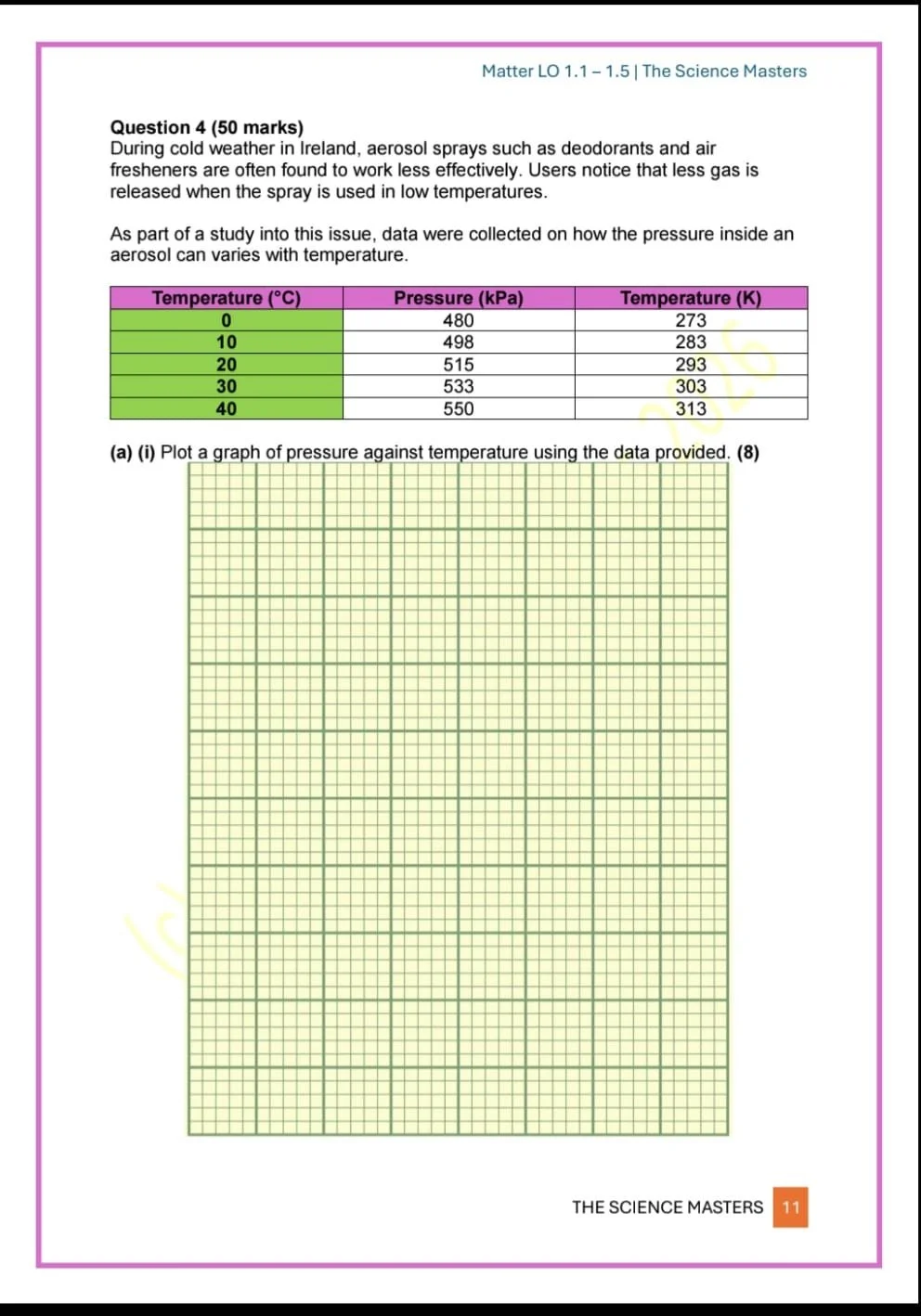
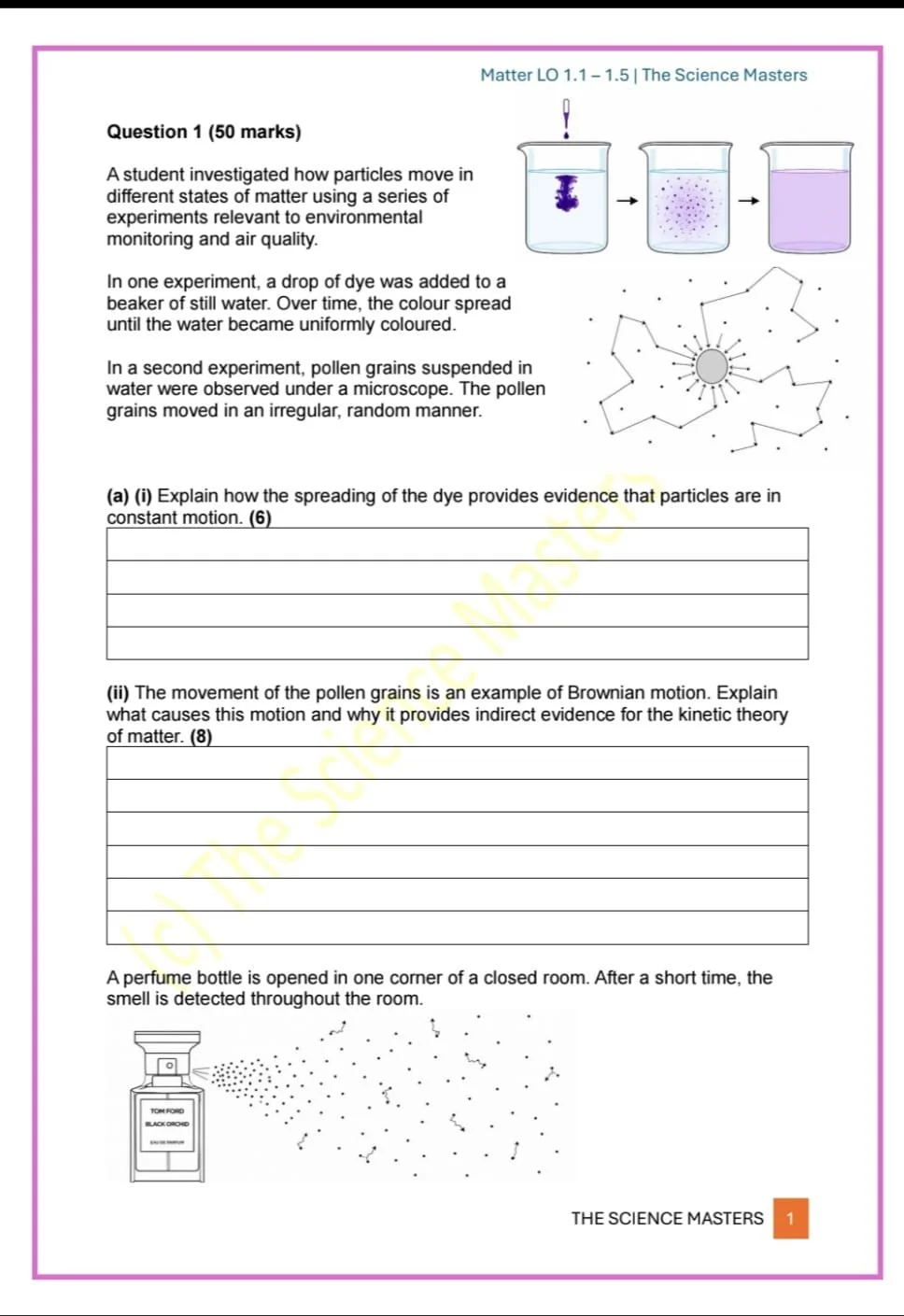
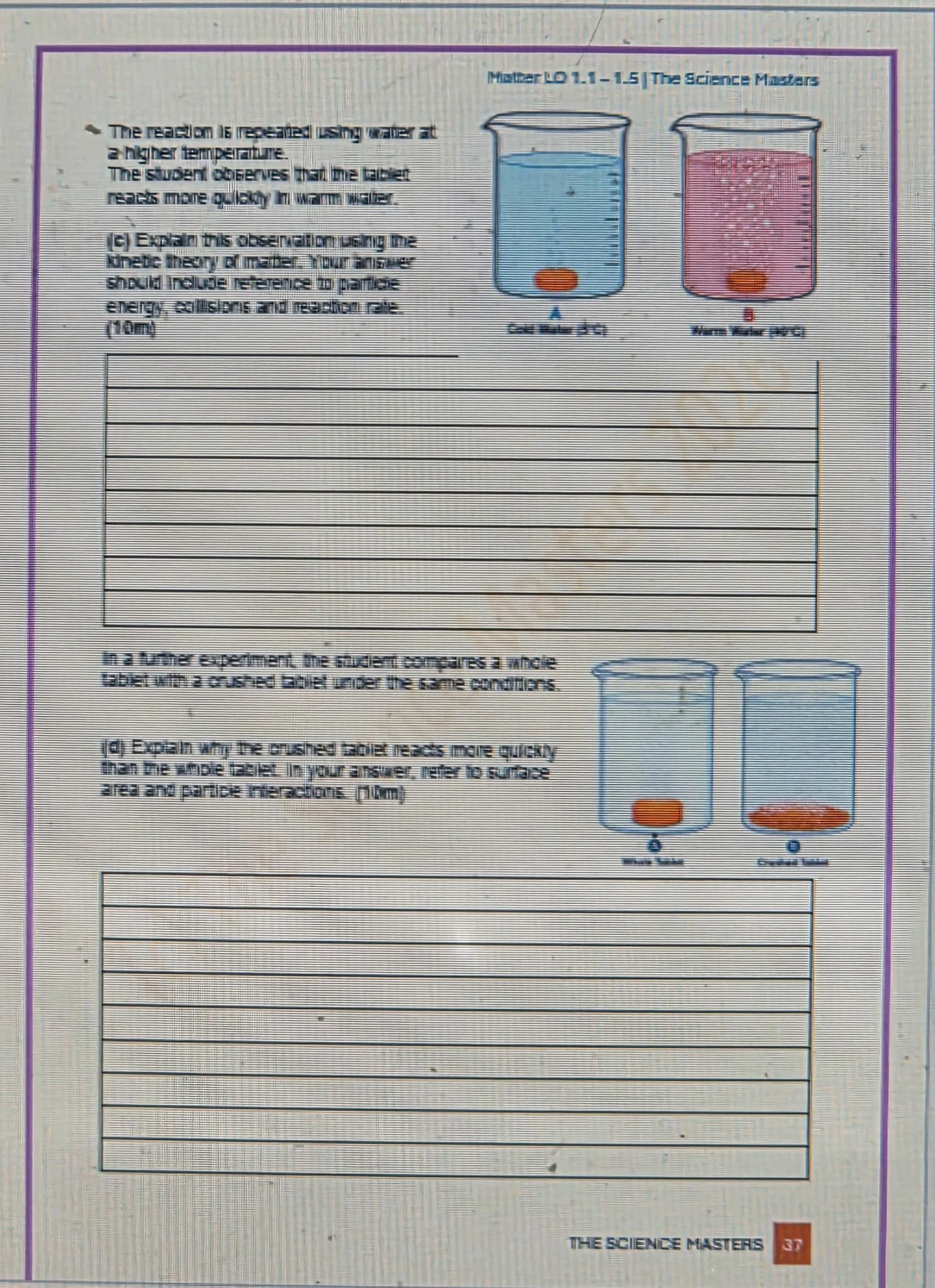
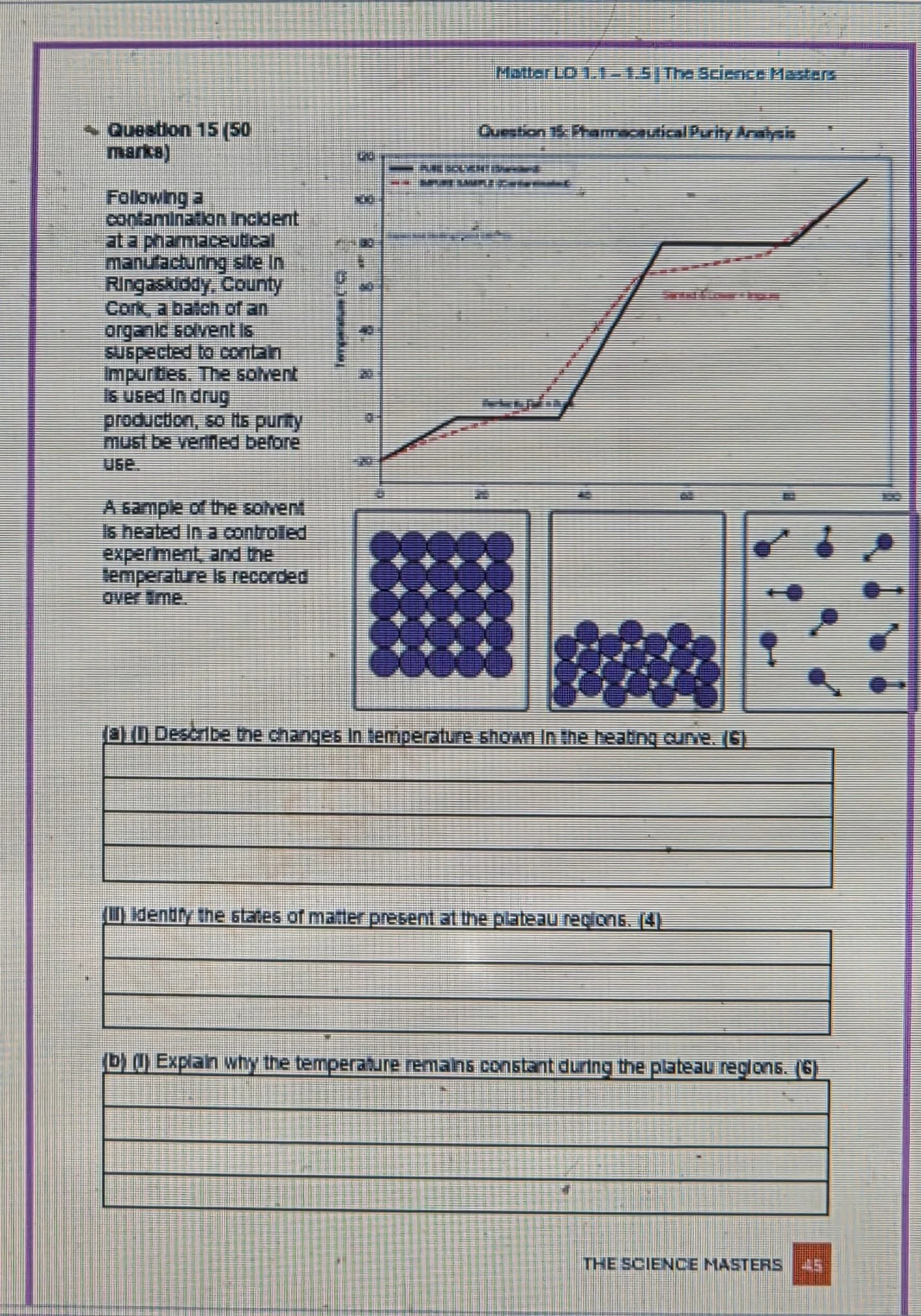
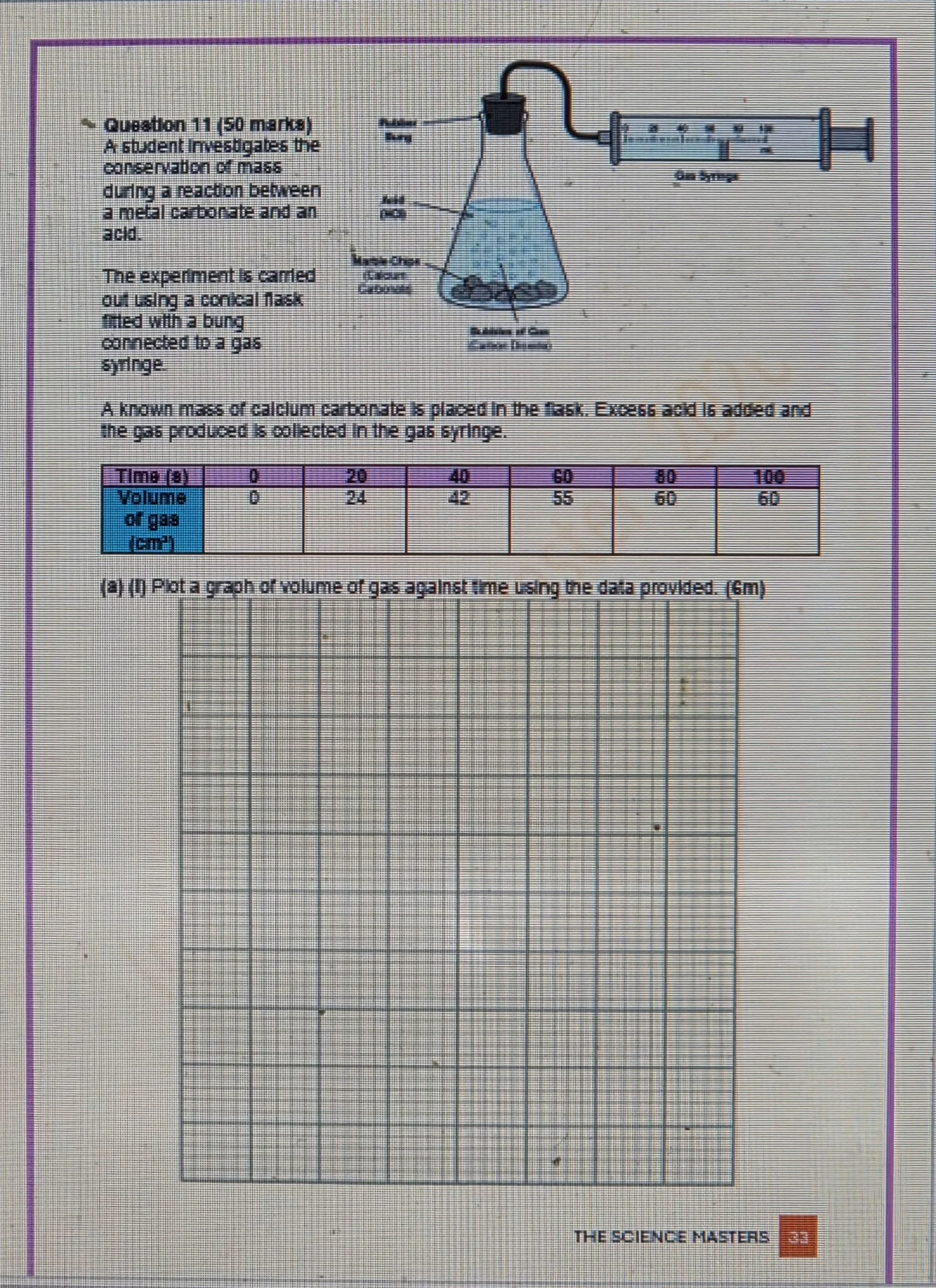
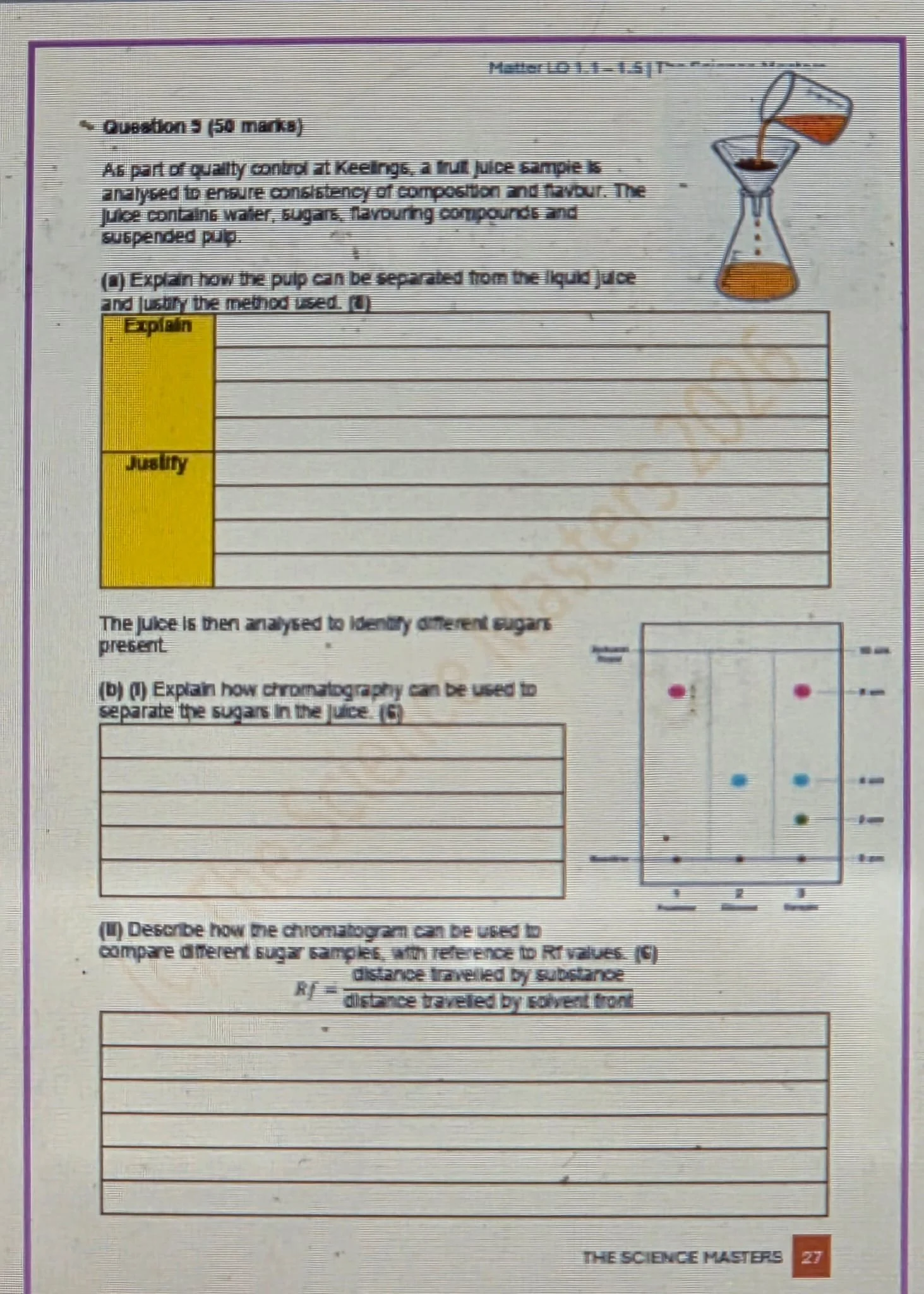
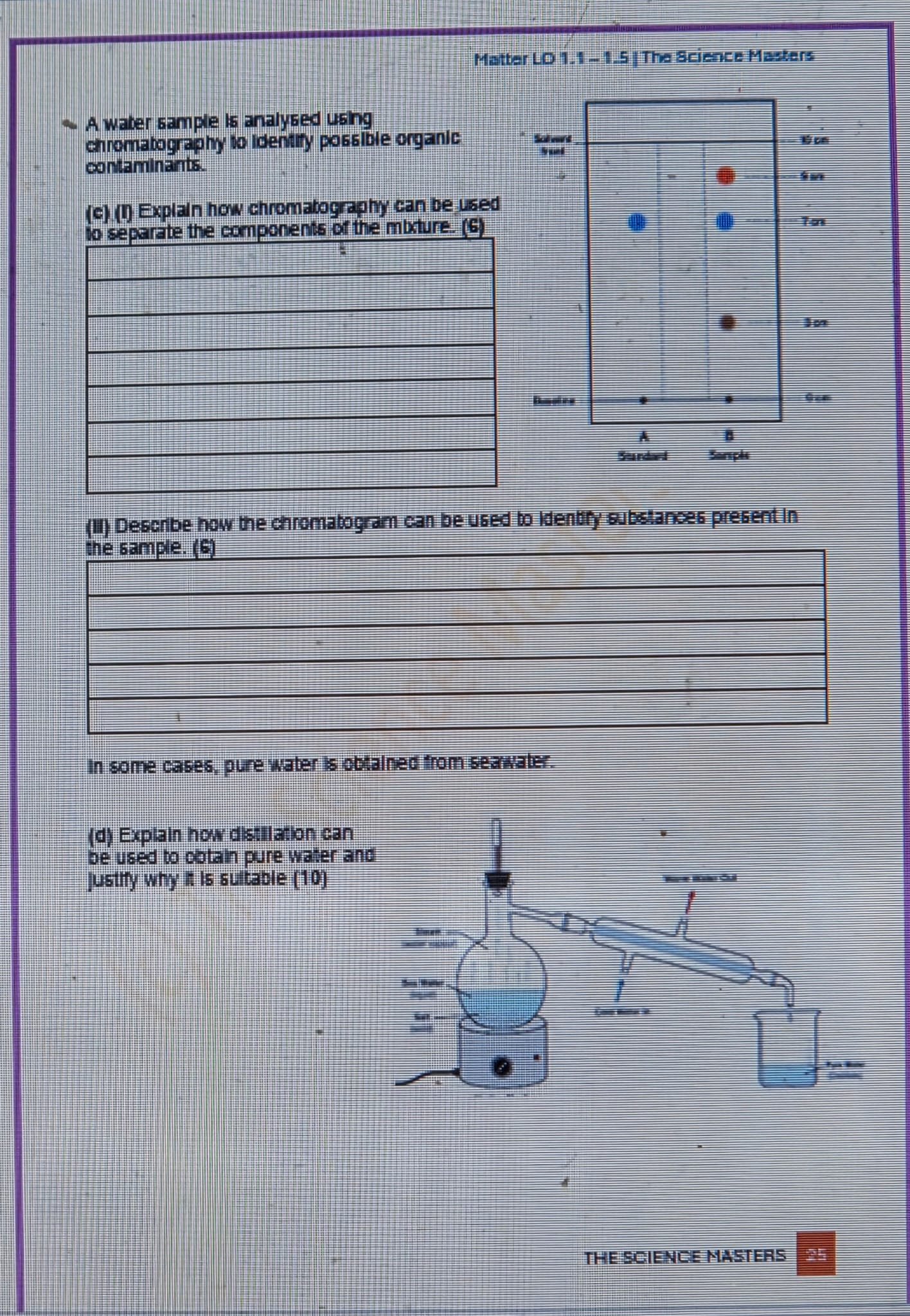
This comprehensive revision pack is designed to help students master the Matter and Kinetic Theory section of Senior Cycle Chemistry. Built using structured Chemistry questions and detailed marking schemes, it provides extensive practice for revision, assessment preparation, and classroom learning.
• 16 full structured Chemistry questions (50 marks each)
• Detailed marking scheme for all questions
• Coverage of all major learning outcomes in Matter and Kinetic Theory
• Realistic scientific language and structured question styles
• Designed for Higher Level students
• Suitable for revision, homework, topic assessments, or mock examinations
• Kinetic Theory of Matter
• Diffusion and Brownian Motion
• Gas Pressure, Volume, and Temperature Relationships
• Changes of State and Particle Behaviour
• Ideal and Real Gases
• Separation Techniques (Filtration, Distillation, Chromatography, Crystallisation)
• Rates of Reaction and Particle Interactions
• Conservation of Mass including environmental applications
• Real-world applications including aerosols, tyres, pharmaceuticals, and environmental science
• Reinforces key concepts through repeated practice in multiple contexts
• Develops both scientific understanding and analytical skills
• Focuses on explanation, evaluation, and application questions
• Encourages deeper understanding rather than rote learning
• Suitable for independent study or classroom use
• Aligned with the style and structure of the new specification
• Senior Cycle Chemistry Higher Level students
• Teachers creating topic tests, mock examinations, or revision material
• Revision in the lead-up to examinations
• Students aiming to improve confidence and overall performance
• PDF download
• Print-ready layout
• Suitable for classroom or independent study
Science Masters
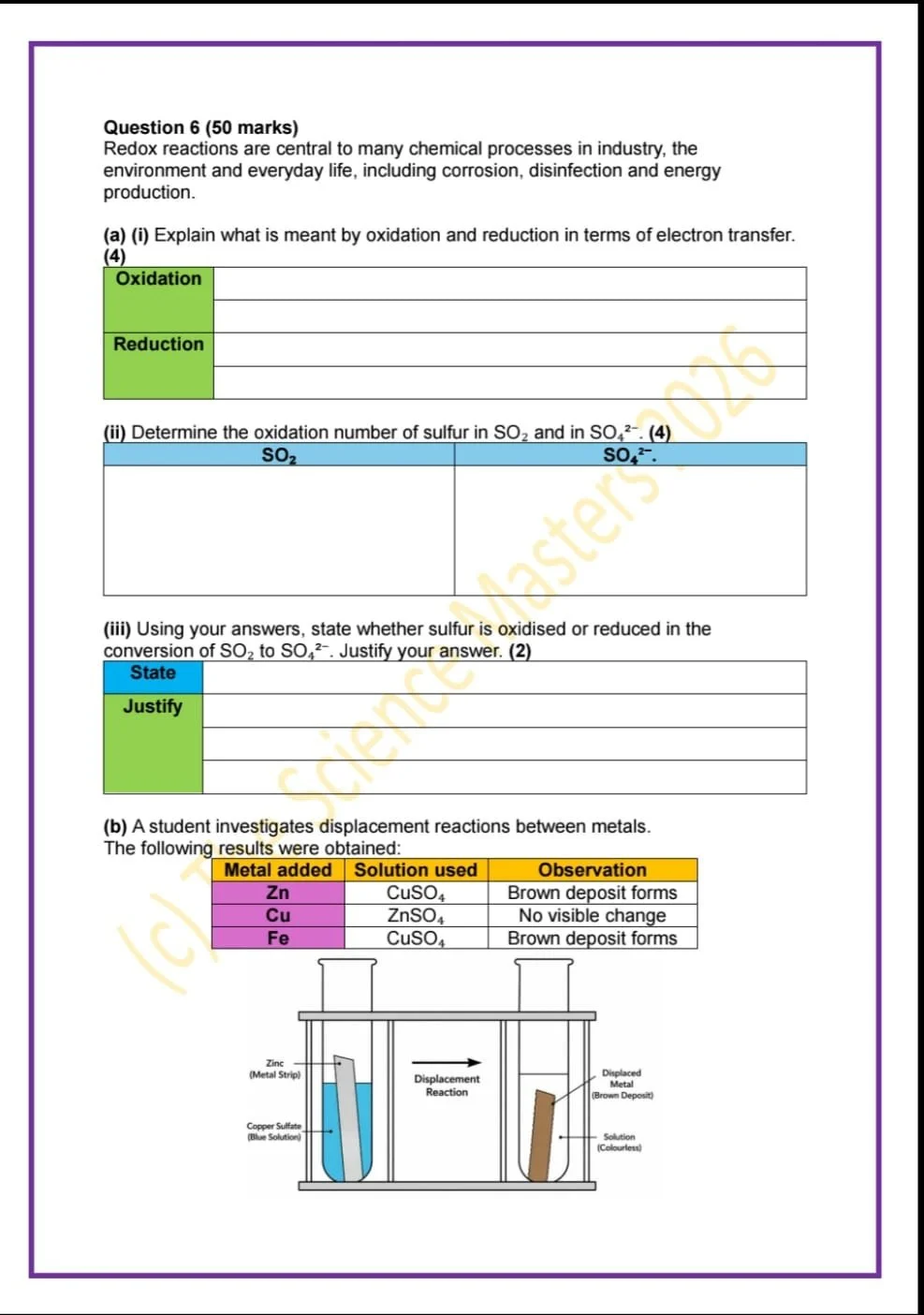
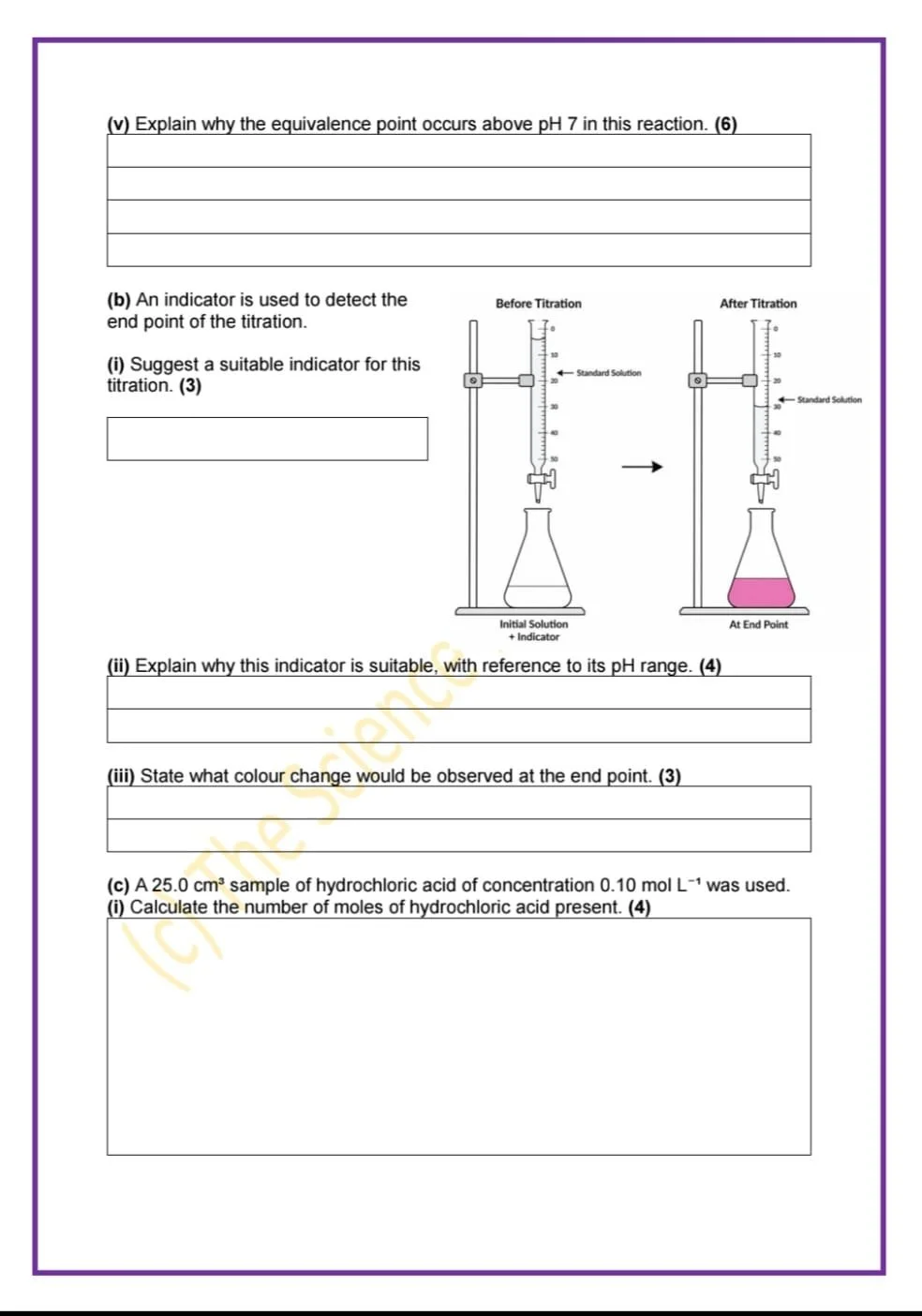
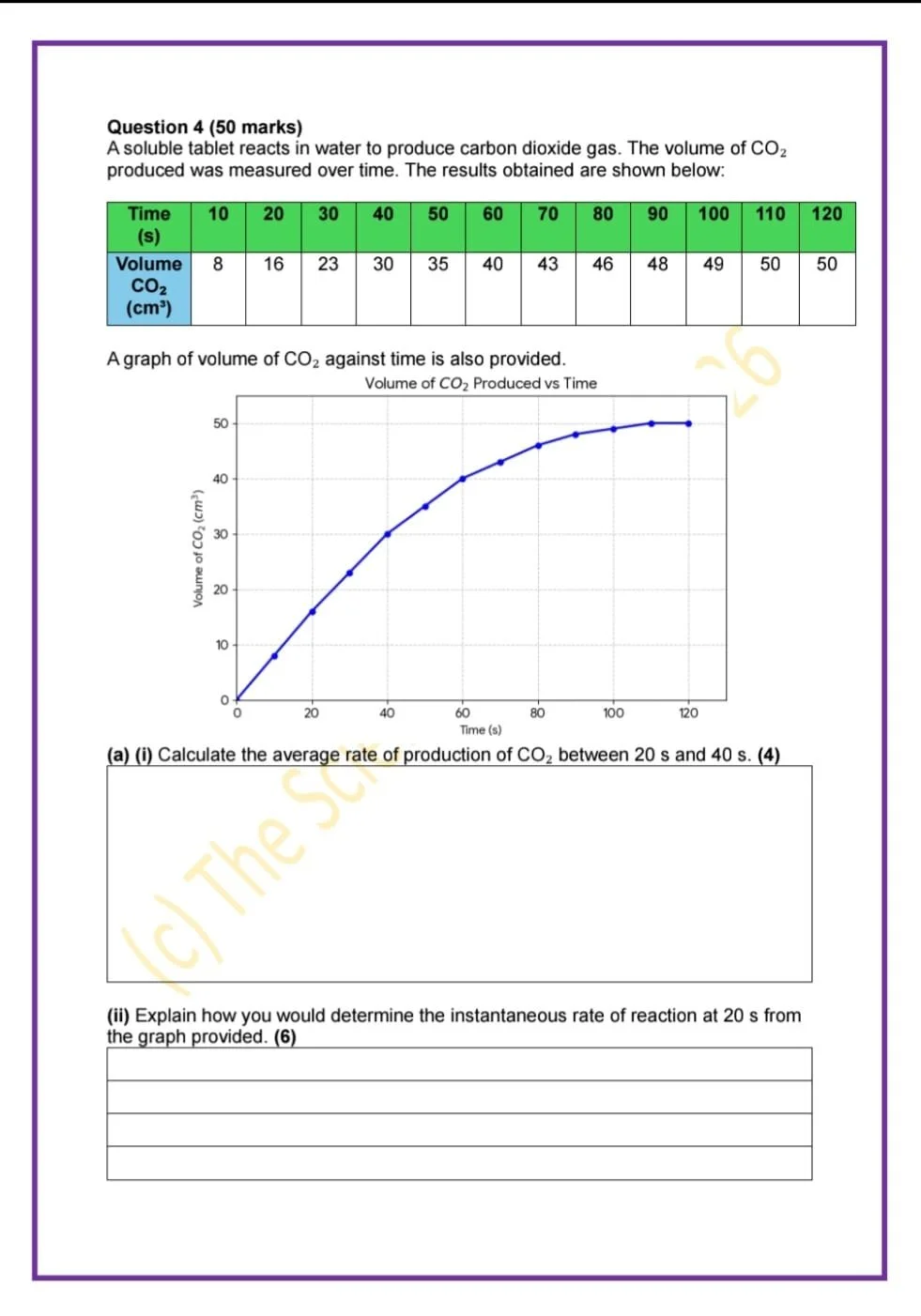
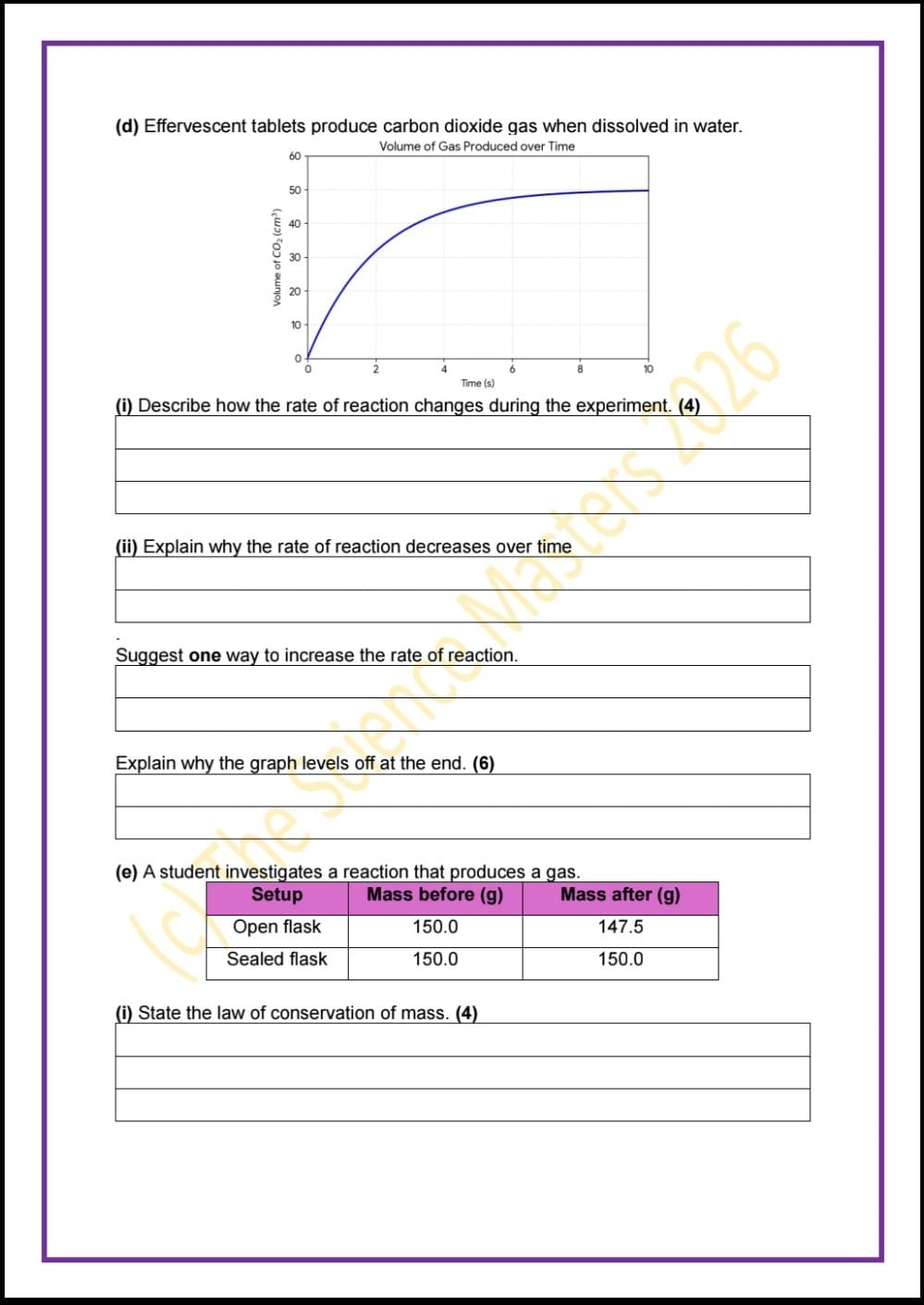
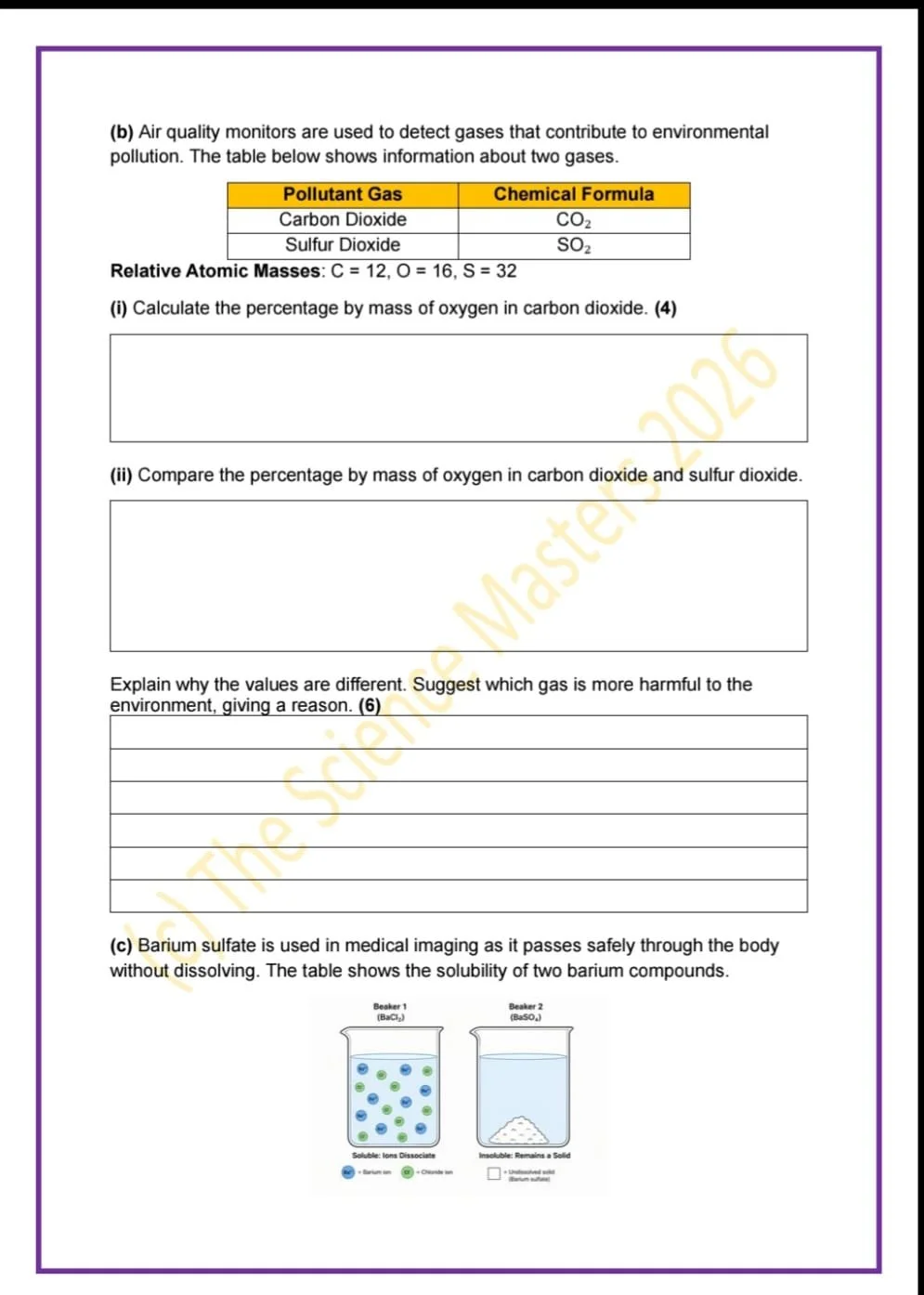
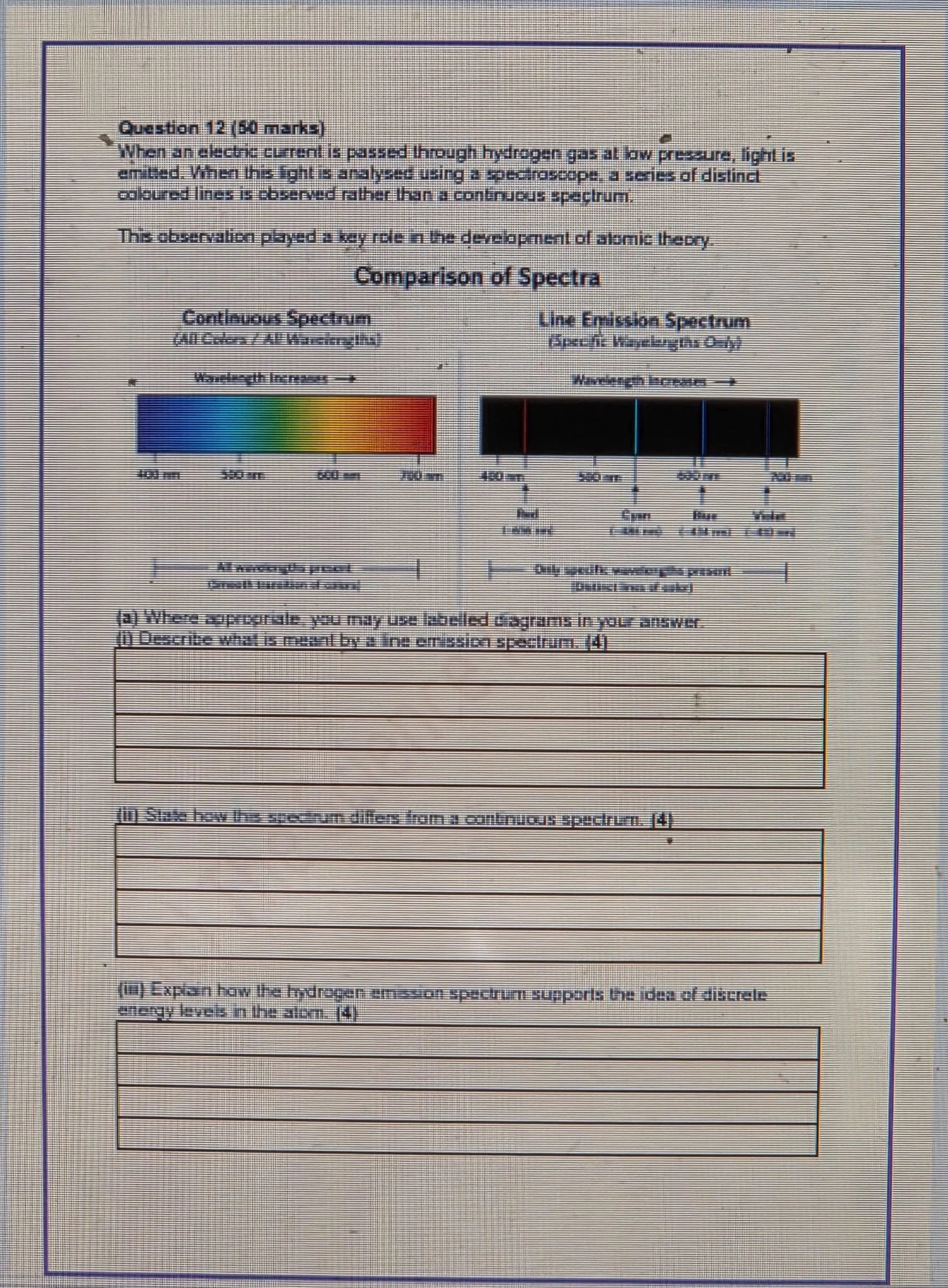
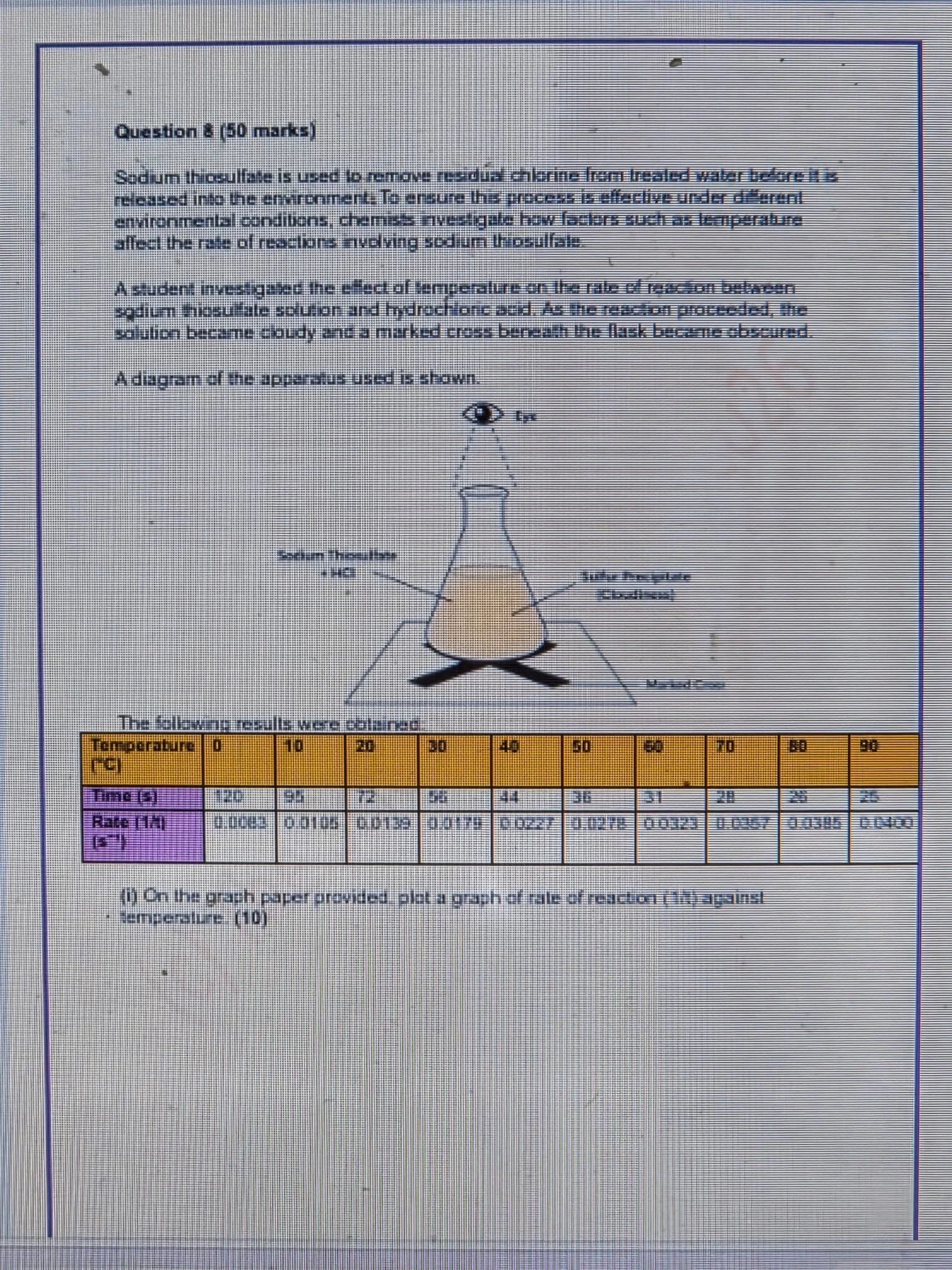
Prepare with confidence this summer using a professionally designed Senior Cycle Chemistry practice paper from Science Masters. This resource has been carefully created to reflect the style, structure, and standard of Higher Level Chemistry assessment questions while remaining fully original and independently produced.
This Chemistry revision paper is ideal for students aiming to consolidate their understanding, strengthen analytical skills, and identify areas for improvement ahead of the academic year.
• A full-length Chemistry practice paper (Questions 1–15)
• Coverage of key Senior Cycle Chemistry topics including stoichiometry and calculations, acids and bases, pH, redox reactions, rates of reaction, atomic theory, periodic trends, and bonding
• A clear, student-friendly marking scheme for all questions
• Structured mark allocations to support timing and question-planning skills
• Senior Cycle Chemistry Higher Level students
• Students preparing for 5th Year or 6th Year revision
• Students completing summer or mid-term revision
• Parents seeking structured, high-quality revision material
• Created by an experienced Irish post-primary science teacher
• Focused on developing confidence, problem-solving, and examination skills
• Supports independent learning and self-assessment
• Clear and accessible layout suitable for home study or classroom use
This resource is independently created by Science Masters. All questions are original and designed to support Chemistry learning, revision, and assessment preparation.
• Provided as a PDF file
• Ready to print or use digitally
Build confidence, improve exam technique, and stay sharp over the summer with a structured Chemistry practice paper designed to support meaningful progress.
Science Masters — Helping you master science learning and revision.
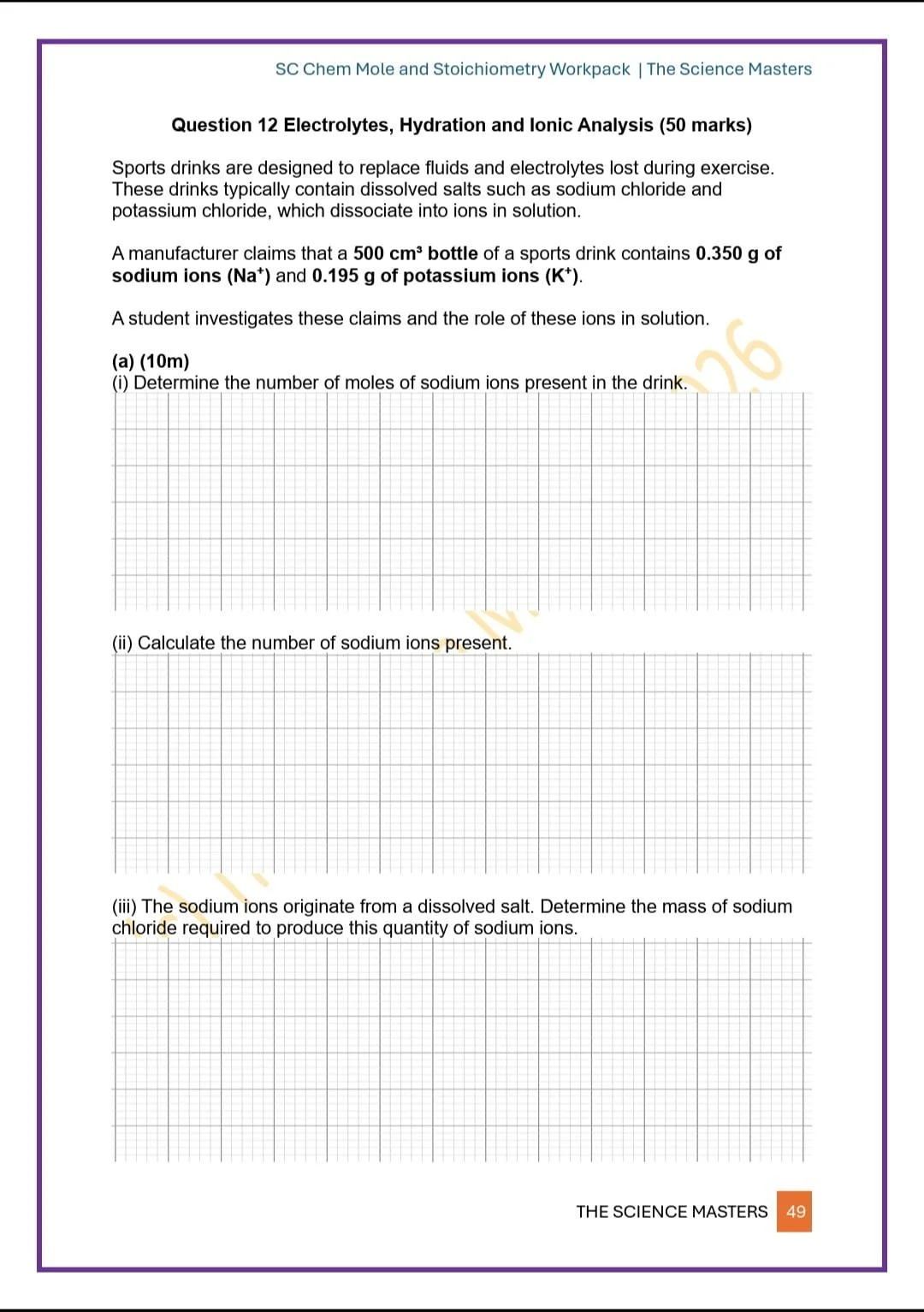
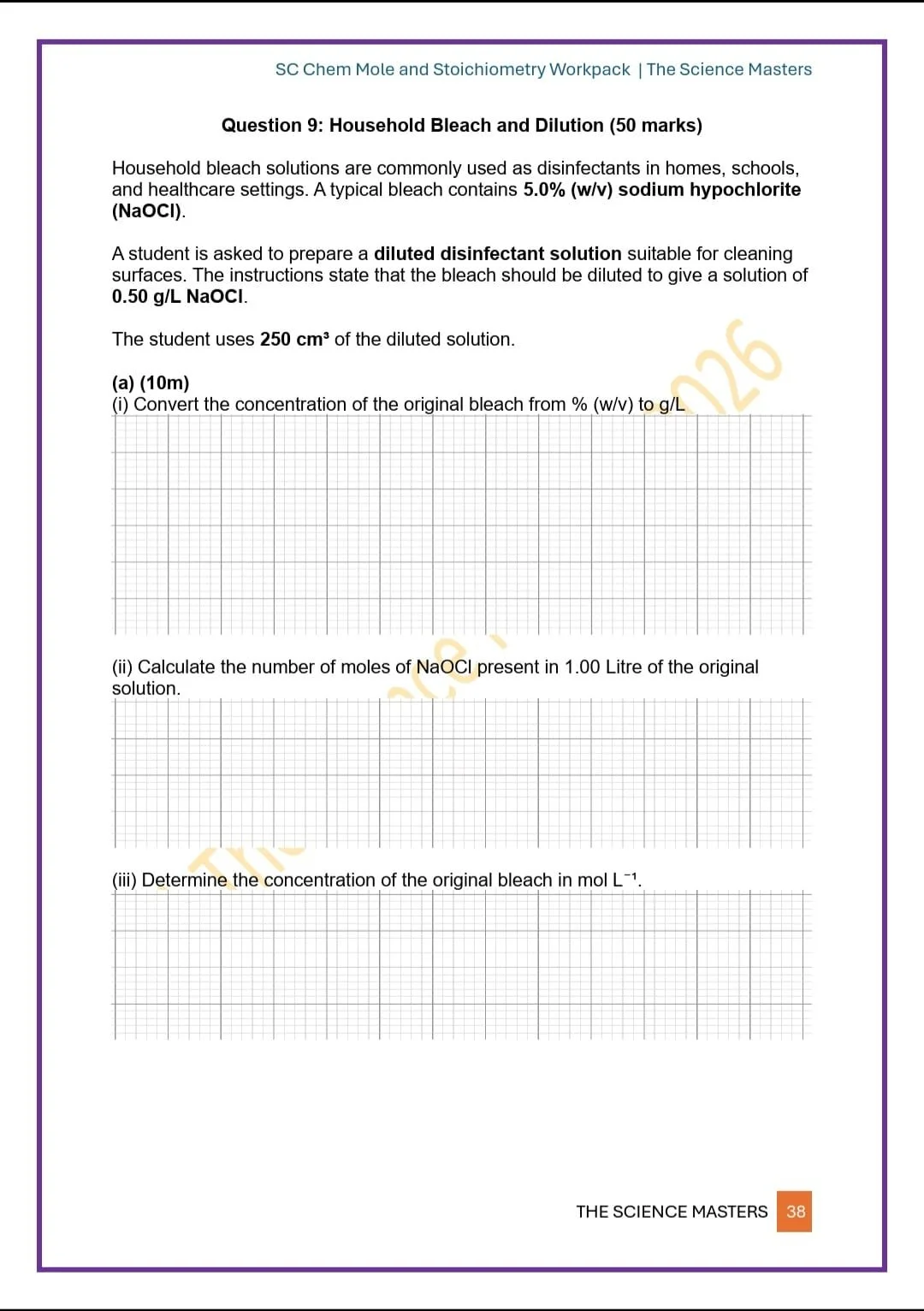
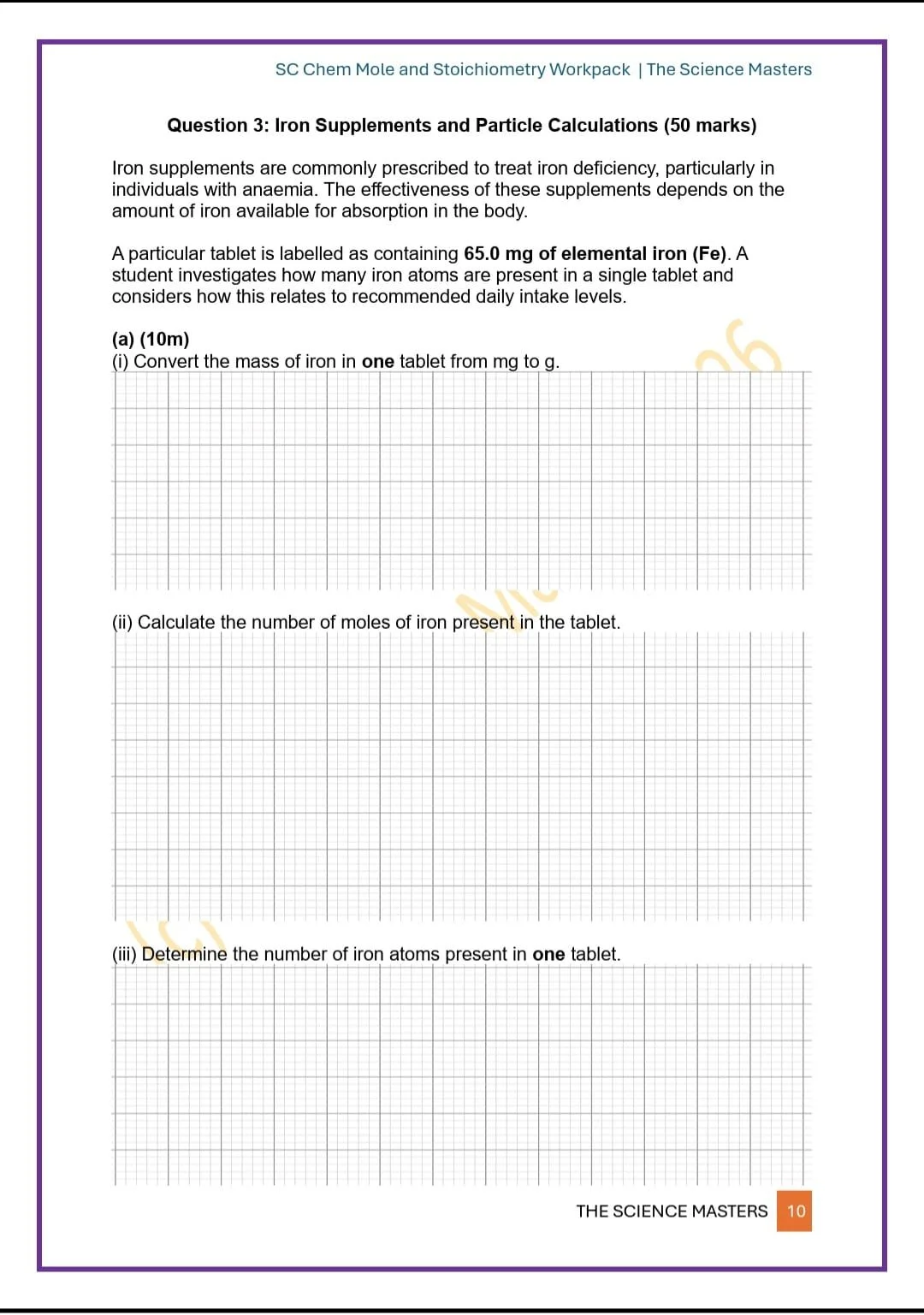
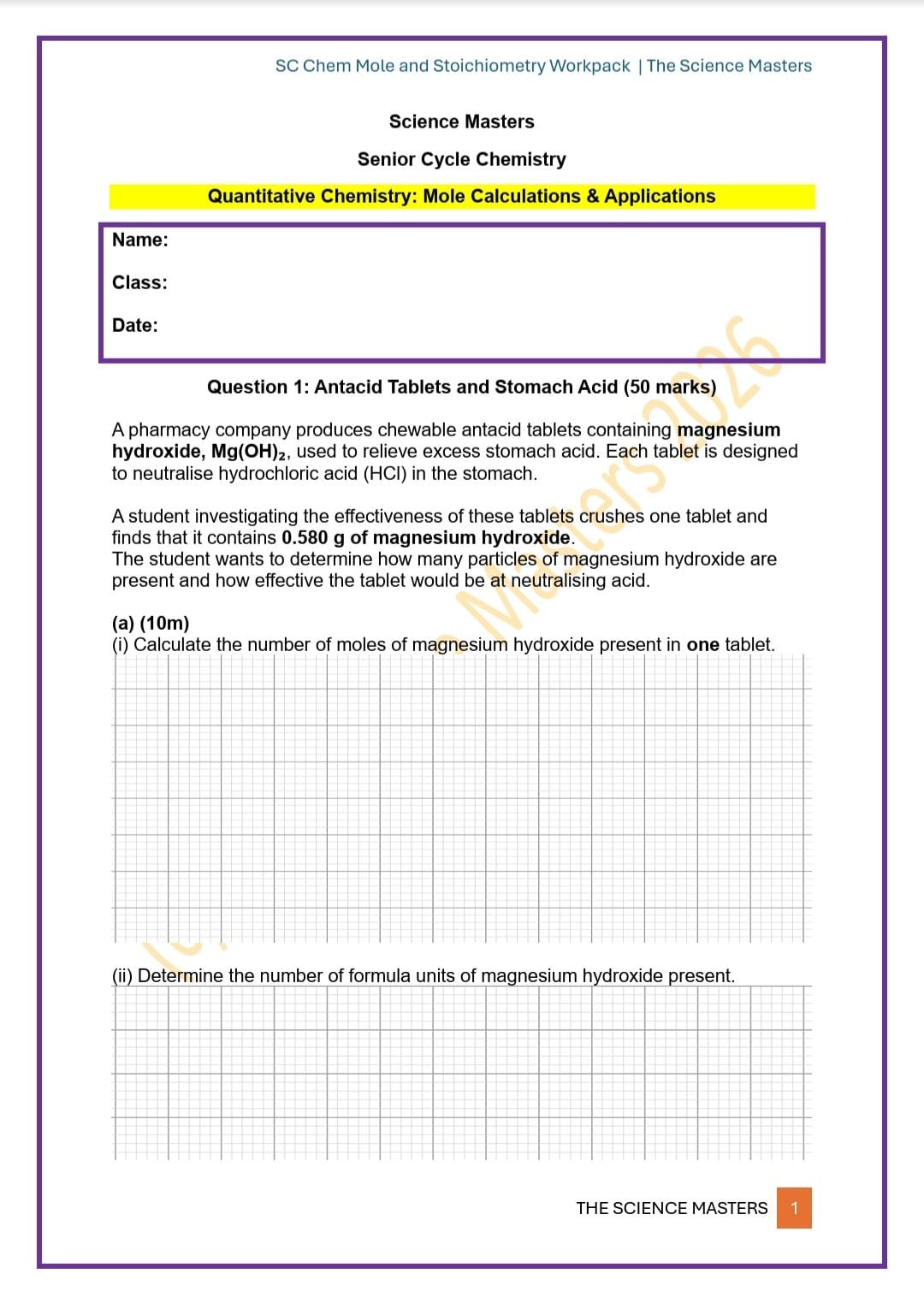
Master one of the most important and challenging areas of Senior Cycle Chemistry with this comprehensive, calculation-focused revision pack from Science Masters.
This Mole Calculations & Stoichiometry Mastery Pack is designed to build confidence, accuracy, and problem-solving ability through structured questions, real-world applications, and detailed worked solutions.
Covering all major areas of Quantitative Chemistry, this resource guides students from core mole concepts through to advanced applications including gas calculations, solution chemistry, limiting reagents, and percentage yield.
• 15 structured Chemistry questions (Higher Level standard)
• Full worked marking schemes for every question
• Real-world contexts including pharmaceuticals, industry, and environmental science
• Step-by-step solutions using correct scientific notation and units
• Strong focus on analytical thinking, calculations, and explanation skills
• Moles and Avogadro’s number
• Stoichiometry
• Gas volume calculations (including STP)
• Solution concentrations and dilution
• Limiting reagents
• Percentage yield
• Industrial Chemistry applications
• Relative Molecular Mass (RMM) calculations
• Isotope calculations
• Empirical and molecular formula calculations
• Senior Cycle Chemistry Higher Level students
• Revision and examination preparation
• Students building confidence with Chemistry calculations
• Teachers looking for structured, high-quality classroom resources
• Clear progression from foundational to advanced calculations
• Realistic scientific and industrial contexts
• Helps reduce common calculation mistakes
• Reinforces correct scientific notation, units, and working
• Supports confidence, accuracy, and structured problem-solving
• PDF download
• Print-ready
• Suitable for classroom or independent study
Science Masters
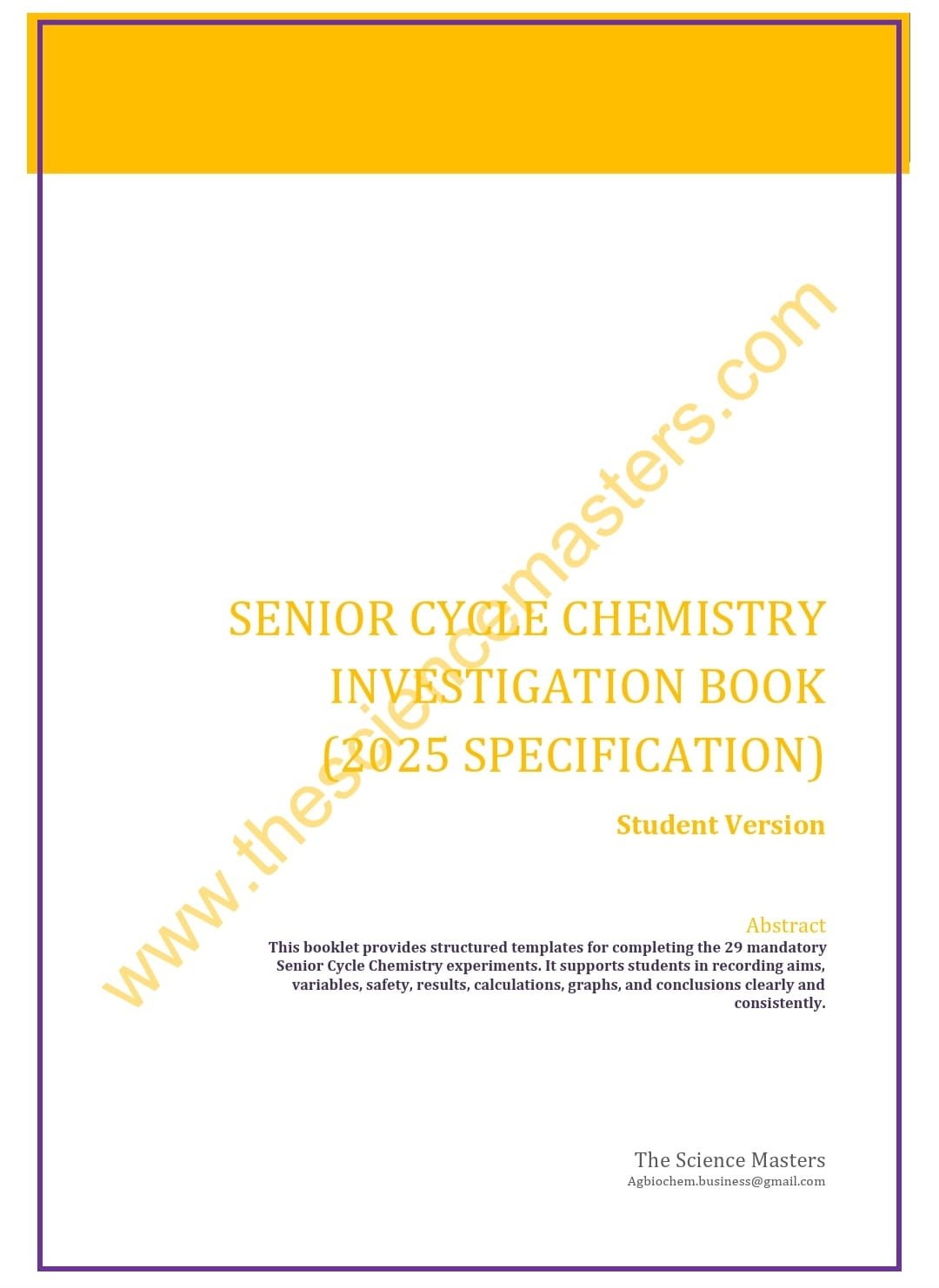
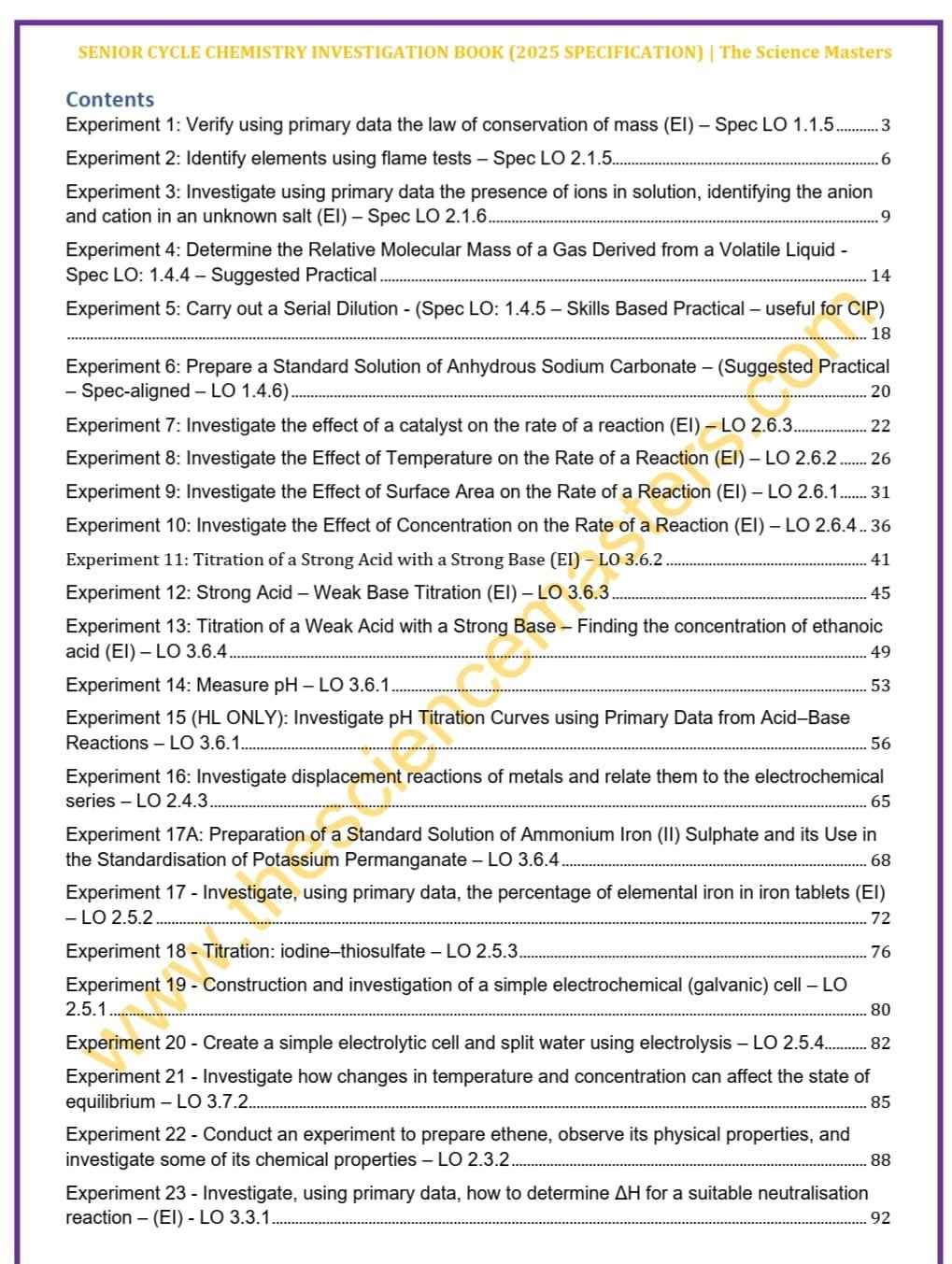
This Student Version of the Senior Cycle Chemistry Investigation Book (2025 Specification) provides structured, student-friendly templates for completing all 29 mandatory Senior Cycle Chemistry experiments, plus 4 Secondary Data Research Investigations.
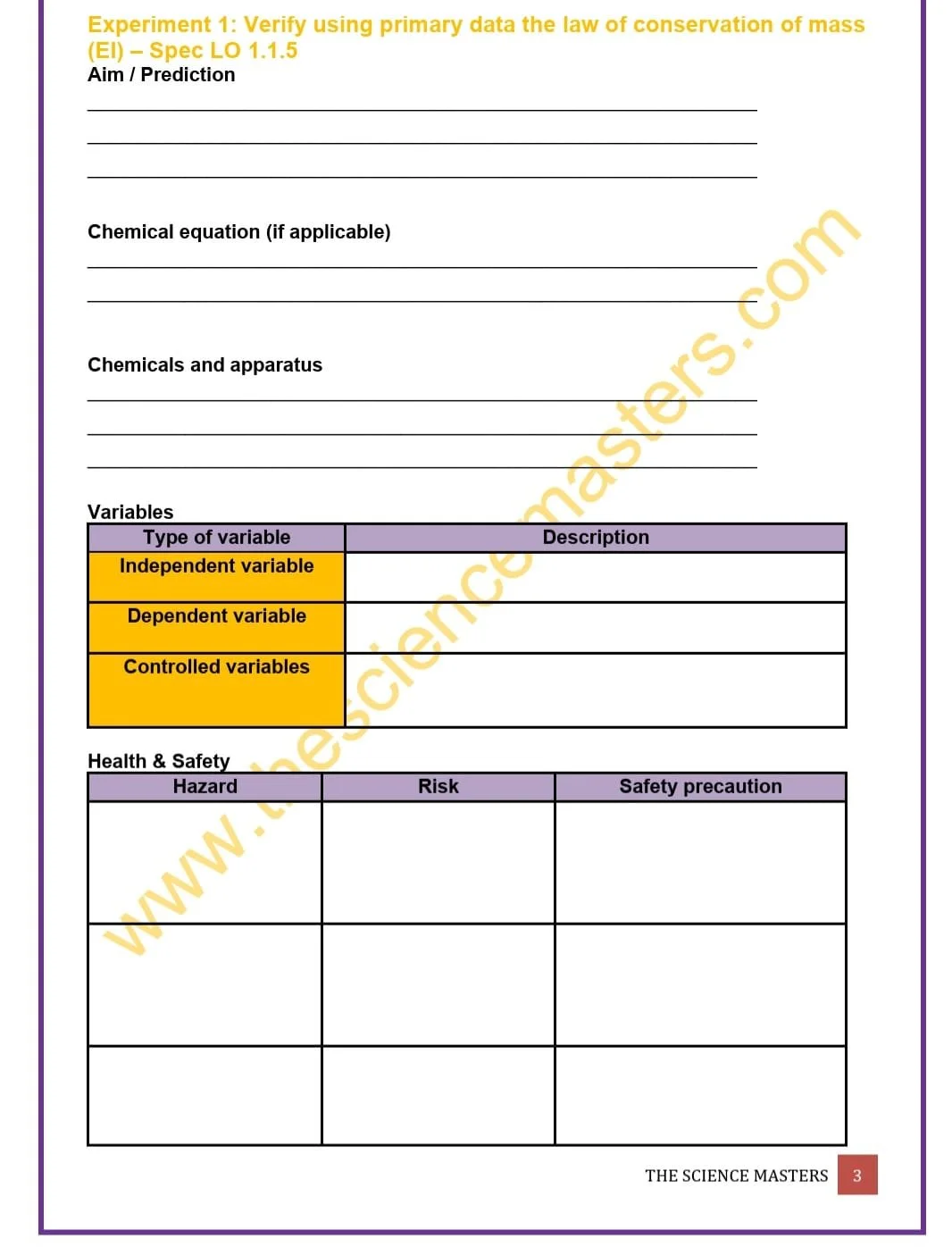
Each experiment template guides students through writing clear and consistent:
Aim / prediction
Chemicals & apparatus
Variables (independent, dependent, controlled)
Health & safety (hazard, risk, precaution)
Method
Diagram
Results tables
Calculations (where relevant)
Graphs (where relevant)
Conclusion
Sources of error + improvements
This resource supports students in producing high-quality experimental write-ups aligned with the new Senior Cycle Chemistry specification, while reducing time spent formatting and improving clarity and consistency across practical work.
Perfect for:
✔ Day-to-day practical work
✔ Chemistry Investigation Portfolio (CIP) preparation
✔ Supporting weaker writers and SEN students
✔ Keeping practical work neat, complete and exam-ready
Student Version = blank templates only (no sample answers).
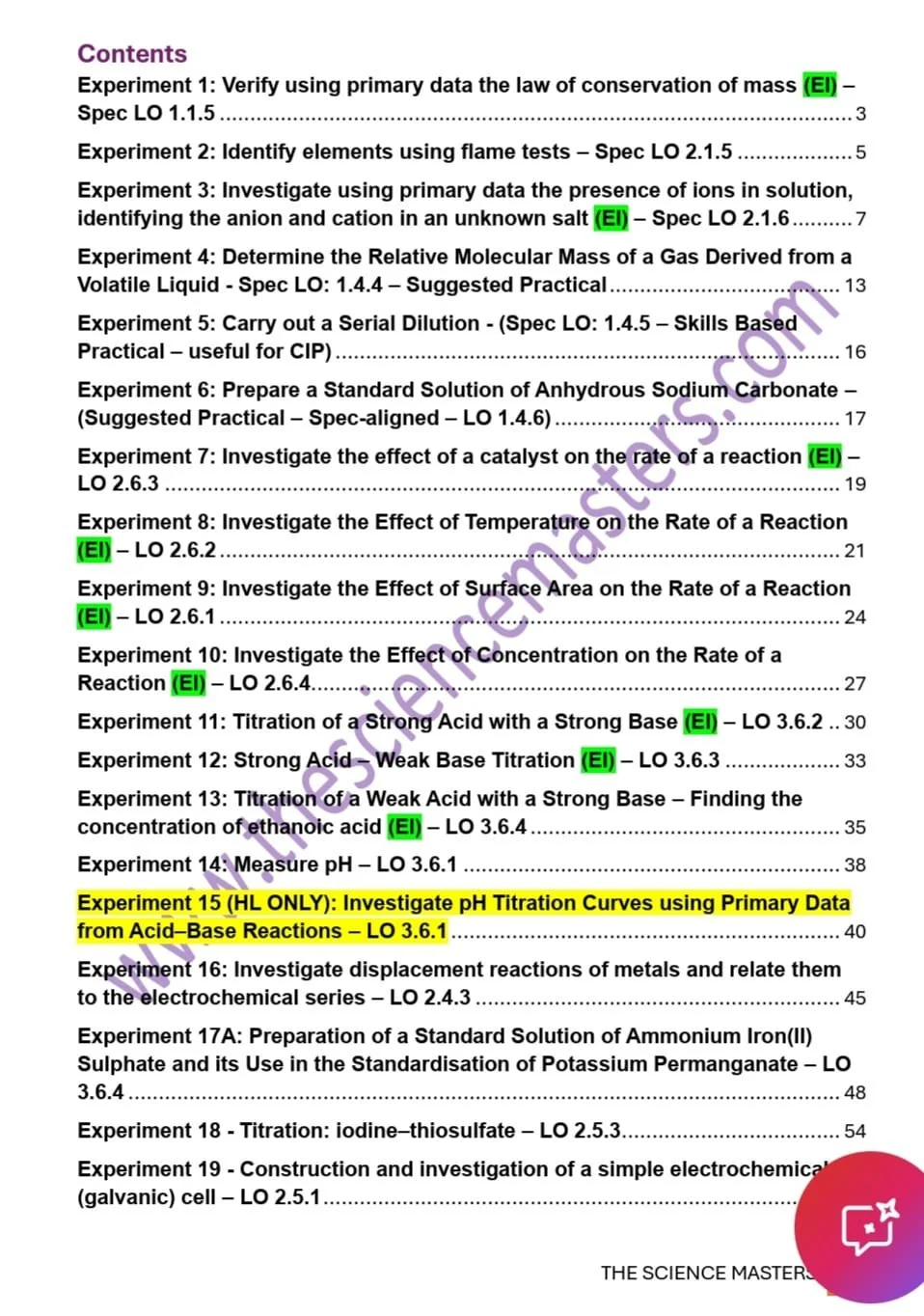

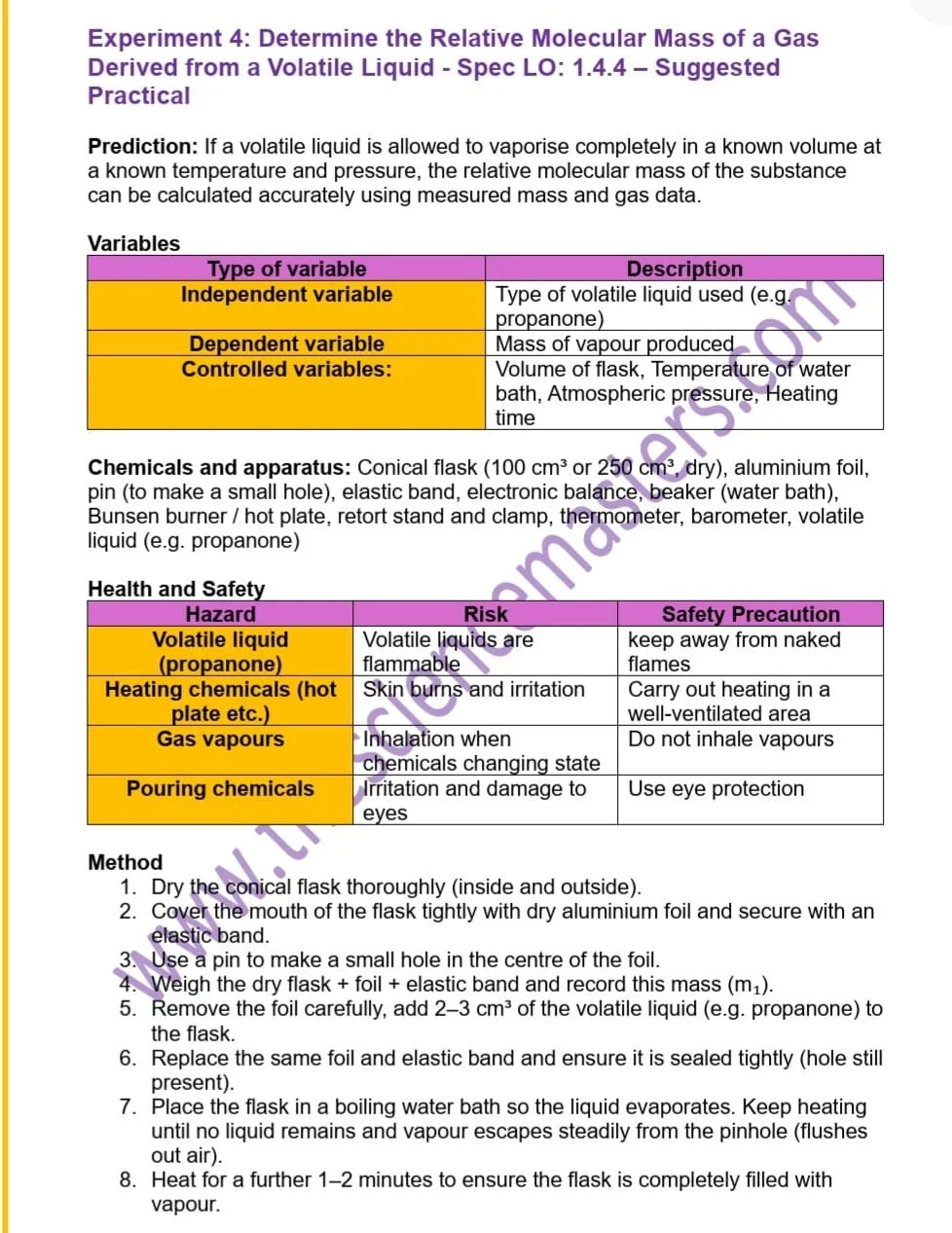
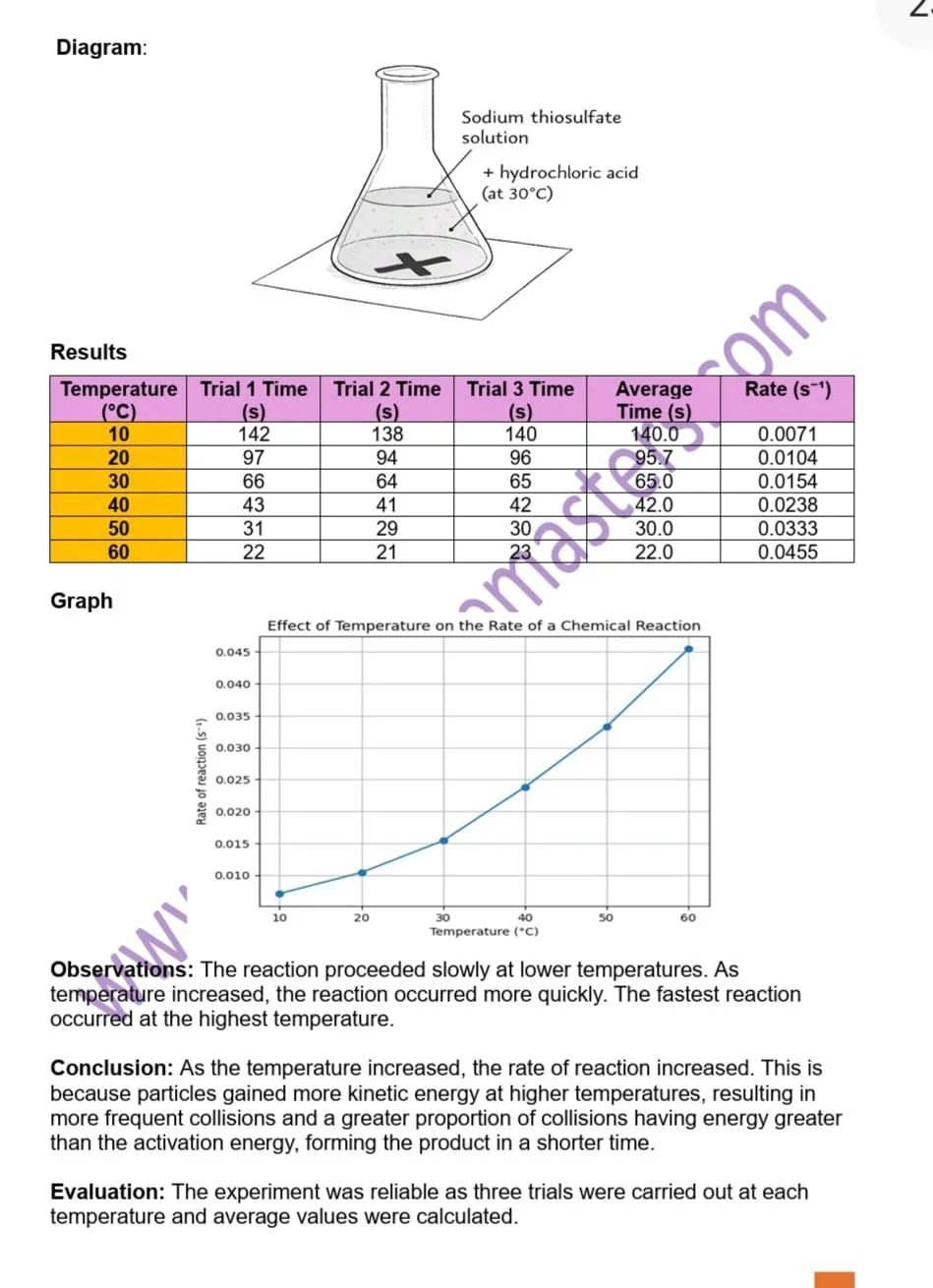
This Complete Teacher Experiment Book is designed for the Senior Cycle Chemistry practical course (2025 specification) and includes the 29 mandatory experiments, fully written up from start to finish.
Each experiment is presented in a clear, structured format, supporting teachers in delivering practical work confidently and efficiently while ensuring students meet the required practical skills.
This is a fully completed teacher resource — not a blank template — and includes worked examples, correct calculations, and full experiment write-ups throughout.
✔ 29 mandatory experiments (fully completed)
✔ Clear aims, predictions, and chemical equations
✔ Full chemicals and apparatus lists
✔ Variables clearly identified (independent, dependent, controlled)
✔ Detailed step-by-step methods
✔ Diagrams included where appropriate
✔ Sample results tables, observations, and conclusions
✔ Worked calculations and graph guidance
✔ Strong focus on good scientific reporting and exam-ready language
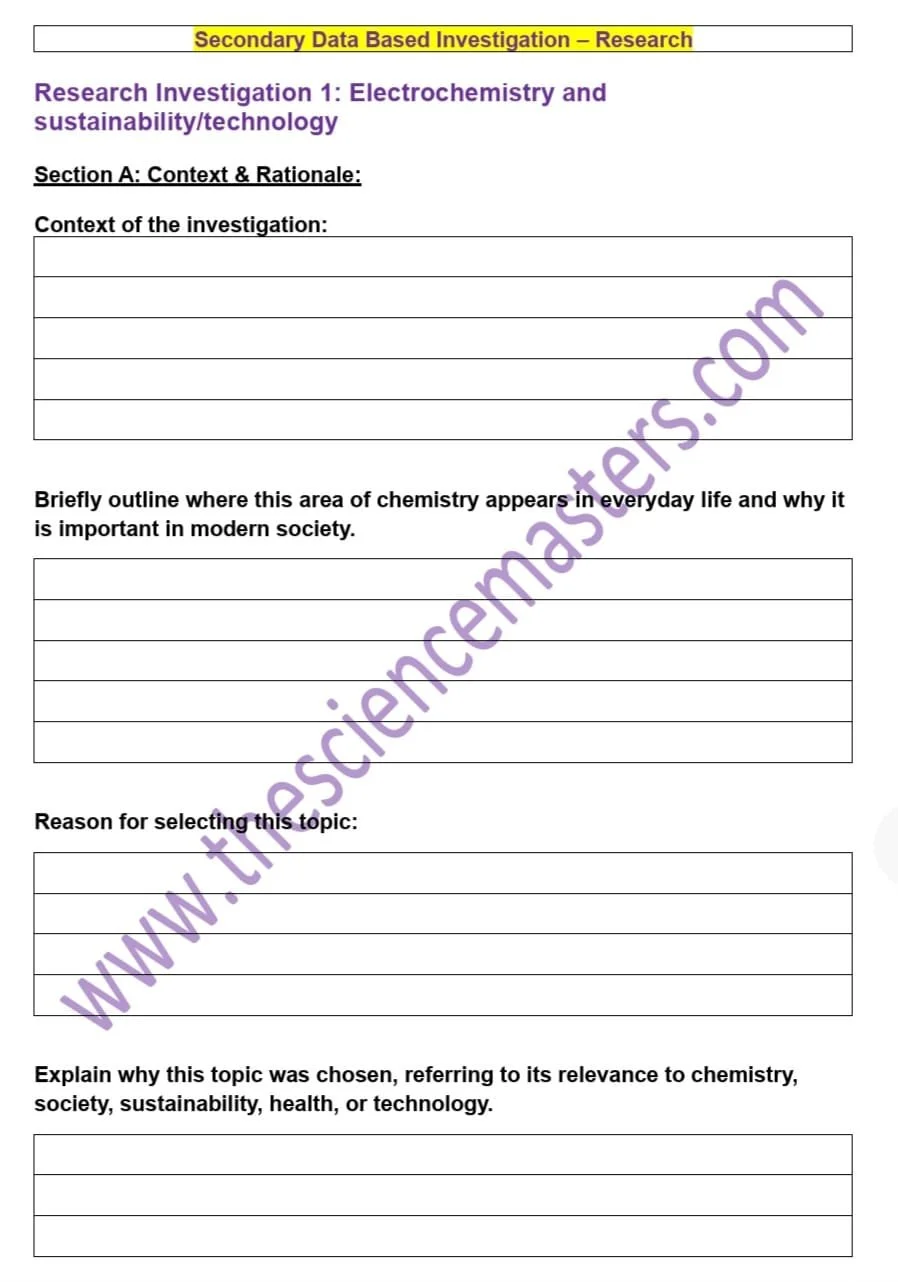
A dedicated final section includes 4 structured Research Investigations, designed to support the new Chemistry practical investigation requirements. These can be used for teacher planning, student modelling, or classroom implementation.
Chemistry teachers delivering the 2025 specification
Teachers looking for a complete, ready-to-use practical book
Department planning and shared practical resources
Supporting consistent student write-ups and practical standards
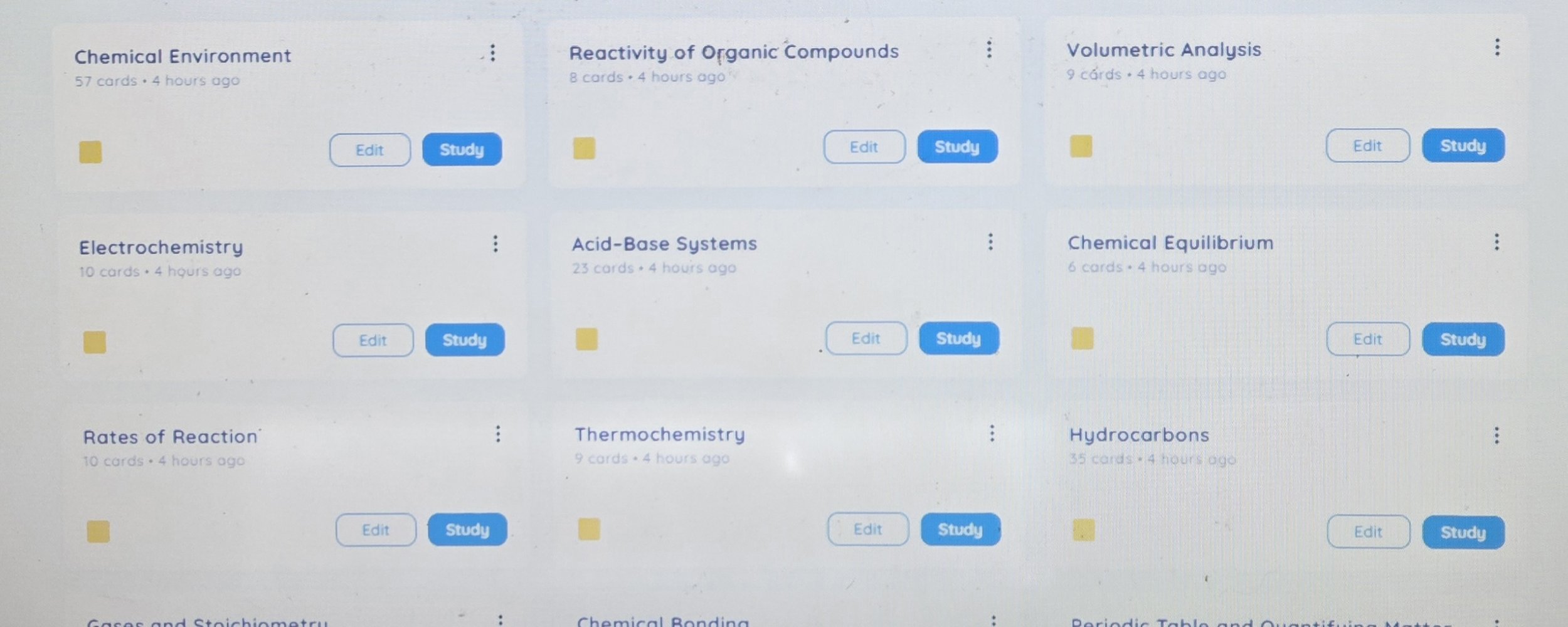

The complete Science Masters Biology + Chemistry Flashcard Bundle.
This pack includes the full 2025 Senior Cycle Biology and Chemistry flashcard libraries — over 1,000 exam-focused, exam-style cards across both subjects.
Both sets are arranged in exact specification order, covering every key term, definition, process and concept for Ordinary and Higher Level.
All answers follow strict marking-scheme style suitable for the June 2027 exams and beyond.
Instant digital download — study smarter.

Master the NEW 2025 Chemistry Specification with this complete Science Masters flashcard pack.
This full digital set contains over 350 specification-aligned flashcards, each designed to match the exact style and precision expected in the June 2027 exam.
Every flashcard includes:
A clear, spec-aligned question
A concise, marking-scheme-style answer
Wording and detail suitable for both OL & HL students
This pack covers all essential definitions, laws, trends, formulae, atomic concepts, bonding theory, stoichiometric principles, and required terminology from the 2025 Senior Cycle Chemistry Specification.
Perfect for:
✔ Students aiming for strong HL or OL exam performance
✔ Teachers building notes, quizzes, revision plans or digital study sets
✔ Parents looking for a reliable, high-quality learning resource
✔ Anyone who wants Chemistry explained clearly, simply and exam-correctly
Instant digital download.
Learn smarter. Learn with Science Masters.

Premium Exam & Worksheet Pack
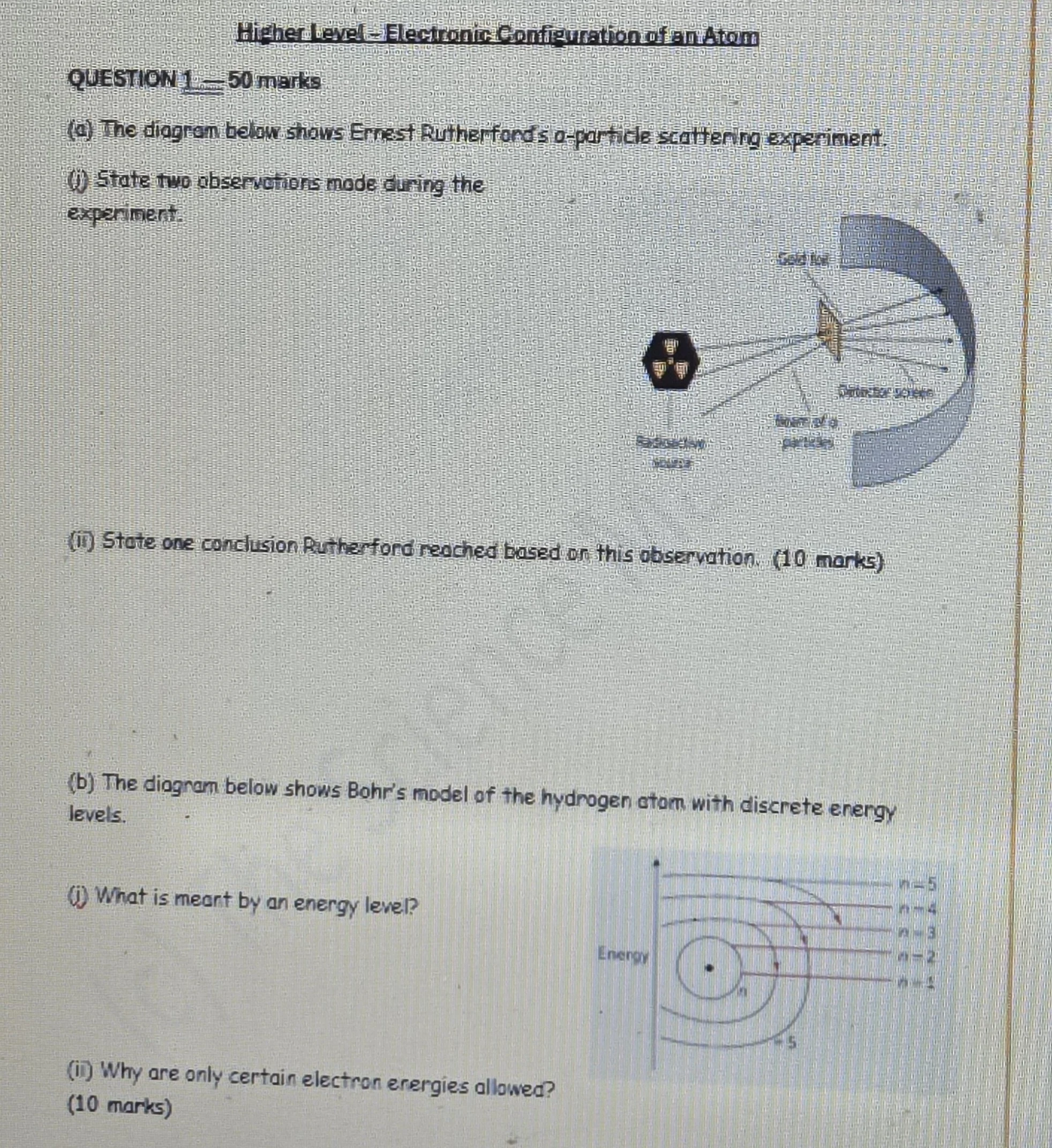
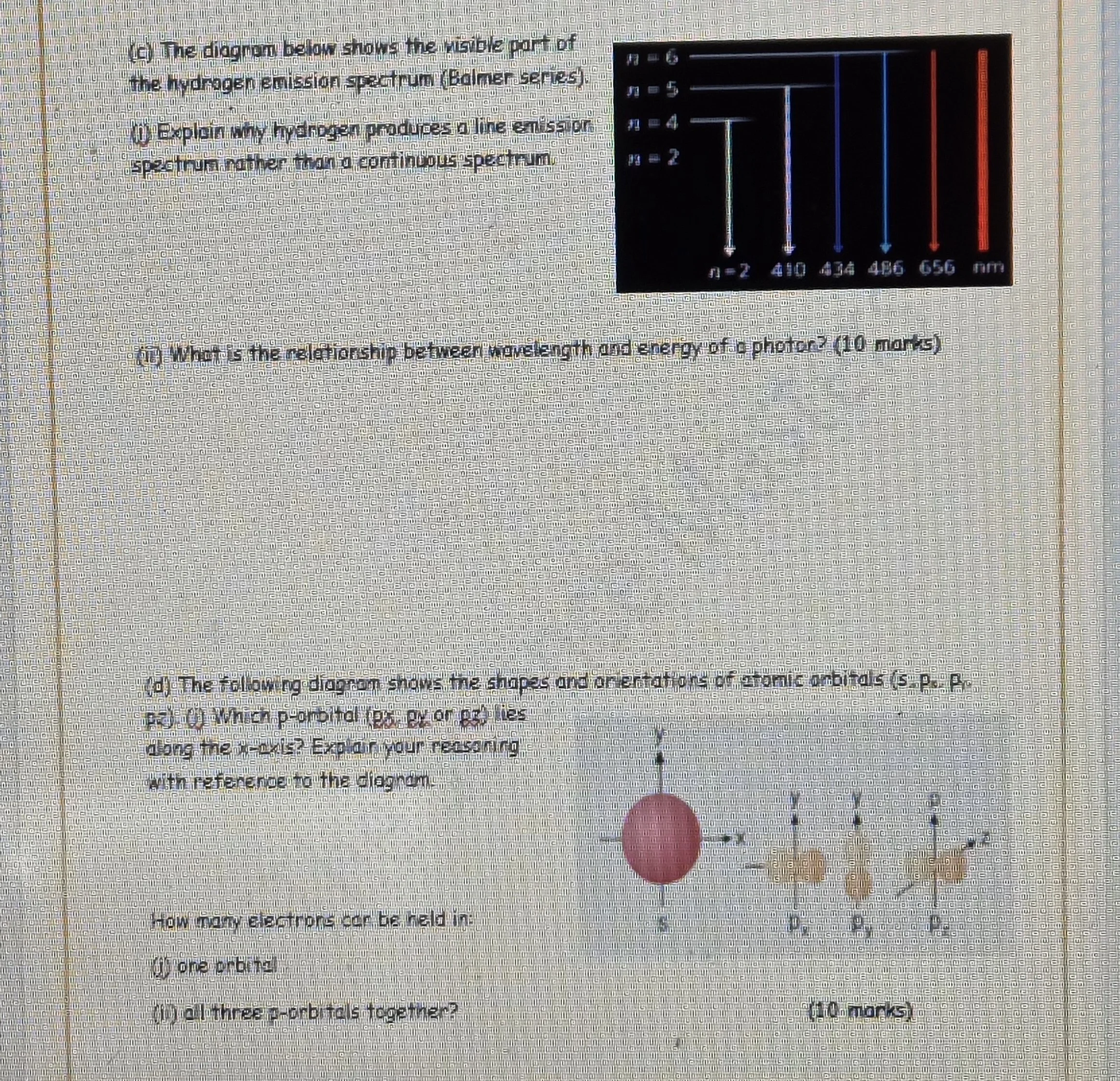
This Higher Level Chemistry resource pack is built around the 2025 Senior Cycle Chemistry specification, with a clear focus on the skills and assessment demands of the revised course.
It combines structured exam-style questions, worksheet practice, diagram-based explanation, and data interpretation tasks aligned to the expectations of the new specification.
Designed for:
Classroom teaching
Revision programmes
Independent student study
This pack supports both content mastery and the development of scientific reasoning required for Higher Level performance.

Worksheet 1 – Intermolecular Forces, Molecular Shapes & Chemical Properties
€4.00
Senior Cycle Chemistry (2025 Specification)
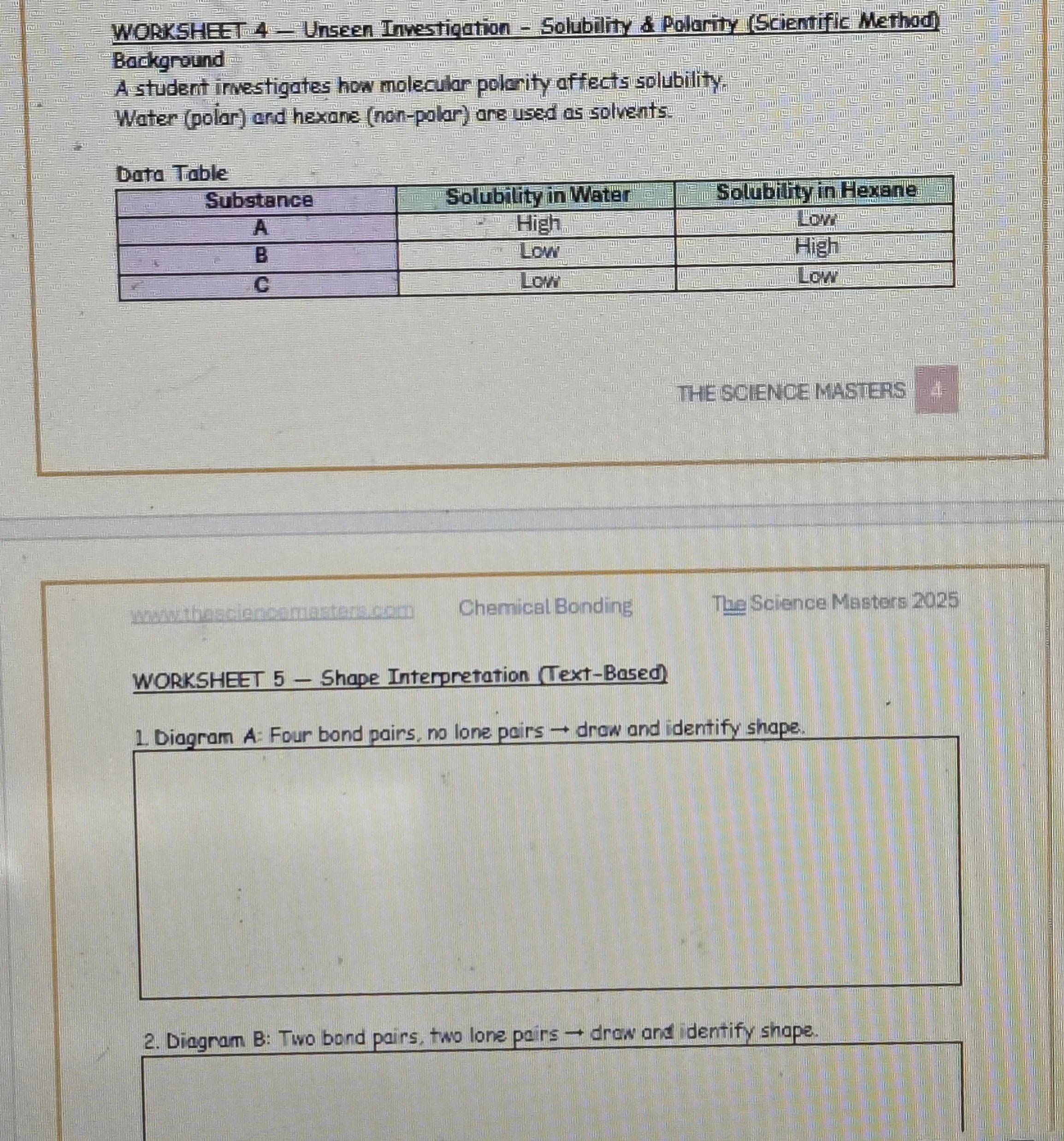
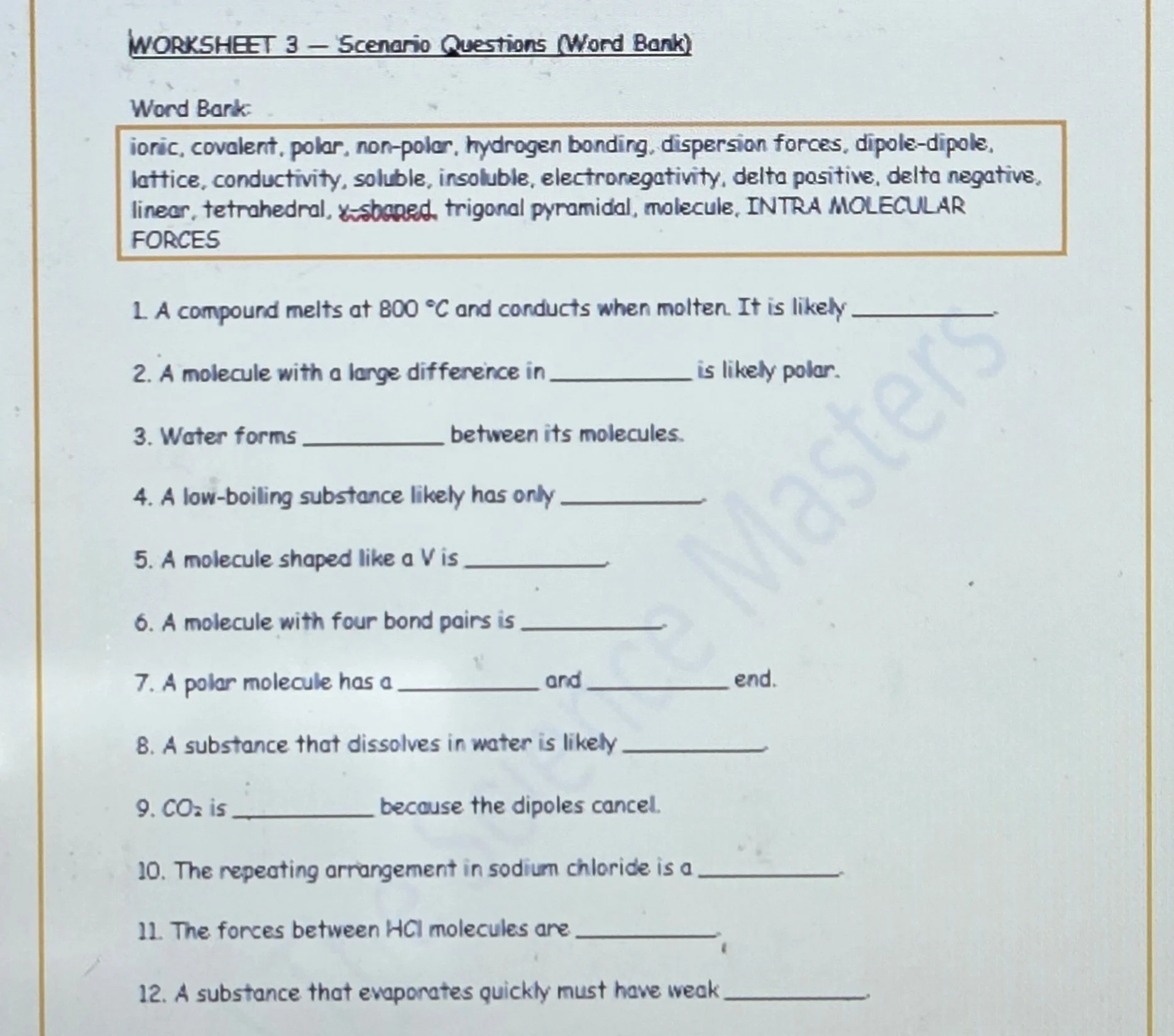
Chemical Bonding Master Pack (Worksheets 1–8)
This 8-worksheet pack is aligned with the 2025 Senior Cycle Chemistry specification and focuses on key learning outcomes in:
Chemical bonding
Structure and shape of molecules
Polarity
Intermolecular forces
Physical and chemical properties
Designed for mixed-ability Senior Cycle classes, these worksheets support:
Skills-based assessment
Scientific literacy
Analysis of data and trends
Evidence-based reasoning
Suitable for classroom teaching, structured homework, or revision support.
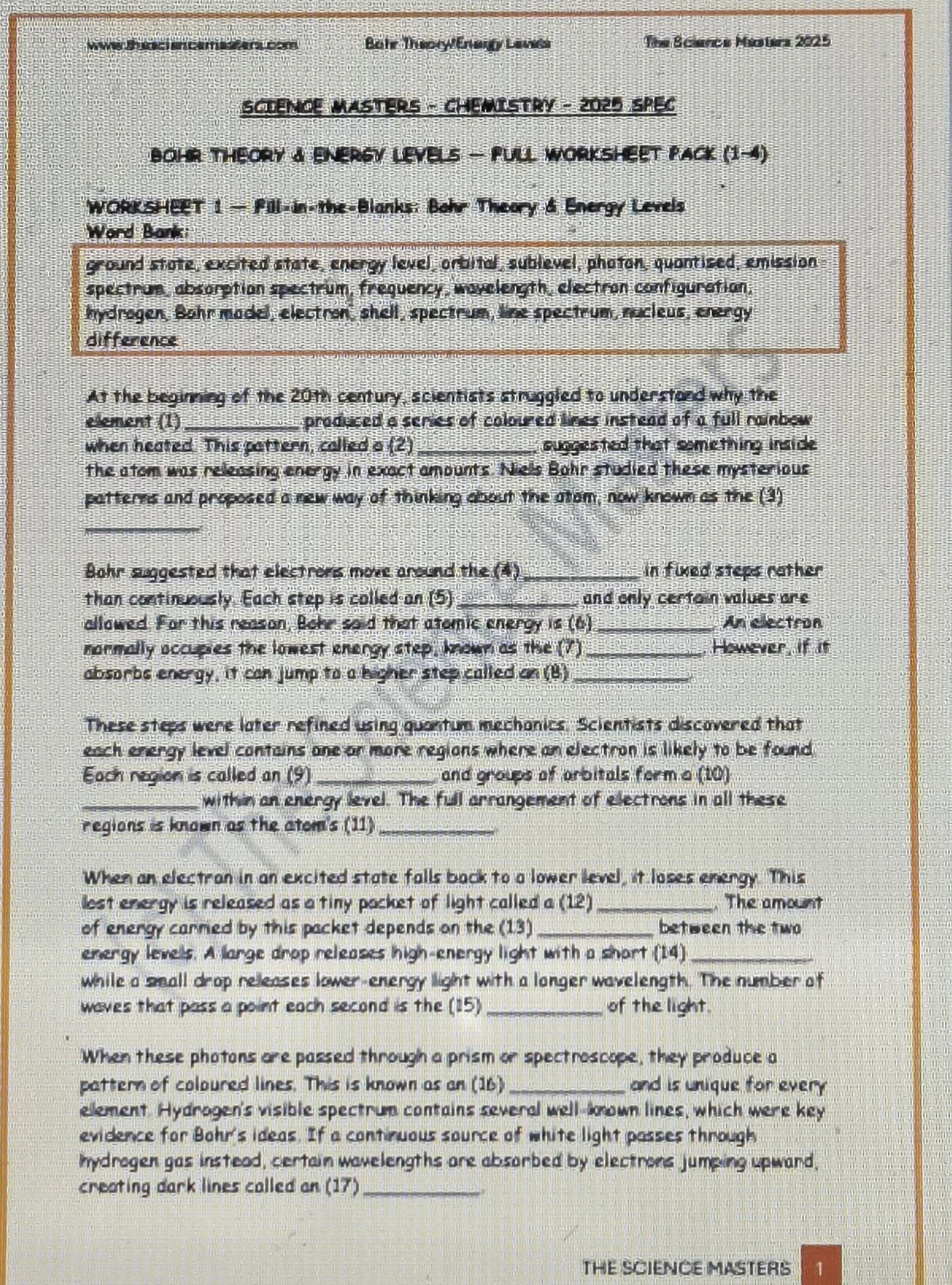
Worksheet 1
€3.00
Senior Cycle Chemistry (2025 Specification)
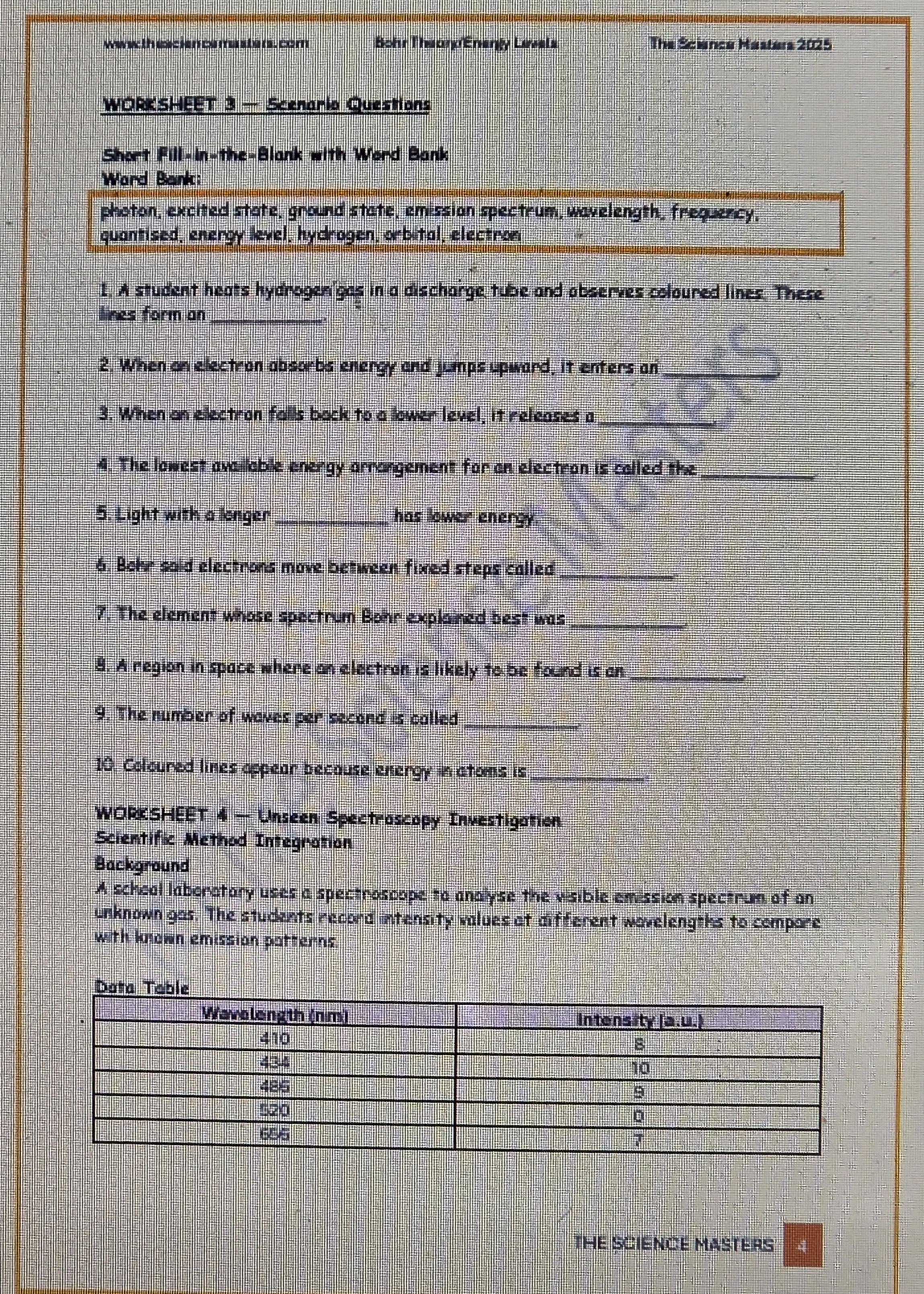
Bohr Theory & Energy Levels – 4-Worksheet Pack
This four-worksheet pack supports the teaching and revision of:
Bohr’s atomic model
Quantised energy levels
Electron transitions
Emission spectra
Atomic structure and model development
Aligned with the 2025 Senior Cycle Chemistry specification, the pack addresses key learning outcomes in Atomic Structure, Spectroscopy, and the development of scientific models.
Designed for mixed-ability Senior Cycle classes, the worksheets support:
Clear conceptual understanding
Structured written explanations
Interpretation of spectra and diagrams
Application of theory to examination-style questions
Suitable for classroom teaching, structured homework, or revision preparation.
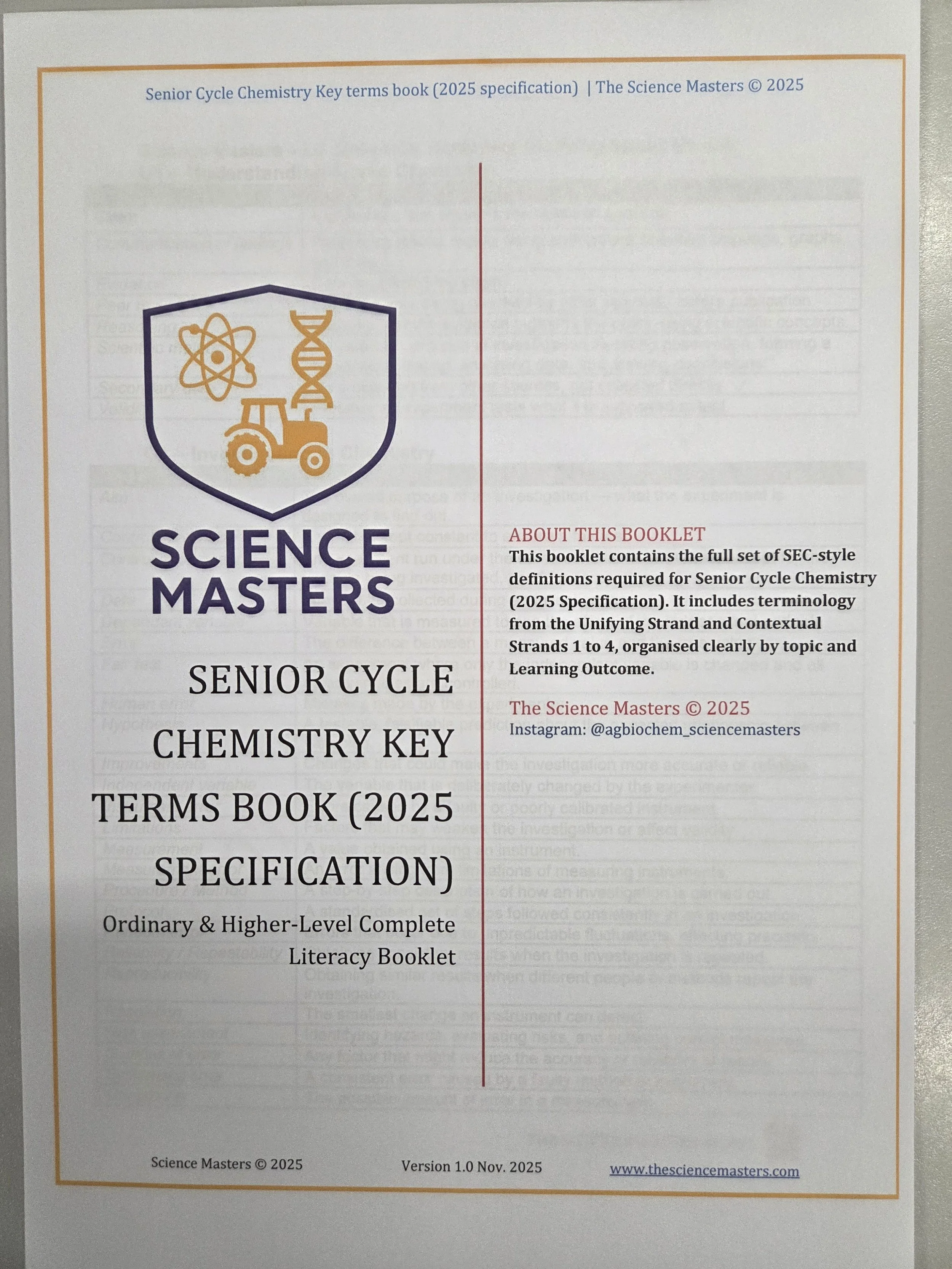
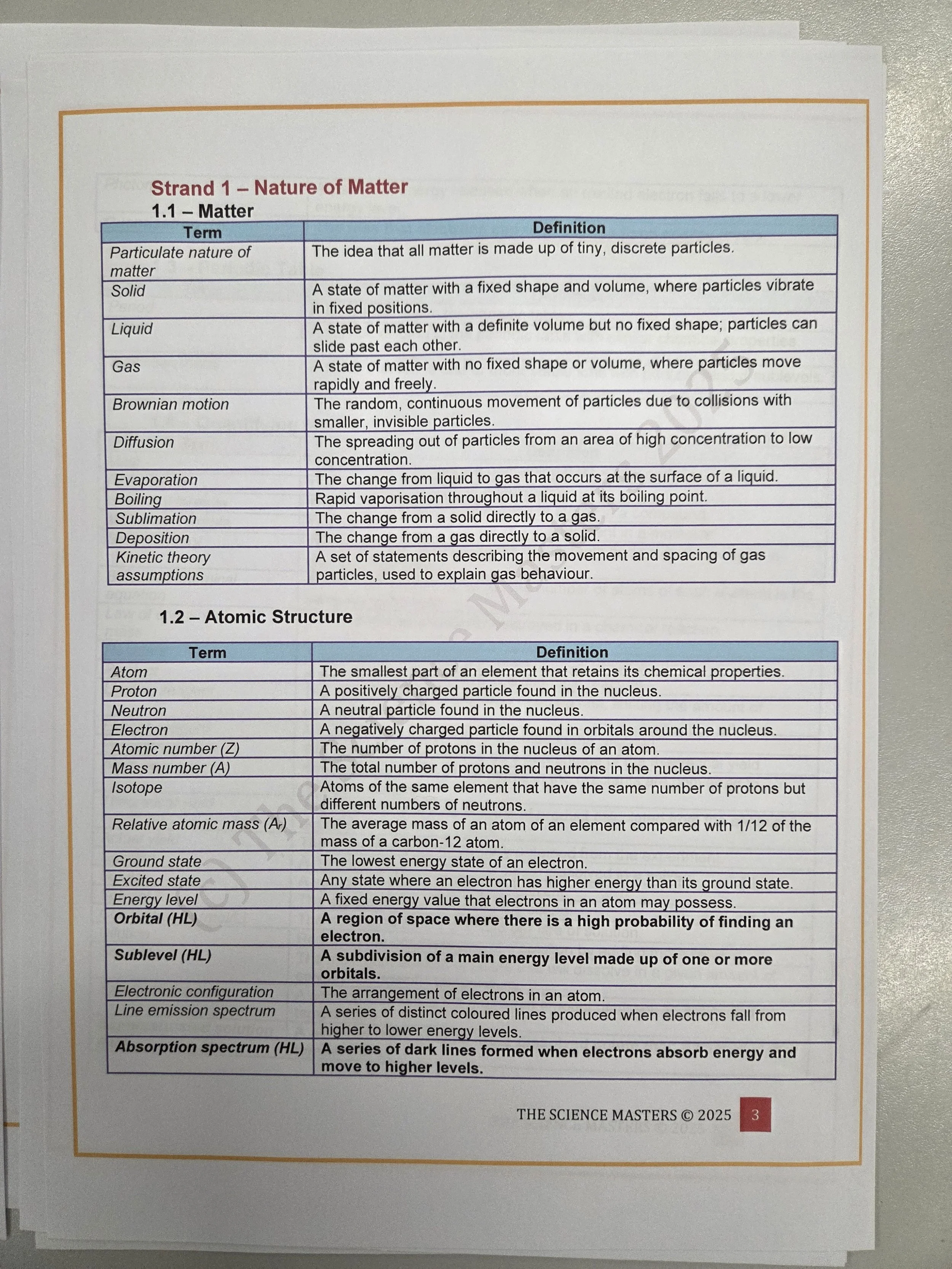
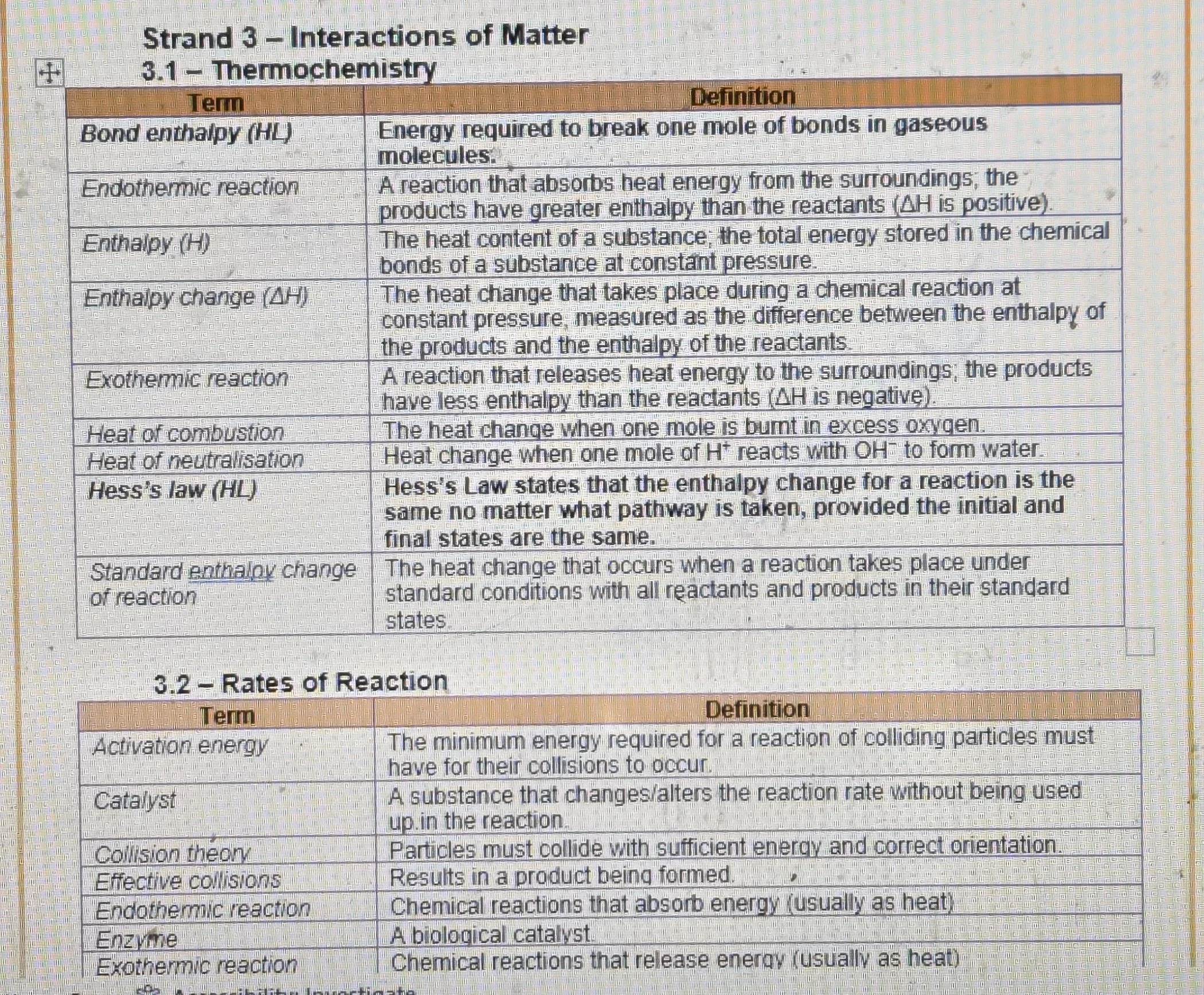
Written using clear, concise scientific language, this booklet provides comprehensive coverage of key terminology across the full 2025 Senior Cycle Chemistry specification.
Developed using the current specification and assessment-style language, it includes terminology from the Unifying Strand and Contextual Strands 1–4 to support broad course coverage and scientific literacy development.
Each definition is written in a precise and student-friendly format to help students improve confidence with scientific terminology and written responses.
• Scientific literacy development
• Accurate use of Chemistry terminology
• Understanding of command words and key concepts
• Structured written responses
• Retrieval practice and revision skills
Suitable for classroom teaching, literacy intervention, revision weeks, homework tasks, and independent study.
✔ Comprehensive set of key terms aligned to the 2025 specification
✔ Organised by strand and Learning Outcome code
✔ Suitable for Ordinary Level and Higher Level
✔ Clear, concise, scientifically accurate phrasing
✔ Designed for print or digital use
• Scientific method and core scientific ideas
• Atomic structure, periodicity, and bonding
• Stoichiometry, gas laws, rates of reaction, equilibrium, acids and bases, redox reactions, and thermochemistry
• Organic Chemistry and environmental Chemistry
• Materials, sustainability, and energy
• A consistent literacy reference across the course
• Suitable for class sets, digital distribution, or targeted support
• Helps reinforce scientific terminology and written communication skills
• Builds confidence with scientific language
• Supports precise and structured written answers
• Useful for revision, retrieval practice, and active recall
• PDF download
• Print-ready
• Suitable for classroom or independent study
Science Masters
No results match your search. Try removing a few filters.
